Reinforcing Steel Bar
Flat steel Steel / Sheet metal Products
Tube & Box Profiles
Rolled Profile Group
Renewable Energy Solutions
IMG Investment
Safe and Durable Reinforced Concrete Structures with Reinforcing Steel Bars
Reinforcing steel bars is one of the fundamental construction materials used in the load-bearing systems of reinforced concrete structures, characterized by its high tensile strength. Unlike concrete, which exhibits high resistance to compression, it is weak against tensile forces; therefore, the use of construction iron in reinforced concrete systems is an indispensable element of structural safety. For this reason, construction iron is recognized as a fundamental structural component that enhances a building’s load-bearing capacity and ensures long-term durability.
Reinforcing steel bar, produced in various diameters and weights, is selected and used according to project-specific static calculations. This technical diversity is of great importance in terms of structural safety and engineering performance.
What Is Reinforcing Steel Bar
Reinforcing steel bars are steel structural elements manufactured in bar form and used in reinforced concrete structures to resist tensile stresses in the concrete. They prevent the concrete from cracking under the loads the structure is subjected to, ensure that loads are transferred in a controlled manner, and maintain structural integrity.
Reinforcing steel bar typically have a ribbed surface. This ribbed structure creates strong adhesion between the concrete and the steel, preventing slippage and enhancing load transfer. As a result, structural elements such as columns, beams, slabs, and foundations function safely.
Technical Specifications and Dimension Ranges
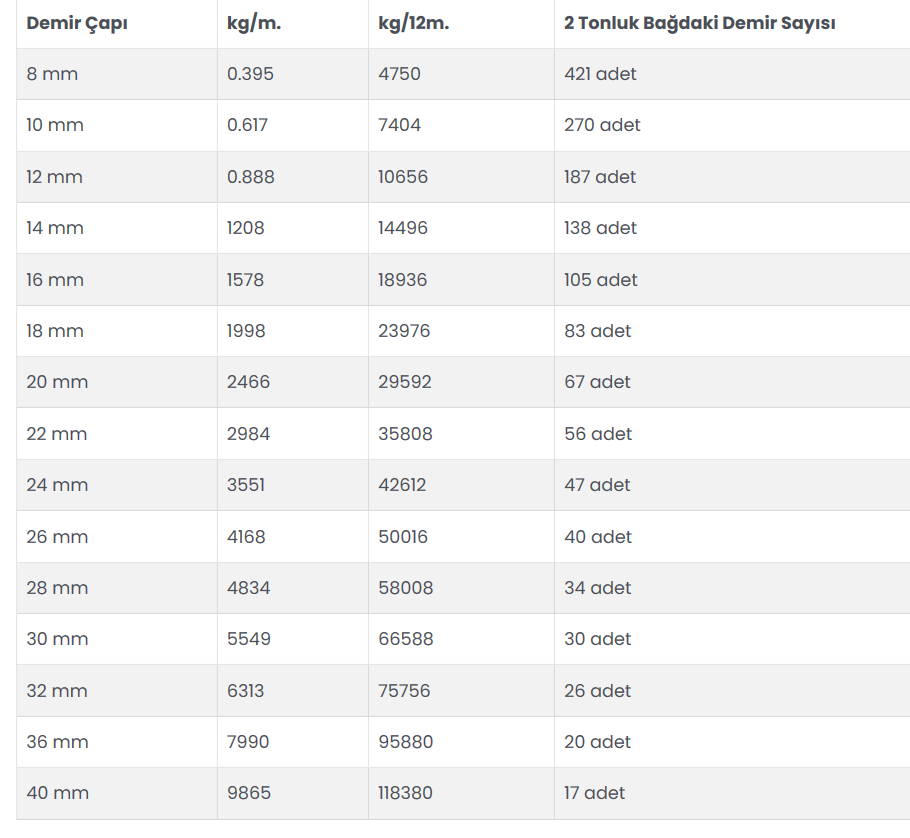
Reinforcing steel bars are manufactured according to standards to have different diameters and weights. As the diameter increases, the weight per meter increases, and this directly affects the load-bearing capacity of the steel. Therefore, in engineering projects, the diameter and weight of the reinforcing steel bars to be used are determined according to static calculations.
Reinforcing steel bars are generally offered in diameters ranging from 8 mm to 40 mm. Weight per meter and total weight according to standard lengths vary for each diameter. This technical data is critical for project planning and material calculations.
Weight Calculations and Project Planning
Weight calculations form the basis of cost and logistics planning when selecting rebar. Rebar with a known weight per meter is typically used in standard lengths of 12 meters. This allows for more controlled installation and inventory management on the construction site.
Furthermore, the total weight of the steel bundles and the number of steel bars in each bundle are also important from a project logistics perspective. The number of steel bars decreases for larger diameter bars, while it increases for smaller diameter bars. This is a technical detail that needs to be considered in terms of both transportation and on-site organization.
The Role of Reinforcing Steel in Reinforced Concrete Structures
In reinforced concrete structures, reinforcing bars are among the most critical components of the load-bearing system. The bars used in columns and beams ensure that the structure remains stable under vertical and horizontal loads. In floor and foundation applications, they help safely transfer loads to the ground.
Reinforcing bars used in the correct size and quantity directly affect structural performance. Insufficient or improperly selected reinforcing bars can lead to cracks, deformation, and structural weaknesses in the long term. Therefore, the use of reinforcing bars in accordance with technical calculations is a fundamental requirement in engineering projects.
Applications of Reinforcing Steel Bar
Reinforcing steel is widely used in virtually every area of the construction industry. As an indispensable component of reinforced concrete systems, this product is reliably chosen for both small-scale structures and large-scale infrastructure projects.
The main areas where rebar is commonly used are listed below:
Residential and commercial building structures
Industrial facilities and factory buildings
Bridge, viaduct, and infrastructure projects
Dams, tunnels, and retaining structures
Road and landscape design projects
These applications clearly demonstrate just how critical a role reinforcing steel plays in structural safety.
Durability and Long-Term Structural Performance
Reinforcing steel works in conjunction with concrete to ensure that structures remain safe and functional for many years. The ductile nature of steel allows the structure to respond to sudden load changes by deforming rather than breaking. This property is of vital importance, particularly in regions prone to dynamic loads such as earthquakes.
When used with proper installation and adequate concrete cover, reinforcing steel is protected against corrosion, thereby extending the structure’s lifespan. This provides a significant advantage by reducing maintenance and reinforcement costs.
Reinforcing Steel: The Cornerstone of Safe Structures
Inconstruction rebar, reinforced concrete structures load-bearing systems an indispensable construction material. Different diameter and weight options, while offering custom engineering solutions for the project; high strength and technical standards compliant production ensures structural safety is supported.
Used in a wide range of applications—from residential buildings to industrial structures, and from infrastructure projects to large-scale engineering projects—rebar remains the cornerstone of modern construction.