


Blog
What Is Magnelis? A Comprehensive Guide – 2026

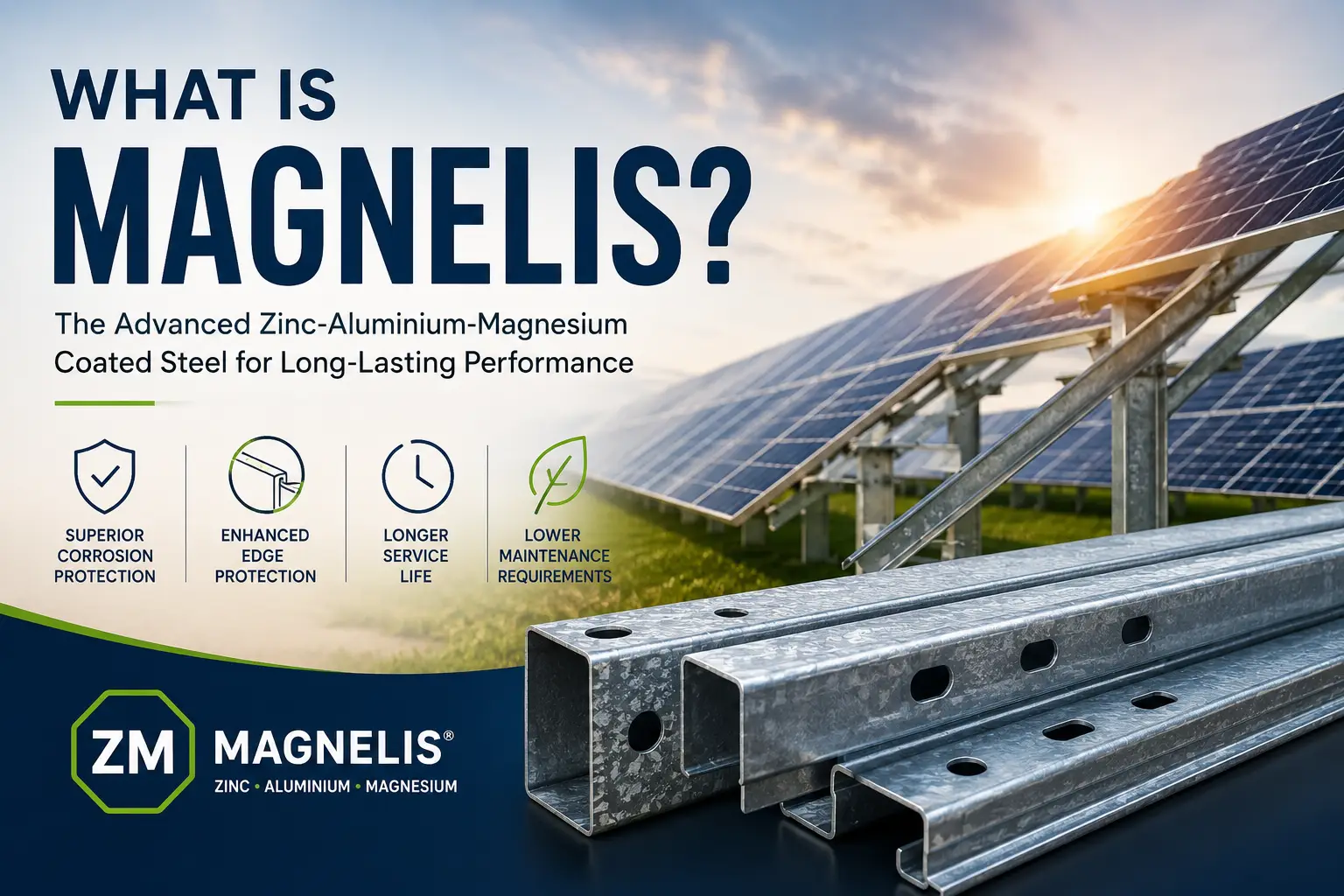
Outdoor steel structures are subject to moisture, temperature fluctuations, industrial pollution and other environmental elements which can accelerate corrosion. For industries that require longer lasting, lower maintenance solutions, protective coatings have become as important as the steel itself.
For decades, galvanised coatings have been widely used to protect steel elements in construction, infrastructure and industrial applications. But the demand for better corrosion resistance, longer life and lower maintenance costs has led to development of advanced coating technologies. The Magnelis is one of the most recognisable innovations in the field.
Magnelis is a zinc–aluminium–magnesium coated steel which has attracted a lot of interest in Europe, especially in applications where long term durability is a key factor. Magnelis is increasingly the specified option for applications requiring dependable corrosion protection in harsh environments, from utility-scale solar farms and agricultural structures to industrial buildings and infrastructure projects.
It’s not only the composition of the coating that makes Magnelis unique, but also the way it protects steel surfaces over time. The unique zinc-aluminium-magnesium technology offers improved corrosion resistance and better protection to edges, perforations and other vulnerable points. This makes Magnelis a good solution to many engineers, EPC contractors and project developers to extend the life of steel structures.
In this article we will look at what Magnelis is, how it is made, how it protects steel from corrosion and why it has become a popular choice for solar projects, industrial applications and other outdoor structures across Europe and beyond.
Magnelis: What is it?
Magnelis is a metallic coating technology engineered to improve the corrosion resistance of steel in challenging environments. The coating is applied to steel by a continuous hot-dip process and consists primarily of zinc, aluminium and magnesium. This fusion results in a shield that contributes to enhanced long-term durability of steel parts subjected to the elements outdoors.
Magnelis is a new, specifically designed coated steel product, which offers superior protection for applications where performance, maintenance and service life can be significantly affected by corrosion. Its coating technology has been used in a range of industries including renewable energy, agriculture, infrastructure and industrial construction.
One of the main reasons for the growing popularity of Magnelis is the ability to offer protection on flat surfaces, as well as on cut edges, perforations and areas where corrosion usually starts. This characteristic makes it very attractive for steel structures which must be reliable for a long time in harsh environments.
Today, Magnelis is used in a lot of applications, such as:
- Ground installed solar structures
- Agro-ecosistemes *Industrial buildings
- Infrastructure projects
- Parts for steel construction
The rising demand for renewable energy projects is further fuelling the adoption of Magnelis across Europe. In particular, utility-scale solar farms need structural components that are able to survive decades of exposure to environmental conditions, while minimising maintenance requirements. This is why Magnelis is the coating solution of choice for many solar mounting system manufacturers and project developers.
To better understand the difference in performance of Magnelis in comparison to conventional coatings, it is important to look at the technology used in its manufacturing process and its coating composition.
How is Magnelis produced?
Magnelis’ performance starts with its advanced coating process. The final product may resemble other coated steel products but the technology chosen for its manufacture is specifically geared to give it superior long term corrosion resistance and durability in severe environments.
Magnelis is made by a continuous hot dip coating process. In the course of manufacture a steel strip is passed through a molten bath of a particular mixture of zinc, aluminium and magnesium. The steel emerges from the bath and a consistent protective coating is formed on the surface.
The performance of the material strongly depends on coating composition. Zinc offers sacrificial corrosion protection. Aluminium provides stability to the coating surface, while magnesium enhances the coating’s protective properties on sensitive areas. These components are integrated into a coating system capable of performing efficiently over a broad range of environmental conditions.
Base Steel Material
Magnelis can be coated on various steel grades depending on the specific application. The coating provides the base material with additional protection and retains its structural properties.
This flexibility allows manufacturers and engineers to choose the right steel grade for specific projects, but also to take advantage of increased corrosion resistance.
Hot Dip Coating Process Continuous
The coating process is performed in strictly controlled industrial conditions in order to provide uniformity over the entire surface of the steel. Predictable long term performance and reliable protection throughout the service life of the product depend on a uniform coating thickness.
Efficient production of large scale industrial applications such as solar structures, construction components, and infrastructure projects is possible with Magnelis products. This is caused by the fact that the coating is performed in a continuous process.
Zinc-Aluminum-Magnesium composition
Magnelis is different from many traditional coating systems which are a combination of zinc, aluminium and magnesium.
Each element contributes to the overall protection mechanism:Zinc offers sacrificial protection from corrosion.
Coating stability is enhanced by aluminium.
* Magnesium enhances corrosion resistance and edge protection.
As these elements react they create a protective coating that acts differently to traditional zinc coatings, particularly in extreme outdoor environments.
Properties of Surfaces
Magnelis is usually smooth and metallic in appearance with a uniform finish. The coating is not only designed to provide visual attributes but also to maintain protective qualities for the entire lifespan of the structure.
This is the basis of the advanced coating technology for Magnelis corrosion performance. To understand why it is increasingly specified for solar projects, industrial facilities and infrastructure applications, it is necessary to understand how the coating protects steel in corrosive environments.
How Does Magnelis Protect Steel Against Corrosion?
The primary purpose of any metallic coating is to protect the underlying steel from corrosion. However, not all coating systems provide protection in the same way. What makes Magnelis particularly effective is its ability to combine several protection mechanisms that work together throughout the service life of the structure.
In outdoor environments, steel is continuously exposed to moisture, oxygen, temperature changes and environmental contaminants. Over time, these factors can initiate corrosion and gradually reduce the performance of structural components. Magnelis is designed to slow down this process by creating a highly protective barrier between the steel surface and the surrounding environment.
Barrier Protection
The first level of protection comes from the coating itself. The zinc-aluminium-magnesium layer acts as a physical barrier that limits direct contact between the steel substrate and corrosive elements.
By reducing exposure to moisture and oxygen, the coating helps delay the initiation of corrosion and supports long-term structural durability.
This barrier effect is particularly important in outdoor applications such as:
- Solar mounting systems
- Agricultural structures
- Industrial facilities
- Infrastructure projects
where steel components remain exposed to environmental conditions for decades.
Sacrificial Protection
Like conventional zinc coatings, Magnelis also provides sacrificial protection.
If the coating surface becomes damaged, the zinc within the coating can help protect exposed steel areas by corroding before the steel substrate itself. This mechanism significantly reduces the risk of localized corrosion and helps maintain structural integrity over time.
Sacrificial protection has long been one of the most important advantages of metallic coatings and remains a key part of Magnelis’ corrosion resistance strategy.
Enhanced Edge Protection
One of the most significant advantages of Magnelis is its performance on cut edges and perforated areas.
In many steel products, edges are among the most vulnerable locations because they expose the base material and can become starting points for corrosion. Magnelis is specifically designed to improve protection in these critical areas.
This characteristic makes the coating particularly attractive for applications involving:
- Profile cutting
- Perforated components
- Structural connections
- Solar mounting systems
where exposed edges are common.
Self-Healing Effect
Magnelis is widely recognized for what is often referred to as a self-healing effect.
When cut edges or damaged areas are exposed, corrosion products generated by the coating can help create a protective layer around these vulnerable locations. This natural protective mechanism contributes to improved edge performance and helps slow the progression of corrosion.
While no coating can completely eliminate corrosion under all conditions, this self-protecting behavior is one of the key reasons why Magnelis has gained popularity in industries requiring long service life and low maintenance requirements.
Long-Term Corrosion Performance
The combination of barrier protection, sacrificial protection and enhanced edge performance enables Magnelis to deliver reliable corrosion resistance across a wide range of environmental conditions.
For project developers, engineers and EPC contractors, this can translate into:
- Longer service life
- Reduced maintenance requirements
- Lower lifecycle costs
- Improved asset reliability
These benefits are particularly valuable in utility-scale solar projects and other outdoor structures where long-term durability is a critical design requirement.
To better understand the practical advantages of Magnelis, it is useful to compare its performance with one of the most commonly used corrosion protection methods in the steel industry: hot-dip galvanizing.
Magnelis vs Hot-Dip Galvanized Steel
When evaluating corrosion protection solutions, one of the most common questions engineers and project developers ask is how Magnelis compares to traditional hot-dip galvanized steel. Both technologies are designed to protect steel against corrosion, but they differ in coating composition, protection mechanisms and long-term performance characteristics.
Hot-dip galvanizing has been used for decades and remains one of the most widely adopted corrosion protection methods worldwide. Magnelis, on the other hand, represents a newer generation of metallic coating technology developed to address increasingly demanding environmental conditions and longer service life requirements.
Understanding the differences between these two solutions can help project teams select the most appropriate material for their specific application.
Coating Composition
The most fundamental difference lies in the coating itself.
Traditional hot-dip galvanized steel relies primarily on a zinc coating to protect the steel substrate. Zinc provides sacrificial protection and has proven effective in a wide range of environments for many years.
Magnelis uses a more advanced coating composition that combines:
- Zinc
- Aluminium
- Magnesium
The addition of aluminium and magnesium changes the behavior of the coating and contributes to improved corrosion performance in certain applications.
Corrosion Resistance
Corrosion resistance is often the primary reason for selecting a coated steel product.
Both hot-dip galvanized steel and Magnelis provide effective protection against corrosion, but Magnelis has been developed to deliver enhanced performance in environments where moisture, humidity and other corrosive factors are more aggressive.
This can be particularly important in:
- Utility-scale solar projects
- Agricultural environments
- Industrial facilities
- Coastal regions
- Infrastructure applications
where steel components are expected to remain in service for decades.
Performance on Cut Edges
One of the most frequently discussed advantages of Magnelis is its behavior on cut edges and perforations.
In many fabricated steel components, exposed edges represent areas where corrosion can begin. Magnelis is designed to provide improved protection around these vulnerable locations through the interaction of zinc, aluminium and magnesium within the coating.
For projects involving extensive cutting, punching or profile fabrication, edge performance can become an important selection criterion.
Maintenance Requirements
The durability of a coating directly influences long-term maintenance needs.
Projects that require regular inspection, repair or recoating may experience higher operational costs throughout their lifecycle. Materials with enhanced corrosion resistance can help reduce maintenance frequency and support long-term asset performance.
For this reason, project developers often evaluate coating systems not only based on initial material costs but also on expected maintenance requirements over the lifetime of the structure.
Service Life Considerations
Service life is a critical factor in sectors such as renewable energy and infrastructure.
Solar farms, for example, are commonly designed to operate for 25 years or more. During this period, support structures must withstand environmental exposure while maintaining structural integrity.
Because of its corrosion protection characteristics, Magnelis is increasingly being considered for applications where long-term durability and lifecycle performance are key project objectives.
Which Solution Is Right for Your Project?
There is no universal answer to whether Magnelis or hot-dip galvanized steel is the better option. The most suitable solution depends on several factors, including:
- Environmental conditions
- Corrosion risk level
- Project lifetime expectations
- Maintenance strategy
- Budget considerations
Both technologies have proven applications across multiple industries. The key is selecting the coating system that aligns with the project’s technical requirements and long-term performance goals.
To understand why Magnelis has become particularly popular in renewable energy developments, it is worth examining its role in one of the fastest-growing sectors in Europe: utility-scale solar projects.
Solar Projects Often Choose Magnelis
The rapid expansion of the solar industry has greatly increased the demand for durable and low maintenance structural materials. Utility-scale solar farms are expected to last for decades, often in conditions where steel structures are exposed to moisture, temperature changes, UV radiation and other environmental factors. This has brought corrosion protection to the forefront of considerations during the design and procurement phases of solar projects.
That is one of the key reasons why Magnelis has created so much interest in the renewable energy industry. Its corrosion protection performance and long-term durability characteristics make it an attractive solution for solar mounting systems and supporting structures.
Ground-Mounted Solar Farms
Ground-mounted solar projects are some of the most challenging environments for structural steel components.
Unlike buildings or enclosed facilities, solar support structures are exposed to weather conditions throughout their entire service life. Rain, humidity and soil conditions as well as seasonal temperature changes can all contribute to the risk of corrosion.
With these structures expected to operate reliably for 25 years or more, developers and EPC contractors are increasingly looking at materials capable of supporting long-term durability objectives.
Magnelis is often considered in such applications because of the potential for improved corrosion protection in outdoor environments.
Utility-Scale PV Projects
Large scale photovoltaic (PV) installations require thousands of structural components such as posts, beams, bracing elements and mounting systems.
For projects of this size even a small reduction in maintenance need can have a significant impact on operational costs over time.
Material selection is thus more than a technical decision, it’s a financial decision. Selecting a coating system that results in long-term performance can make the project more economical overall.
This has led to increased use of Magnelis in utility-scale solar projects in Europe and elsewhere in the world.
Less Maintenance Requirements
Maintenance costs are a big consideration for owners of solar assets.
Each inspection, repair or replacement activity contributes to operational expenses which can affect project profitability. Therefore, developers often look for materials that can reduce the need for maintenance interventions during the life of the installation.
With this goal in mind, Magnelis’ corrosion resistance properties can contribute by helping steel parts keep their protective properties for long periods of exposure.
Minimising maintenance can be particularly valuable for solar projects in remote locations.
Long-Term Asset Performance
Solar projects are usually developed for long-term investment. As a result, investors, EPC contractors and asset owners are assessing materials not only in terms of upfront procurement cost, but also expected lifecycle performance.
Parts of a structure that are durable in time contribute to:
- Enhanced asset reliability
- Reduced operational risk
- Reduced lifecycle costs
- Increased confidence in long-term project performance
This lifecycle view has become more important as the solar industry matures and project developers focus more on long-term value rather than short-term material costs.
Support Sustainable Infrastructure
Another aspect that affects the choice of materials in renewable energy projects is sustainability.
Long lasting coating systems can prolong the service life of steel structures and reduce the need for repairs or replacements, leading to a more efficient use of resources over the lifetime of an installation.
As governments and developers continue to invest in renewable energy infrastructure, so does the need for materials that are durable, reliable and provide long-term performance.
These are the reasons why Magnelis has become the coating of choice in many solar applications.” But solar energy is just one of a number of sectors that are taking advantage of its corrosion-resistance capabilities. Magnelis is also widely used in many industries where long-term protection and durability are important.
Common Applications of Magnelis
Magnelis is now synonymous with solar energy projects but it’s application is far broader than the renewable energy market. Its corrosion resistance and durability make it suitable for a wide range of applications where steel parts are exposed to harsh environmental conditions.
With industries placing greater emphasis on the performance of products over their lifecycle and the reduction of maintenance, more and more Magnelis® is being specified on projects where reliable corrosion protection is required for many years of service.
Solar Structures
Magnelis is still one of the most relevant applications of solar mounting systems.
The steel components in large numbers of ground mounted solar farms are exposed to weather conditions all year round. The support posts, beams, bracing elements and structural connections must remain intact for the life of the plant.
Magnelis is often used in solar mounting structures for its corrosion protection properties, where durability and lower maintenance are important project goals.
Steel structures are also particularly difficult in an agricultural setting.
Many applications are prone to corrosion accelerated by exposure to moisture, fertilisers, animal waste and changing weather conditions. As a result, corrosion-resistant materials are often preferred for:
- Glass houses
- Animal facilities
- Farm storage facilities
- Irrigation works
“Magnelis can help to enhance the durability of such structures and support long-term operational performance.”
Factory Buildings
Structural steel elements in industrial facilities are often subjected to conditions of high humidity, airborne particles or chemicals.
Warehouses, production facilities and logistics centers require often materials that can maintain their performance for long periods of time with minimum maintenance interventions.
It is for these reasons that Magnelis is increasingly being specified for industrial construction projects where resistance to corrosion is a critical requirement.
Infrastructure Projects
Infrastructure assets are often subject to harsh environmental conditions and are typically designed for long service lives.
Applications can be:
- Transport infrastructure
- Installations of utilities
- Common amenities
- Structural support systems
Maintenance access can be difficult and costly in these projects. Materials that aid in minimising deterioration due to corrosion can improve lifecycle performance and reduce long term operating costs.
Steel Structural Components
Magnelis is also used in a wide range of steel construction applications where the choice of material is influenced by environmental exposure and durability considerations.
Engineers and fabricators can specify Magnelis®-coated components for structures where they want extra corrosion protection without sacrificing structural performance.
Its versatility means that it can be used in many construction and engineering projects across multiple industries.
A Growing Material Across Multiple Industries
The widespread adoption of Magnelis is fuelled by a common challenge faced by many industries: increasing the life span of steel constructions and reducing maintenance requirements.
Magnelis is used in solar farms, agricultural facilities, industrial buildings or infrastructure projects, providing a corrosion-resistant coating solution to help meet long term durability objectives.
However, not all environments are equally corrosive. In some locations such as coastal locations and high humidity locations, material selection is even more critical. In judging the suitability of Magnelis for a project it is important to understand the performance of Magnelis in these conditions.
Magnelis in Coastal and High-Humidity Environments
Steel structures are greatly affected by environmental conditions in a long term. Corrosion can occur in almost any outdoor application but some environments pose much greater challenges and require a higher level of protection. Exposed steel components are subjected to some of the most demanding conditions in coastal areas, high humidity environments and industrial atmospheres.
In these environments, moisture, airborne salts and aggressive contaminants can speed up the development of corrosion. The choice of the right coating system is a critical part of the engineering and material selection process.
Coastal Areas
Coastal environments are one of the most corrosive environments for steel structures.
Salt particles blown by wind can deposit on exposed surfaces and accelerate corrosion processes. Structures close to coastlines usually have to cope with humidity, salt spray and fluctuating weather conditions. This forms a very aggressive environment for the steel parts.
For projects such as:
- Coastal solar farms
- Port infrastructure
- Industrial facilities near the sea
- Agricultural installations in coastal regions
long-term corrosion protection becomes a key design requirement.
Thanks to its advanced coating technology, Magnelis is often considered for applications where corrosion resistance is vital in ensuring structural integrity over long service periods.
High-Humidity Regions
Even locations in the interior can have high humidity levels, which can greatly increase corrosion risks.
Constant moisture or high humidity in areas with frequent rainfall creates conditions where corrosion processes can continue for longer periods. Steel structures working in such environments often need better protection to ensure their expected service life.
Applications commonly exposed to high humidity include:
- Agricultural facilities
- Greenhouses
- Renewable energy installations
- Industrial buildings
- Water treatment facilities
In these cases, corrosion-resistant coating systems can help reduce deterioration and support long-term operational performance.
Industrial Atmospheres
In addition to moisture and humidity, an industrial environment could also have other corrosion challenges.
But when airborne pollutants combine with chemical emissions, they can develop a hostile atmosphere and steel surfaces exposed to it can corrode faster. These additional risks are usually found in facilities located near manufacturing plants, processing facilities or heavy industrial areas.
In such environments the choice of the material has to be made not only considering the structural requirements, but also the corrosion mechanisms related to the local atmosphere.
Understanding Corrosion Categories
Engineers often use corrosion categories to assess the severity of the environment and classify exposure conditions in terms of the anticipated corrosion risk.
These categories help project teams assess:
- Environmental aggressiveness
- Expected corrosion rates
- Appropriate coating systems
- Maintenance strategies
- Service life expectations
The selection of a coating system is therefore not only a product decision but also an environmental engineering decision.
Long-Term Reliability in Challenging Conditions
Coating system performance in coastal, humid and industrial environments directly affects maintenance requirements and overall life cycle costs.
The durability of the materials is directly connected to the long-term financial performance of asset owners and project developers. Long-lasting structures that retain their protective properties can reduce the number of inspections, maintenance interventions and corrosion-related repairs.
Consequently Magnelis is increasingly being considered for projects in environments where corrosion protection is an important factor in long-term asset management.
And the economic impact of material selection must be considered by project stakeholders, not just the environmental performance. Understanding service life expectations and total cost of ownership is key to evaluating the long-term value of any coating system.
Why Magnelis Is Becoming a Preferred Coating Solution
The demand for durable and corrosion-resistant steel solutions continues in industries such as renewable energy, construction, infrastructure and agriculture. Material selection is very important to long term performance and maintenance planning as projects get bigger and expectations for service life increase.
Magnelis® is a proven coating technology, delivering a unique combination of corrosion protection, edge performance and long-term durability in one solution. Its zinc-aluminium-magnesium coating system provides protection for steel structures exposed to challenging environmental conditions and makes it suitable for applications where reliability is a key requirement.
As utility scale solar projects continue to grow, interest in Magnelis has also seen a considerable increase. Developers, EPC contractors and engineers are increasingly assessing materials based not only on initial procurement costs but also lifecycle performance and maintenance requirements. In this context, corrosion protection is an important factor for the protection of long-term investments.
Magnelis is also used in agricultural structures, industrial facilities, infrastructure projects and steel construction applications where environmental exposure can play a major role in the service life, in addition to the renewable energy sector. Versatility enables it to meet a broad spectrum of engineering needs while assisting project teams in solving corrosion-related problems.
With industry focus on durability, efficiency and lifecycle value, advanced coating technologies will assume an increasingly critical role in structural steel applications. Magnelis has become a real solution for many projects to ensure reliable corrosion protection and support long term asset performance.
Looking for a Reliable Magnelis® Steel Supplier?
Whether you’re planning a solar mounting system, agricultural structure, infrastructure project, or any application requiring exceptional corrosion resistance, choosing the right material is only part of the equation. Partnering with an experienced supplier ensures consistent quality, competitive pricing, and dependable delivery schedules.
Our team is ready to help you find the most suitable Magnelis® steel solution for your project requirements. Simply complete the form below, and one of our specialists will provide a tailored quotation and answer any technical questions you may have.
Request your free quote today and discover how Magnelis® can enhance the durability and performance of your next project.