


Blog
What Are Hollow Sections? Comprehensive Guide – 2026

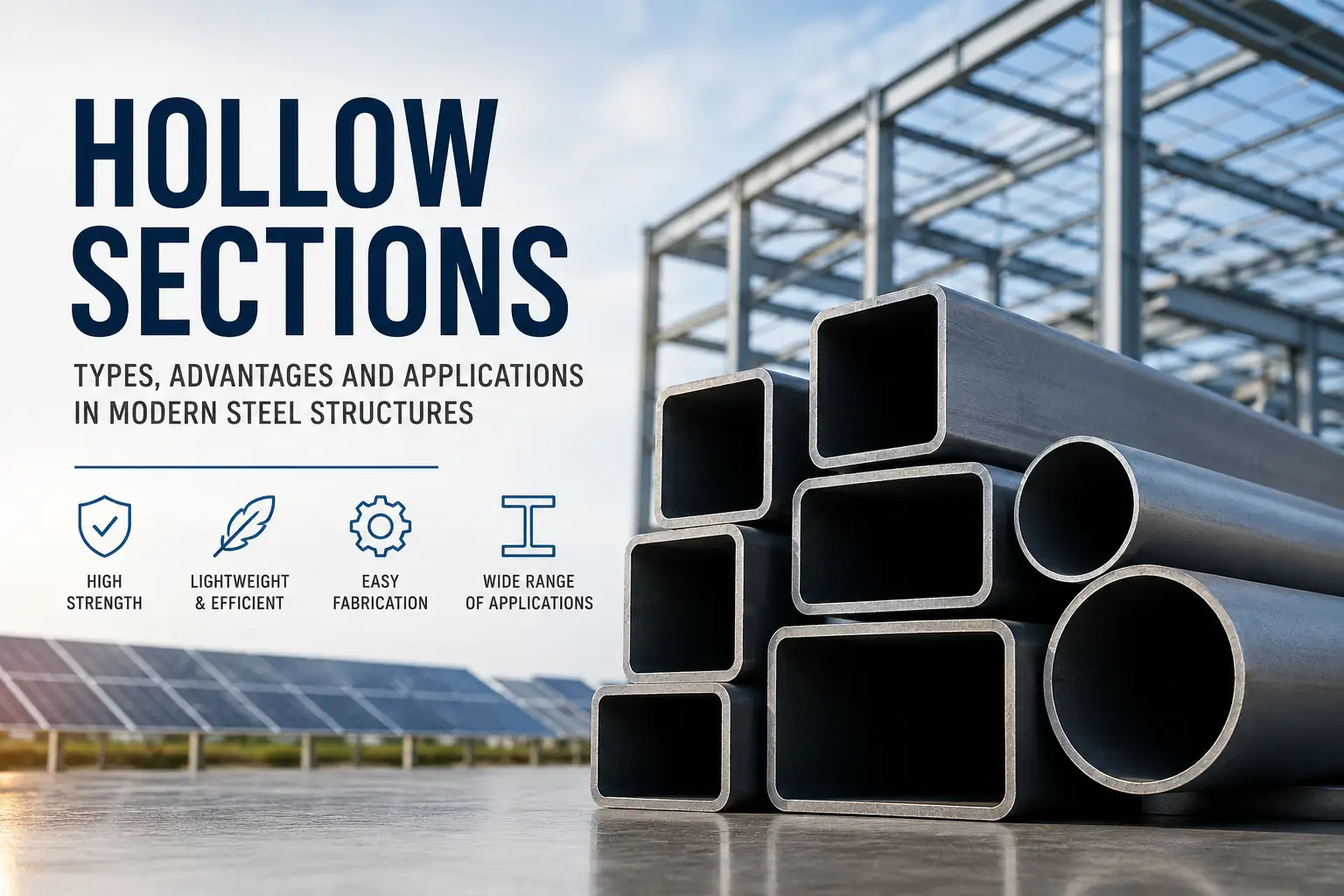
Structural steel is a cornerstone of modern construction, providing the strength, stability and flexibility necessary for a wide range of engineering applications. Steel profile structures are the backbone of industrial buildings and warehouses, infrastructure projects and renewable energy facilities, all built to operate safely for decades. Hence, choosing appropriate structural profile is one of the most important decisions in any steel construction project.
Hollow sections are among the most widely used structural steel products today because of their excellent combination of strength, efficiency and versatility. The closed cross-section offers high structural performance with minimum materials. These make them attractive for load bearing structures and architectural uses.
Hollow sections are manufactured in different shapes such as square, rectangular and circular profiles to cater to different structural requirements. Their balanced geometry provides excellent resistance to compression, bending and torsional forces, allowing engineers to design efficient structural systems for a wide range of projects.
Today, hollow sections are used in a range of industries from commercial building construction to industrial facilities, infrastructure, agricultural buildings and renewable energy projects. They are also frequently specified for steel support structures, equipment frames and a wide variety of structural components where durability, ease of fabrication and long term performance are important.
In this guide we’ll cover what hollow sections are, how they are manufactured, types of hollow sections, the structural advantages of hollow sections, and where they are most commonly used. We’ll also discuss the key factors to consider when selecting the right hollow sections for construction, industrial and renewable energy projects.
What Are Hollow Sections?
Hollow sections are structural steel profiles with an enclosed cross-section, designed for high strength with an efficient weight-to-performance ratio. Hollow sections can resist loads in different directions with very good structural efficiency since the material is distributed around the profile perimeter unlike open structural profiles like I-beams or channel sections.
The geometry of hollow sections provides a combination of strength, stiffness and stability, which makes them suitable for a wide range of structural applications. They are common in buildings, bridges, industrial facilities, infrastructure projects and renewable energy developments where both structural performance and fabrication efficiency are important considerations.
In international engineering standards these are often referred to as Hollow Structural Sections (HSS). According to the shape of their cross section, hollow sections are generally divided into three main groups:
- Square Hollow Sections (SHS)
- Rectangular Hollow Sections (RHS)
- Circular Hollow Sections (CHS)
Each type of profile has different structural properties, so that engineers can choose the most appropriate solution for the loading conditions, connection details and architectural requirements.
Why Are Hollow Sections Widely Used?
One of the primary reasons for the growing popularity of hollow sections is their structural efficiency.
Because the material is distributed around a closed section, hollow profiles are often more resistant to torsion than many open section steel profiles. This makes them especially suitable for structures that are subject to multidirectional loading or dynamic forces.
The smooth geometry also assists in distributing loads more evenly which can help reduce stress concentrations in the structure.
Structural Performance
Hollow sections perform well under several loading conditions, including:
- Axial compression
- Bending loads
- Torsional forces
- Combined structural loading
This versatility allows them to be incorporated into a wide variety of structural systems ranging from simple building frames to complex industrial facilities.
A Versatile Structural Solution
Not only the mechanical performance but also the flexibility of hollow sections is appreciated.
They can be cut, welded, drilled and fabricated into a number of structural components with a clean, modern look. Another advantage is that their closed profile makes them the ideal choice for exposed steel structures where the aesthetics is an important design consideration.
Many structural engineers, architects and steel fabricators opt for hollow sections as they offer a good balance between strength, durability and design flexibility.
In order to determine the most suitable hollow section for a particular application the various profile shapes available need to be considered and also the structural benefits of each.
Types of Hollow Sections
They are all based on the same principle of a closed cross-section, but the different shapes of the hollow sections are designed to meet specific structural and architectural requirements. Each type of profile has advantages and disadvantages with regard to load distribution, stiffness, fabrication and appearance.
The selection of the suitable hollow section is influenced by the type of load, the structural configuration, the details of the connections and the project requirements. By knowing the properties of each part , engineers can choose the most efficient solution for a particular application .
Square Hollow Sections (SHS)
Square Hollow Sections (SHS) feature equal width and height dimensions, resulting in a symmetrical profile with balanced structural properties in both principal directions.
Because of this symmetry, SHS profiles are commonly used for:
- Columns
- Structural frames
- Architectural steelwork
- Support structures
- Industrial equipment frames
Their uniform geometry provides excellent resistance to compression and torsional forces while also offering a clean and modern appearance for exposed steel applications.
Rectangular Hollow Sections (RHS)
Rectangular Hollow Sections (RHS) have unequal width and height dimensions, allowing engineers to optimize structural performance depending on the direction of the applied loads.
This makes RHS profiles particularly suitable for:
- Beams
- Roof structures
- Building frames
- Equipment supports
- Steel construction projects
Their geometry often allows greater bending resistance in one direction while maintaining efficient material usage, making them one of the most widely specified hollow section types in structural engineering.
Circular Hollow Sections (CHS)
Circular Hollow Sections (CHS) are characterized by their round cross-section.
Because stresses are distributed uniformly around the profile, CHS sections provide excellent torsional performance and perform efficiently under multidirectional loading conditions.
They are frequently used in:
- Trusses
- Towers
- Bridges
- Architectural structures
- Offshore and infrastructure projects
In addition to their structural benefits, circular sections are often selected for projects where aesthetics play an important role.
Choosing the Right Hollow Section Shape
There is no universally “best” hollow section. The most appropriate profile depends on the structural requirements of the project.
Engineers typically evaluate:
- Load type and magnitude
- Span length
- Connection details
- Fabrication methods
- Architectural considerations
- Material efficiency
before selecting a section shape.
Choosing the correct profile not only improves structural performance but can also reduce fabrication complexity and optimize overall project costs.
Regardless of the selected geometry, the manufacturing process also plays a significant role in determining the mechanical properties, dimensional accuracy and performance of hollow sections. Understanding how these profiles are produced provides valuable insight into their behavior in structural applications.
How Are Hollow Sections Manufactured?
The manufacturing process has a significant influence on the quality, the dimensional accuracy and the structural performance of hollow sections. The modern production techniques guarantee uniformity of geometry, predictable mechanical properties, and international standards compliance, making the hollow sections suitable for demanding structural applications in a broad spectrum of industries.
The production of hollow sections, which varies according to product specification and application, is generally carried out by hot-forming or cold-forming processes. Each method has its own particular advantages, and is selected according to the required dimensions, material properties and project requirements.
Hot-Formed Hollow Sections
Hot formed hollow sections are manufactured at elevated temperatures so that the steel can be shaped while the good structural properties of the steel are kept.
Since the forming is done at elevated temperatures, the residual stresses are typically smaller than in cold worked products. This can be useful in some structural applications where difficult loading conditions are expected.
Projects that require hot formed hollow sections are typically specified to:
- Uses in heavy structures
- High load carrying capacity
- Better dimensional stability
- Giant structural members
Cold-Formed Hollow Sections
Cold formed hollow sections are produced by passing steel strip through a succession of forming rolls at room temperature, with the profile being subsequently welded to its final shape.
One of the most widely used manufacturing methods, as it provides:
- High-precision in high dimensions
- Manufacturing efficiency
- Quality you can count on
- Cost-effective production
Cold formed hollow sections are widely used in commercial buildings, industrial buildings, warehouses, renewable energy projects and a number of other structural applications.
Most square and rectangular hollow sections are made from flat steel which is slowly formed into shape and then welded along the longitudinal seam.
With modern welding techniques you can produce strong and reliable joints meeting international structural standards. After welding the seam is carefully examined to ensure that the profile meets the requirements of the dimensional and mechanical quality standards.
The quality of a weld is critical because it directly affects the structural integrity and subsequent performance of the final product.
Quality Standards
Structural hollow sections are manufactured according to internationally recognized standards to ensure consistent quality and performance.
These standards typically define requirements for:
- Dimensional tolerances
- Mechanical properties
- Steel grades
- Manufacturing quality
- Inspection procedures
Compliance with recognized standards provides engineers and project owners with confidence that the selected hollow sections meet the performance requirements of structural applications.
Manufacturing Quality and Structural Reliability
The structural performance can be relied upon only if the manufacturing quality is high, no matter what the method of production.
The hollow sections perform predictably mechanically during fabrication and throughout the entire service life of the structure due to accurate dimensions, uniform wall thickness and controlled production processes.
Hollow sections are now among the most dependable structural steel products available today. This is due to a combination of modern quality control and efficient manufacturing techniques. The production methods they use ensure high quality of the product and contribute to the numerous structural and economic advantages that make hollow sections a preferred choice in construction and engineering projects.
Advantages of Hollow Sections
Hollow sections are now one of the most used structural steel products with an excellent combination of strength, efficiency and versatility. The closed cross-section design provides engineers high structural performance with optimised material usage, expanding their application from commercial buildings to large-scale industrial & renewable energy projects.
Compared to many traditional open section profiles, hollow sections offer a number of mechanical and practical advantages, leading to safer, more economical and more efficient structural designs.
High Strength-to-Weight Ratio
A major advantage of hollow sections is that they have a high strength to weight ratio. Due to the enclosed cross-sectional geometry these profiles can provide excellent structural performance in an efficient use of material. This allows engineers to design strong, yet lightweight, load-bearing systems that facilitate optimised structural solutions for a variety of applications.
Hollow sections can frequently provide the necessary structural capacity using less material than many traditional structural shapes. This will help not only to design structures efficiently, but can also ease transportation, handling and installation throughout the construction process.
Several practical benefits can be derived from the lower structural weight, such as:
- Reduced transport costs
- Easier to handle during installation
- Increased construction efficiency
- Improved use of materials
From an engineering and economic point of view, an optimised strength to weight ratio is advantageous, leading to more economical projects. Hollow sections help to increase resource efficiency and allow cost effective structural solutions without affecting safety or reliability by reducing unnecessary steel consumption while maintaining the required structural performance.
Excellent Torsional Resistance
Under torsional loading, closed sections perform far better than many open structural sections.
Hollow sections are more resistant to torsional deformation under the twisting forces due to wind loads, eccentric loading or dynamic conditions. This feature makes them especially well suited for applications where structural stability is a primary concern.
Efficient Load Distribution
The loads are distributed more evenly across the section by the symmetrical geometry of the hollow sections.
This uniform distribution of stress can reduce localised stress concentrations and help to improve the structural performance under a variety of loading conditions.
Hence, hollow sections are extensively used in structures where a good performance under compression, bending and combined loading situations is required.
Easy Fabrication and Installation
Modern manufacturing techniques are very suitable for hollow sections.
They are highly adaptable to various engineering needs, capable of cutting, welding, drilling and assembling into a broad spectrum of structural systems. Dimensional stability simplifies manufacturing and installation as well.
Flexibility of made to measure allows executing projects efficiently in construction, industrial & infrastructure sectors.
Clean Architectural Appearance
In addition to the structural benefits, hollow sections are fashionable and tidy.
The Hollow sections have smooth surfaces and enclosed geometry and are a popular choice for exposed steel structures where aesthetics are as important as structural performance. Architects usually select hollow sections for projects where they want to combine engineering functionality and contemporary architectural design
Long-Term Structural
Hollow sections produced to international standards and used with appropriate corrosion protection methods can give assured performance through the whole service life of a structure.
For enhanced durability and reduced long-term maintenance, surface treatments such as galvanising or others can be used depending on project requirements and environmental conditions.
The combination of structural efficiency, fabrication flexibility and durability over time explains the use of hollow sections in such a wide range of industries. Their advantages are even more evident when we look at the numerous structural applications where they are an indispensable component of modern engineering projects.
Common Applications of Hollow Sections
The versatility of the hollow sections has become an essential component of modern structural engineering. The high strength, good load distribution and simple fabrication of these allow them to be used in a large number of construction and industrial applications .
Hollow sections are used in a wide range of applications from supporting large industrial facilities to being used as structural elements in renewable energy projects, giving engineers flexible design choices while maintaining reliable structural performance.
Steel Buildings
Steel-framed buildings are among the most common applications for hollow sections.
Square and rectangular hollow sections are frequently used for:
- Structural columns
- Primary and secondary beams
- Roof support systems
- Building frames
- Bracing elements
Their balanced structural properties enable efficient load transfer while contributing to lightweight yet robust steel structures.
Industrial Facilities
Manufacturing plants, production facilities and logistics centers often require structural systems capable of supporting heavy equipment and large open spaces.
Hollow sections are widely used in these environments because they offer:
- High structural efficiency
- Excellent fabrication flexibility
- Reliable long-term performance
- Compatibility with welded and bolted connections
These characteristics make them suitable for both new industrial developments and facility expansions.
Warehouses and Logistics Centers
Modern warehouses have wide column spacing and high roof structures to maximise usable floor space.
Hollow sections are often used in warehouse buildings . They can achieve the strength required for long spans , while helping to optimise the use of steel .
The clean geometry makes them easier to fabricate and install which helps complete projects faster.
Infrastructure Projects
Infrastructure developments often demand structural components capable of withstanding continuous loading and challenging environmental conditions.
Hollow sections are used in a variety of infrastructure applications, including:
- Pedestrian bridges
- Transport facilities
- Utility structures
- Public infrastructure
- Steel support systems
Their structural reliability and versatility make them suitable for projects with demanding performance requirements.
Agricultural Structures
Agricultural buildings frequently operate in environments where humidity, temperature changes and operational demands require durable structural materials.
Hollow sections are commonly specified for:
- Greenhouses
- Livestock buildings
- Storage facilities
- Agricultural equipment structures
When combined with appropriate corrosion protection systems, they can provide long service life even in challenging operating conditions.
Renewable Energy Projects
The rapid expansion of renewable energy has opened up new opportunities for the use of hollow sections.
They are often used in
- Solar Power Stations
- Support frames for equipment
- Cable management systems
- Maintenance platforms
- Steel auxiliary constructions
Because of their good strength-to-weight ratio and fabrication flexibility, they are well suited for the support structures used throughout renewable energy facilities.
Hollow sections are used in many industries, but one of the fastest growing application areas is solar energy. As utility-scale photovoltaic projects continue to increase across Europe and the Balkans, hollow sections have become an important structural solution for a variety of steel components in contemporary solar installations.
Hollow Sections in Solar Energy Projects
The rapid growth of solar energy has led to a greater demand for robust and efficient structural steel solutions. Although the photovoltaic modules are the most visible components of a solar power plant, the supporting steel structures are equally crucial for the long-term performance, stability and safety of the installation.
Ground-mounted solar farms and industrial rooftop systems are built to last for 25 years or more. As every structural part must withstand constant exposure to wind, rain, humidity, temperature changes, and other environmental conditions, the importance of corrosion protection cannot be stressed enough. Therefore, the right steel section is an important element of every solar project.
Hollow sections have gained popularity for many auxiliary and supporting structures, as they provide an attractive combination of structural efficiency and excellent fabrication flexibility.
Solar Mounting Structures
Solar mounting systems consist of numerous structural elements that support photovoltaic panels while transferring loads safely to the foundations.
Depending on the project design, hollow sections may be incorporated into:
- Support frames
- Bracing systems
- Cross members
- Secondary structural elements
- Custom steel assemblies
Their high strength-to-weight ratio allows engineers to design robust structures while optimizing material usage.
Equipment Support Frames
Beyond the panel mounting system itself, utility-scale solar projects require various steel structures to support electrical and mechanical equipment.
Hollow sections are frequently used for:
- Inverter platforms
- Transformer support structures
- Electrical equipment frames
- Cable tray supports
- Maintenance platforms
Their versatility makes them suitable for a wide range of fabricated steel components found throughout a solar facility.
Utility-Scale Solar Farms
Large photovoltaic power plants contain thousands of structural steel components distributed across extensive sites.
In these projects, engineers seek materials that offer:
- Reliable structural performance
- Efficient fabrication
- Long service life
- Ease of installation
- Reduced maintenance requirements
Because hollow sections are available in multiple shapes and sizes, they can be adapted to meet a variety of structural requirements within utility-scale solar developments.
Industrial Rooftop Solar Systems
Industrial rooftop photovoltaic systems often require additional structural steel to support equipment, allow access for maintenance, and accommodate auxiliary systems.
Depending on the building design and engineering calculations hollow sections can be used in rooftop support structures, service platforms and other secondary steel assemblies.
Their small size and ease of manufacturing allow them to be efficiently integrated with existing steel construction systems.
Supporting Long-Term Renewable Energy Infrastructure
Structural reliability is an important issue for long-term investments in renewable energy facilities.
Selecting the right hollow section is not just a question of the size of the profile. Engineers must also look at loading conditions, corrosion protection, fabrication requirements and environmental exposure to ensure that structural components continue to perform throughout the operational life of the project.
Therefore, the use of hollow sections continues to be an important structural solution in the modern developments of solar energy, offering support not only for the construction of efficient steel structures but also for the long-term sustainability and reliability of renewable energy infrastructure.
How to Choose the Right Hollow Section
Choosing the right hollow section is one of the most important decisions for any structural steel project. Square, rectangular and circular hollow sections all offer excellent structural performance. However the optimum choice of profile will depend on the particular engineering requirements of the application rather than the shape of the profile.
The right hollow section will ensure structural safety, efficient use of materials and long-term performance of the project. On the other hand, the choice of inappropriate profile can cause an increase of steel consumption, fabrication difficulties and lower efficiency of the structural system.
Structural Loads
The first consideration when selecting a hollow section is the type and magnitude of the loads it will carry.
Engineers must evaluate all relevant loading conditions, including:
- Dead loads
- Live loads
- Wind loads
- Snow loads
- Equipment loads
- Dynamic loads
A complete structural analysis ensures that the selected profile can safely withstand all expected forces throughout the design life of the structure.
Span Length
The distance between structural supports has a direct impact on profile selection.
As span lengths increase, bending moments and deflection become more significant. Larger spans may require hollow sections with greater dimensions or thicker wall sections to maintain structural performance and comply with design standards.
Selecting the correct profile size helps achieve the required balance between strength, stiffness and material efficiency.
Steel Grade
The mechanical properties of the steel are just as important as the profile dimensions.
Structural hollow sections are available in a variety of steel grades depending on project requirements. The selected grade influences:
- Yield strength
- Load-bearing capacity
- Weldability
- Fabrication performance
- Overall structural efficiency
Choosing an appropriate steel grade helps optimize both safety and project costs.
Corrosion Protection
Environmental exposure should always be considered during material selection.
Projects located in coastal regions, industrial environments or areas with high humidity may require additional corrosion protection to ensure long-term durability.
Depending on the application, hollow sections can be protected using:
- Hot-dip galvanizing
- Protective coating systems
- Project-specific corrosion protection solutions
Selecting the appropriate protection method helps reduce maintenance requirements and extend service life.
Fabrication Requirements
The profile choice should also be dictated by the manufacturing process.
The selection of the hollow section for a particular project will be based on factors such as cutting, welding, drilling and assembly requirements.
Choosing the right fabrication method profiles improves production efficiency while lowering manufacturing costs and installation time.
Environmental and Operational Conditions
Every project is done in different environmental conditions.
Long term structural performance is affected by variations in temperature, humidity, corrosive atmospheres and operational demands. These conditions should be considered at the design stage to ensure that the selected hollow section will continue to perform reliably over the anticipated service life of the structure.
Engineering-Based Material Selection
The best hollow section is not always the largest or strongest profile – it is the one that most effectively satisfies the structural, environmental and operational requirements of the project.
The combined consideration of the loading conditions, span lengths, steel grades, corrosion risks and fabrication requirements allow engineers to select hollow sections that provide both structural reliability and cost-effective performance.
But even good projects can run into problems if common selection mistakes are overlooked. Awareness of such pitfalls results in improved engineering decisions and safer, more economical steel structures.
Common Mistakes When Selecting Hollow Sections
Hollow sections can perform very well structurally if chosen correctly, but selecting the wrong profile can have implications for the safety and cost-efficiency of a project. Very frequently, the problem is not the unsuitability of the hollow section but the neglect of important engineering considerations in the design and procurement process.
The selection process needs to be well informed and look beyond just profile dimensions or material costs to consider structural requirements, environmental conditions, methods of fabrication and long-term project goals.
Selecting an Undersized Profile
One of the most common mistakes is choosing a hollow section that does not provide sufficient capacity for the intended structural loads.
An undersized profile may lead to:
- Excessive deflection
- Increased stress levels
- Reduced structural stability
- Lower safety margins
Proper structural calculations are essential to ensure the selected profile performs safely under all expected loading conditions.
Choosing the Wrong Section Shape
It is just as important to select the right shape as it is to get the right size.
The structural characteristics are different for square, rectangular and circular hollow sections. If you select the wrong section, you could end up wasting material or reducing the efficiency of the structure.
For example, a rectangular hollow section might be better suited for beam applications where bending is mainly in one direction, while square sections are generally good for structural columns.
Ignoring Corrosion Conditions
Don’t forget environmental exposure when specifying structural steel.
Projects located in coastal regions, industrial environments or areas of high humidity may require additional corrosion protection to achieve the desired service life.
The choice of hollow sections without considerations for environmental conditions may result in increased maintenance in the future and a reduced long-term structural durability
Overlooking Fabrication Requirements
Successful projects are not just about structural performance.
Profile selection should also take into account fabrication processes such as cutting, welding, drilling and assembly. A difficult profile to manufacture can mean longer production times and higher overall project costs.
By aligning structural design with fabrication requirements, efficiency can be increased throughout the whole construction process.
Focusing Only on Material Cost
Selecting a hollow section based on purchase price alone can be a costly mistake.
A lower cost profile may not deliver the required structural performance or durability, and may result in higher fabrication costs, higher maintenance or premature replacement.
Instead, the project teams should evaluate the total worth of the chosen material on the basis of:
- Structural performance
- Service life
- Maintenance needs
- Manufacturing effectiveness
- Life-cycle costs
The Importance of Engineering-Based Decisions
Every construction project has its own technical requirements. So you need an engineering analysis to select the right hollow section.
A careful assessment of structural loads, profile geometry, steel grade, environmental exposure and fabrication methods helps ensure that the chosen profile will provide safe, reliable and cost-effective performance throughout the life of the structure.
The engagement of experienced structural engineers and qualified steel suppliers can further reduce the project risks, while ensuring that the hollow sections are selected according to internationally recognised engineering standards and the requirements of the project.
Choosing the Right Hollow Section for Long-Term Structural Performance
Thanks to their strength, versatility and material efficiency, hollow sections have become an integral part of modern structural steel construction. The closed cross-section offers good structural performance for a high variety of loading conditions and allows efficient fabrication and erection processes.
Hollow sections are available in square, rectangular and circular shapes and can be tailored to meet the specific needs of commercial buildings, industrial facilities, infrastructure developments and renewable energy projects. Combined with the appropriate steel grade and corrosion protection system, they offer reliable long term performance with reduced maintenance requirements.
But choosing the right hollow section is more than just picking a profile according to its size. The combination of structural loads, span lengths, environmental conditions, fabrication methods and project-specific engineering requirements should be considered together. An engineering based selection process optimises material use, enhances structural safety and maximises long term value of the investment.
IMG Group supplies top quality hollow sections for construction, industrial and renewable energy projects throughout Europe and the Balkans. Whether you’re designing a steel building, infrastructure project or utility-scale solar farm, our experienced team can help you select the most appropriate hollow section for your technical requirements. Get in touch with us today to discuss your project and receive personalised product recommendations from our steel specialists.