


Blog
What Are IPE Profiles? Types, Sizes and Applications (TS910/5 – DIN 1025/5)

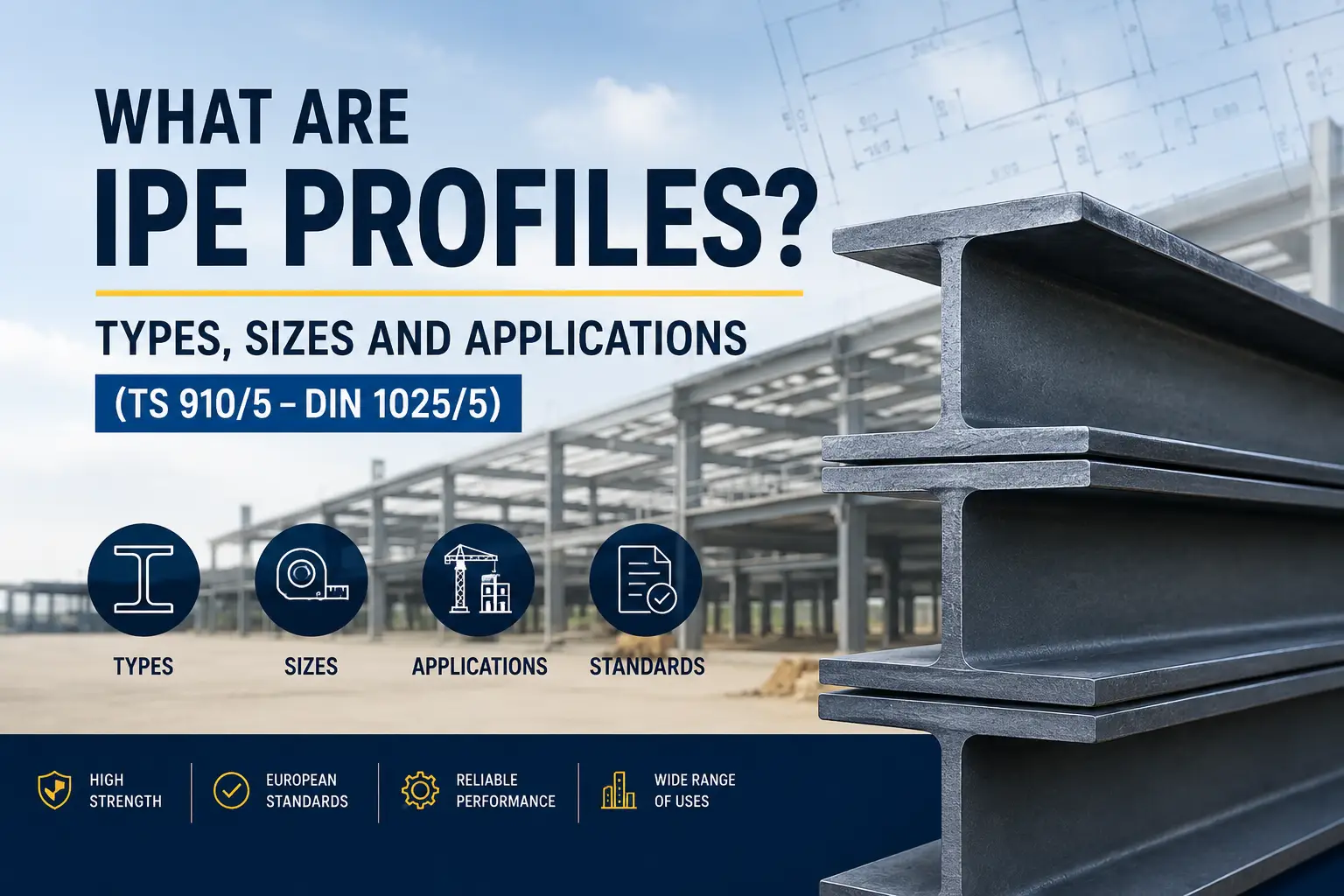
The strength and stability necessary for any project, ranging from commercial buildings and industrial facilities to bridges and infrastructure, are supplied by structural steel, the backbone of modern construction. There are several varieties of structural steel sections available, but IPE profiles are one of the most commonly used profiles nowadays. The reason is that they are efficiently built, have good load bearing performances, and are versatile for a wide range of applications.
IPE profiles are built to European standards. The profile has a parallel flange shape, which gives good structural efficiency through optimisation of material. They have become a favourite with structural engineers, fabricators, and EPC contractors working on projects of all sizes due to their capacity to support significant bending loads without adding weight.
With building projects being more and more geared towards cost-effectiveness, sustainability, and long-term performance, the choosing of the correct structural profile is more crucial than ever. The correct IPE profile will impact the structural integrity of the building; the manufacturing efficiency; transportation; installation; and the total cost of the project.
IPE profiles are one of the most reliable structural steel products on the market, offering the perfect mix of strength, durability and design flexibility. They can be used as primary profiles in industrial buildings, floor systems in commercial developments or supporting members in renewable energy infrastructure.
In this article we will talk about what IPE profiles are, how they are created, the standard sizes available, their structural advantages, popular uses and important aspects engineers should consider when selecting the proper IPE profile for a building project.
What Are IPE Profiles?
IPE profiles are hot-rolled structural steel profiles, I-shaped in section, with parallel flanges, made to European standards. They are specifically designed to give high bending resistance with an efficient strength-to-weight ratio. They are one of the most commonly used structural members in modern steel construction.
IPE is short for ‘IPE European I-profile with parallel flanges’. The IPE profiles have parallel flange surfaces which are different to the older profile types with tapered flanges, making fabrication, bolted connections and welding operations easier. This common geometry also corresponds to modern engineering practices and structural design codes used throughout Europe and many international markets.
IPE profiles are efficient in resisting bending moments, and due to their optimised cross-section, minimise unnecessary steel consumption. This enables engineers to design safe, economical and lightweight structures without compromising structural performance. Hence, IPE profiles are widely used in commercial buildings, industrial plants, warehouses, bridges and many infrastructure projects.
Basic Cross-Section Geometry
An IPE profile consists of three primary components that work together to distribute structural loads efficiently:
- Web – The vertical section that primarily resists shear forces.
- Flanges – The horizontal sections that resist bending moments.
- Fillets – Smooth transition areas between the web and flanges that improve stress distribution.
This balanced geometry provides excellent structural performance while keeping the overall weight of the profile relatively low compared to its load-bearing capacity.
Why Are They Called “IPE”?
IPE is an acronym from the European standards for structural steel, and it stands for a family of I-profiles with standard dimensions and parallel flanges.
Each profile is named according to its nominal section height. For instance:
- IPE 100
- IPE 160
- IPE 240
- IPE 300
- IPE 450
- IPE 600
The profile load-bearing capacity and stiffness increase with increasing section size, allowing engineers to choose the most appropriate profile for the span length, structural loads and project requirements.
Why IPE Profiles Are So Widely Used
IPE profiles are a standard solution in structural engineering, because they offer an excellent balance between strength, weight and fabrication efficiency.
They are popular for a number of reasons:
- Excellent bending performance
- Good strength to weight ratio
- Good use of material
- Simple to make and weld
- Available in many international markets
- European structural standards compliant
These features allow IPE profiles to be used in projects ranging from small commercial buildings to large industrial facilities and complex infrastructure projects.
So to understand why engineers specify IPE profiles so often, we need to look at the profile sizes available and the dimensional standards and the mechanical properties that determine how they perform structurally.
Types and Standard Sizes of IPE Profiles
The availability of standardised dimensions is one of the key reasons for the wide adoption of IPE profiles in structural engineering. These profiles are made to European standards and have uniform geometric properties which facilitate structural design, fabrication and international sourcing.
The standardised dimensions of all IPE profiles allow engineers to accurately calculate the structural performance and to choose the most appropriate profile according to span length, loading conditions and project requirements. This standardisation lets manufacturers, fabricators and contractors use compatible components on different projects and in different markets.
Standard IPE Dimensions
IPE profiles are produced in a wide range of sizes for applications from lightweight structural to heavy industrial construction.
Typical profile sizes are the following:
- IPE 80
- IPE 100
- IPE 120
- IPE 140
- IPE 160
- IPE 180
- IPE 200
- IPE 220
- IPE 240
- IPE 270
- IPE 300
- IPE 330
- IPE 360
- IPE 400
- IPE 450
- IPE 500
- IPE 550
- IPE 600
As the nominal height of the profile increases, its section properties, bending resistance and load-bearing capacity increase.
Section Properties
Each IPE profile has its own structural characteristics that determine its suitability for different applications.
Before choosing a profile, engineers generally consider some of the following properties as important:
- Section height
- Flange width
- Web thickness
- Flange thickness
- Cross-sectional area
- Unit weight
- Section modulus
- Moment of inertia
These values are needed for structural calculations to determine whether a given profile can safely carry the expected loads and deflect no more than an acceptable amount.
Steel Grades
Generally, IPE profiles are manufactured of structural steel grades as specified in European standards.
Typical grades used depending upon project requirements are the following:
- S235
- S275
- S355
Additional grades may be available depending on the manufacturer and applicable specifications for projects requiring higher mechanical performance.
Choosing the right steel grade is as important as choosing the right profile size. The right steel grade has a direct effect on strength, weldability and overall structural performance.
Compliance with European Standards
Most IPE profiles are manufactured in accordance with internationally recognised European standards, ensuring consistent quality and dimensional accuracy.
These standards typically define:
- Geometric tolerances
- Mechanical properties
- Material quality
- Manufacturing requirements
- Inspection procedures
Compliance with standardised specifications provides confidence that the selected profile will perform as expected throughout the design life of the structure.
Selecting the Appropriate Size
Choosing the largest IPE profile is not enough. Structural engineers consider span length, applied loads, support conditions, and design requirements when choosing the most appropriate profile for each application. The right-sized IPE profile means the structure has the required strength without the excess use of steel and without increased project costs.
The first step in choosing the right profile is knowing the various sizes and section properties. But it is also important to know the structural advantages which have made IPE profiles one of the most used steel profiles in constructions and engineering projects all over the world.
Advantages of IPE Profiles
IPE profiles have gained reputation as one of the most used structural steel profiles due to their perfect balance of strength, efficiency and versatility. Their standardised geometry and optimised cross-section allow engineers to design safe, economical and durable structures for a wide variety of construction projects.
IPE profiles offer dependable structural performance and assist in optimising material usage and manufacturing efficiency whether used in commercial buildings, industrial facilities or infrastructure developments.
Excellent Strength-to-Weight Ratio
One of the most important advantages of IPE profiles is their great strength-to-weight ratio. The I-section concentrates steel where it is most effective in resisting bending, allowing the profile to support significant loads without excessive weight. This optimisation enables engineers to satisfy structural capacity requirements with the minimum amount of material.
There are also some practical advantages to a lighter structural system:
- Reduced transportation costs
- Easier to handle on-site
- Quicker installation
- Less overall structural weight
These benefits are especially valuable for large construction projects where hundreds or even thousands of structural members are needed.
Efficient Load Distribution
IPE profiles are specifically designed to work with bending loads.
The web efficiently transfers shear forces along the length of the profile, and the broad flanges resist both compression and tension forces. The result is a more efficient structure and the ability for engineers to design stable framing systems for a wide variety of uses.
Due to such structural behaviour, IPE profiles are applied as follows:
- Floor joist
- Joists in the roof
- Other secondary structural members
- Trusses in a frame
- Steel support elements
Easy Fabrication and Assembly
Another significant benefit of IPE profiles is the versatility of their fabrication.
Their standard dimensions and parallel flange design facilitate many manufacturing operations, such as:
- Slitting
- Solder
- Drilling and well operations
- Fleeing
- Finish on surface
This simplifies the manufacturing process and enables steel fabricators to manufacture structural assemblies more efficiently.
Moreover, the compatibility of IPE profiles with modern connection systems leads to faster installation and increased productivity in construction.
Cost-Effective Structural Solution
Efficient structural design is not just about strength but also about optimisation of project costs.
Due to high structural performance and efficient material usage, IPE profiles are a cost-effective solution for projects with long spans and reliable load bearing capacity.
If the correct IPE profile is selected, Proper engineering calculations can help in the reduction of:
- Consumption of steel
- Cost of fabrication
- Transport costs
- Time of installation
And in the end, lower the total cost of the project.
Wide International Availability
IPE profiles are the most common steel section for construction in Europe and many worldwide markets.
Its standard sizes make it easy for contractors to find them for international and domestic projects and are compatible with European engineering standards and fabrication practices.
This wide availability also makes it easy to replace, extend and modify existing steel structures in the future.
Long-Term Structural Reliability
IPE profiles manufactured in accordance with recognised quality standards and protected by appropriate surface treatments where necessary provide consistent performance throughout the service life of a structure.
Their structural efficiency, durability and proven engineering performance mean they remain one of the profile types of choice for architects, structural engineers and EPC contractors worldwide.
These benefits make IPE profiles suitable for a wide variety of construction projects. The fact that they are most often used where they are helps explain why they remain an essential part of modern structural steel engineering.
Common Applications of IPE Profiles
IPE profiles are used in a large number of construction and engineering projects due to their excellent structural performance and standardised geometry. Their ability to efficiently resist bending loads makes them one of the most versatile structural steel profiles, supporting a variety of applications from commercial buildings to large industrial facilities and infrastructure projects.
IPE profiles are available in a broad selection of sizes and steel grades, allowing engineers to choose profiles that suit the individual load demands of each project, leading to an efficient structural solution.
Commercial Buildings
Commercial buildings frequently rely on IPE profiles as primary and secondary structural members.
They are commonly incorporated into:
- Office buildings
- Shopping centers
- Educational facilities
- Hospitals
- Mixed-use developments
Their excellent strength-to-weight ratio allows designers to create open interior spaces while maintaining structural stability and optimising steel consumption.
Industrial Facilities
Industrial buildings often require structural systems capable of supporting heavy machinery, cranes and large roof spans.
IPE profiles are commonly used for:
- Manufacturing plants
- Production facilities
- Manufacturing facilities
- Workshops
- Warehousing
They provide reliable load-bearing capacity and can be combined with welded and bolted connections, making them an efficient solution for demanding industrial applications.
Warehouses and Logistics Centers
Modern warehouses require long-span structural systems to maximise usable floor space and minimise interior columns.
These projects often select IPE profiles because they offer:
- Structural performance efficiency
- High resistance to bending
- Fabrication made easier
- Quick installation
These features make the warehouse economical to build yet allow for flexible building layouts.
Bridges and Infrastructure Projects
IPE profiles are also applied in all kinds of infrastructure uses where reliable structural performance is a must.
Typical applications include the following:
- Footbridges
- Platforms for equipment
- Walking paths
- Facilities maintenance
- Utility support systems
IPE profiles may be primary load-bearing members or secondary framing members as required structurally in large infrastructure projects.
Renewable Energy Projects
The increase in investments in renewable energies increases the importance of IPE profiles for the support of steel structures in relation to photovoltaic and energy infrastructure projects.
They can be used for:
- Support frames for equipment
- Platforms for maintenance
- Walkways for service
- Structures of electrical equipment
- Auxiliary steel structures
Their versatility allows them to be efficiently integrated with other structural components used in renewable energy facilities.
Structural Renovation and Expansion Projects
The use of IPE profiles is not only for new construction but also plays an important role in renovation and expansion projects.
IPE profiles are often chosen for the strengthening or extension of existing buildings, because their standard dimensions make it easier to integrate them into existing structural systems. This makes them a practical choice for upgrading industrial facilities, commercial buildings and infrastructure with little construction complexity.
That broad spectrum of uses is why IPE profiles are still one of the most specified structural steel profiles in the world. But picking the right profile is more than just knowing what you want to use it for. Manufacturing quality, steel grade and production standards guarantee reliable structural performance.
How IPE Profiles Are Manufactured
The quality of the manufacturing process, along with the dimensions of an IPE profile, determines its performance. The manufacturing of structural steel profiles that conform to international engineering standards requires very strict control over the properties of the material, the dimensional accuracy and quality control in all phases of the manufacturing process.
IPE profiles are manufactured by hot rolling, a well-tested process that ensures uniform mechanical properties and reliable structural performance. Combined with strict quality control procedures, the process guarantees that every profile complies with the highest structural requirements.
Hot Rolling Process
IPE profiles are produced by hot rolling structural steel billets at high temperatures.
In the production process the heated steel is then rolled through a number of rolling stands, which step by step form the characteristic I-profile with parallel flanges. The rolling process is controlled to obtain the required sizes and the mechanical characteristics required by international standards.
There are many advantages of hot rolling:
- Improved dimensional consistency
- Homogeneous mechanical properties
- High efficiency in production
- Consistent structural performance
- Applicability to large structural sections
This manufacturing technique is the industry norm for manufacturing structural steel I-profiles for use in construction and infrastructure projects.
Structural Steel Grades
The mechanical performance of an IPE profile heavily depends on the steel grade used for manufacturing.
European structural profiles are often produced from grades such as the following:
- S235
- S275
- S355
Depending on the project, there may also be higher strength grades available for specialised applications.
The choice of the steel grade will influence a number of important characteristics, such as:
- Tensile strength
- Strength in tension
- Weldability
- Structural performance
- Overall design effectiveness
With the right profile size and the right grade of steel, engineers can optimise safety and material usage.
Dimensional Accuracy
The structural steel projects of today require components that fit together with extreme precision.
IPE profiles are made to very tight dimensional tolerances so that each profile is exactly identical. Accurate dimensions aid fabrication, improve the quality of connections and avoid problems during site installation.
Key features of closely monitored are the following:
- Height of section
- Width of the flange
- Web thickness
- Thickness of flange
- Linear
- Generic profile geometry
It is therefore important that these tolerances are maintained to ensure that the structure is predictable over the life of the project.
Quality Control and Inspection
Quality control procedures are applied at all stages of the production process.
Before the products leave the plant, the manufacturer checks each IPE profile for compliance with the required dimensions, mechanical and material specifications.
The usual quality control procedures are the following:
- Dimensional inspection
- Surface quality inspection
- Verification of mechanical properties
- Materials certification
- Documentation of traceability
These processes give engineers, contractors and project owners the confidence that the profiles supplied are compliant with applicable structural standards.
Compliance with International Standards
IPE profiles are manufactured to the recognised European standards to ensure consistent quality and compliance with structural design requirements.
These standards set out requirements for:
- Tolerances of manufacturing
- Grades of steel
- Mechanical characteristic
- Identification of product
- Inspection processes
Adhering to internationally accepted standards means that IPE profiles can be specified with confidence for commercial, industrial and infrastructure projects across Europe and many global markets.
To understand the reliable structural performance of IPE profiles, it is important to know their manufacture. However, the right choice of profile still requires careful consideration of the structural loads, span lengths and project-specific needs, so the selection of the profile is equally as important in the engineering process.
How to Choose the Right IPE Profile
Choosing an IPE profile is one of the most important decisions when it comes to building with structural steel. IPE profiles come in a variety of standard sizes and steel grades. The choice of a suitable profile should be made according to the structural needs of the project and not just because of the choice of a larger or heavier section.
Optimised profile selection enhances structural safety, reduces unnecessary use of steel and improves fabrication and construction efficiencies. By taking into account these key engineering factors in the design process, the performance and long-term value of the selected IPE profile can be assured.
Structural Loads
The first thing to do when you select an IPE profile is to understand the loads the profile will need to support.
These usually consist of:
- Funeral charges.
- Live loads
- Wind Forces
- Loads from snow
- Loads of equipment
- Dynamic loads (where applicable)
The accurate calculations are important to find the right profile size and compliance with the applicable design codes.
Span Length
The span length is an important factor in profile selection.
With longer spans, the bending moments and deflections increase significantly. Longer spans generally require deeper or stronger IPE sections to ensure structural stability and meet acceptable deflection limits.
Choosing a profile that is too large will increase the cost of the project, and a profile that is too small will affect the structural performance. So it’s a question of getting the right mix.
Steel Grade
The size of the profile does not determine its structural capacity.
Also, the grade of steel is very important for the performance of the whole profile. Engineers may use grades S235, S275 or S355, depending on project requirements, to achieve desired strength, weldability and structural efficiency.
Choosing the right grade of steel can deliver improved material optimisation without compromising your engineering specifications.
Connection Design
Profile performance is not only a function of the profile per se but also of its relationship with the surrounding structural system.
Bolted or welded connections shall be designed to safely carry loads without undue stresses or impairment of the frame integrity.
Advantages of a correct connection detailing:
- Increased structural stability
- Simpler fabrication
- Quicker installation
- Long-term dependability
Corrosion Protection
Environmental conditions should always be taken into account in the selection of profiles.
Where high humidity exists, in industrial environments or in coastal areas, additional corrosion protection may be required to ensure structural performance over the intended service life.
IPE profiles can be protected with the following, depending on project requirements:
- Hot-dip galvanizing
- Protective paint systems
- Project-specific coating solutions
The selection of the protection method is beneficial for reducing the maintenance cost and prolonging the service life of the steel structure.
Engineering-Based Selection
The choice of the appropriate IPE profile is a balance between structural performance, safety and cost-effectiveness.
Instead of looking at only profile dimensions or material cost, engineers should consider the whole structural system, including loading conditions, span lengths, steel grade, exposure to the environment and fabrication requirements.
This holistic engineering approach optimises steel consumption and ensures the selected profile will perform reliably throughout the life of the structure.
Even with careful engineering, mistakes can still occur in profile selection. Knowing the most common specification mistakes can help designers, contractors and procurement teams avoid unnecessary costs and achieve better structural results.
IPE vs Other Structural Steel Profiles
IPE profiles are one of the most popular structural steel profiles, but they’re not always the perfect solution for every project. In modern steel construction many structural sections are in use, each of which has been designed to perform well under different loading conditions and structural requirements.
The choice of IPE sections instead of other steel sections such as HEA, HEB or hollow sections depends on the span length, structural loads, connection details and project objectives. Knowing the differences of these profiles, engineers can choose the best and most cost-effective solution.
IPE vs HEA Profiles
IPE & HEA profiles are I-shaped structural sections, but they serve different purposes.
IPE profiles have relatively narrow flanges and are optimised for resisting bending loads. This makes them an excellent choice for floor profiles, roof profiles and secondary structural members.
On the other hand, HEA profiles have wider flanges and a larger cross-section. The shape gives better performance under the axial compression, and therefore HEA profiles are widely used for structural columns and support members that are under a heavy load.
Generally:
- IPE profiles are preferred for profiles carrying bending loads.
- HEA profiles are commonly selected for columns and combined loading conditions.
IPE vs HEB Profiles
HEB profiles are used for applications requiring even greater structural capacity.
HEB sections have much thicker webs and flanges than IPE profiles, which means they can take much higher axial and bending loads. They are often specified for heavy industrial buildings, bridges and structures carrying substantial loads even though they are heavier.
Usually engineers will choose:
- IPE profiles for efficient profile applications.
- HEB profiles for heavy-duty structural elements requiring maximum load-bearing capacity.
IPE vs Hollow Sections
Hollow Sections (SHS, RHS & CHS) are very different from IPE profiles, as they possess closed cross-sections.
Such closed geometry provides excellent torsional resistance and is the ideal choice for columns, trusses, architectural steelwork and structures subjected to multi-directional loads.
However, IPE sections are generally more efficient to resist bending moments and are also easier to incorporate into traditional profile-and-column framing systems.
The choice between these sections depends largely on the structural function of each member in the project.
Which Profile Should You Choose?
There is no universally “best” structural profile.
The appropriate choice depends on several engineering considerations, including:
- Structural loading conditions
- Span length
- profile or column function
- Connection design
- Fabrication requirements
- Project budget
- Architectural objectives
Each of the profile types has been developed to address different structural challenges, and the selection of the correct section should always be done through engineering calculations and not on the basis of appearance or material cost alone.
Selecting the Most Efficient Structural Solution
Modern structural engineering is performance- and material-efficient.
IPE sections remain one of the preferred profile sections as they offer an excellent balance between strength, weight and fabrication efficiency. However, knowing how they compare with HEA, HEB and Hollow Sections enables engineers to design safer, more economical and better optimised steel structures.
Specification errors may still occur although the right profile type has been chosen. Identifying typical errors in selecting IPE profiles avoids wastage, manufacturing problems and structural issues down the line.
Common Mistakes When Selecting IPE Profiles
Choosing the right IPE profile is an important part of structural design. IPE sections are standard and readily available, but inappropriate selection may cause unnecessary material costs, fabrication difficulties or structural performance problems. In many cases these problems are not intrinsic to the profile but are due to failure to take important engineering factors into account in the design and procurement of the device.
Understanding the most common missteps can help engineers, fabricators and procurement teams make better decisions and improve project safety and cost efficiency.
Choosing a Profile Based Only on Size
One of the common misconceptions is that selecting a bigger profile will provide a better structural solution by default.
Larger IPE profiles have greater load-carrying capacity but will use more steel, cost more to transport and be heavier to install. Adding too much detail to profiles can increase the total project cost a lot, with no advantage in practice.
However, if you select a profile that is too small, it can deflect too much, reducing its structural capacity and causing safety issues. The size of the profile shall always be determined by proper engineering calculations.
Ignoring Structural Calculations
Each building has its own loading conditions and design criteria.
If you choose an IPE profile without doing a detailed structural analysis, you could possibly end up with a wrong profile size and inefficient use of materials. Engineers must consider:
- Loads applied
- Length of spans
- Support conditions
- Limits to deflection
- Safety factors
before defining a profile.
Correct calculations provide secure operation of the selected profile during the entire service lifetime of the structure.
Selecting the Wrong Steel Grade
Profile geometry is just one part of the design process.
The choice of the wrong steel grade can impact structural performance, weldability and overall project efficiency. Depending on the application, higher-strength grades may offer the engineer the opportunity to optimise profile dimensions whilst still achieving the required load-bearing capacity.
The selected steel grade always has to meet the project specifications and relevant structural standards.
Overlooking Environmental Conditions
Environmental conditions often affect the long-term durability of structural steel.
Additional corrosion protection may be necessary in industrial zones, coastal areas or high-humidity environments to avoid premature degradation.
When choosing IPE profiles, engineers should consider environmental exposure and the need for protective measures such as hot-dip galvanising or specialised coating systems to achieve the desired service life.
Focusing Only on Initial Cost
Buying decisions based on material price alone often fail to account for the total cost of ownership.
Lower cost profiles may be attractive at the point of purchase but may involve more complexity in fabrication, maintenance or long-term operational costs.
Instead, project teams should consider the overall value of the chosen profile by:
- Structural behaviour
- Quality of the material
- Production efficiency
- Strength
- Life cycle costs
This broader perspective enables more sustainable and economic engineering decisions.
The Importance of Engineering and Quality
The successful application of IPE profiles is more than just choosing the right section size. Good-quality manufacturing, adherence to international standards and proper engineering design ensure a steel structure is reliable in the long term.
Working together with knowledgeable structural steel suppliers and avoiding specification pitfalls can boost construction efficiency, reduce project risks and ensure IPE profiles perform as expected throughout the life of the structure.
Clearly understanding their properties, applications and selection criteria shows why IPE profiles are still one of the most trusted structural steel profiles in modern-day construction. The last section reiterates these important points and explains why the selection of the correct supplier is as vital as the selection of the correct profile.
Why Engineers Prefer IPE Profiles
Structural engineers choose the profile section based on performance, reliability and long-term efficiency rather than the strongest or heaviest profile available. Among the various structural steel profiles used in modern construction, IPE profiles are among the preferred solutions thanks to their optimal balance between structural capacity, material efficiency and ease of fabrication.
IPE profiles have a standardised geometry, are readily available and compatible with international design standards. They are suitable for projects ranging from commercial buildings and industrial facilities to infrastructure and renewable energy developments.
Proven Structural Efficiency
IPE profiles are designed to meet bending loads in an efficient way.
Their optimised cross-section places material where it is most effective in structural performance, allowing engineers to achieve high load-bearing capacity while minimising unnecessary use of steel.
This efficient design allows for:
- Safe structural behaviour
- Less material consumption
- Reduced structural weight
- Affordable project implementation
Therefore, IPE profiles are particularly interesting for projects where safety and cost optimisation are priorities.
Standardized European Design
IPE profiles are great because they are built to European dimensional standards.
Engineers can be assured that structural analysis can be carried out on the basis of known properties of the sections due to the standardised profile dimensions. Fabricators like the consistent dimensions which simplify fabrication, connection detailing and installation.
IPE sections are so standardised that they are one of the most commonly specified structural sections in Europe and many international markets.
Flexibility Across Multiple Applications
Another reason engineers often opt for IPE profiles is their versatility.
They may be incorporated into a wide range of structural systems, such as:
- Commercial buildings
- Industrial plants
- Warehouses
- Steel platforms
- Bridges
- Infrastructure projects
- Renewable energy facilities
The range of sizes available allows designers to select profiles to suit the structural needs of both small and large projects.
Reliable Fabrication and Installation
More stringent project schedules are increasing the importance of construction efficiency.
IPE profiles are ideal for modern fabrication techniques that allow steel contractors to cut, weld, drill and assemble structural components efficiently. The parallel flange shape makes bolted and welded connections easier, which helps speed installation and increase construction productivity.
Contractors will experience major practical benefits in fabrication reduction and on-site labour on large structural steel projects.
Long-Term Performance
Structural steel profiles are designed to reliably perform throughout the life of a building or infrastructure project.
IPE profiles are produced according to international quality standards and, where necessary, protected by suitable corrosion protection systems to ensure reliable structural performance for decades with minimal maintenance.
Engineers keep specifying these products for a wide variety of industries and structural applications because of their proven reliability.
A Trusted Structural Solution
IPE profiles have been successfully used in structural engineering for decades and are widely used.
This combination of mechanical efficiency, standardised production, design flexibility and economic performance makes them one of the most reliable structural profile solutions available today. IPE profiles are used in commercial construction, industrial facilities and renewable energy infrastructure and continue to provide engineers with a dependable basis for safe and effective structural design.
Choosing the Right IPE Profile for Long-Term Structural Performance
The IPE profile is one of the most widely used types of structural steel profiles in construction, offering strength, efficiency and versatility in a standardised design that can meet the demands of modern construction. They offer dependable structural performance for commercial buildings, industrial facilities, infrastructure and renewable energy projects, helping engineers optimise material usage and overall project costs.
In this guide we have covered what IPE profiles are, how they are manufactured, their standard sizes, structural advantages, common applications and key engineering considerations involved in selecting the right profile. IPE profiles are used in many projects, but to obtain the best results it is important to select the correct size of the section, the steel grade and the corrosion protection according to the requirements of each structure.
Designing structures is not just a matter of picking out a profile from a catalogue. The loads, spans, environmental conditions, fabrication requirements and compliance with international standards must be considered along with long-term safety and performance. Working with experienced structural engineers and reliable steel suppliers reduces project risks and improves the efficiency and value of the construction process over the project’s lifespan.
At IMG Group we supply high-quality IPE profiles for construction, industrial and infrastructure projects in Europe and the Balkans. We offer a broad range of standard sizes and steel grades, supported by a dependable supply, consistent quality and project-orientated service. If you need structural profiles in standard sizes or help in choosing the most appropriate profile for your application, our team is here to offer you technical support and reliable supply solutions.
If you are planning a structural steel project and looking for a trusted supplier of IPE profiles, contact IMG Group today to discuss your technical requirements, request a quotation or get expert guidance on selecting the right steel profile for your next project.