


Blog
Advantages of IPE Steel Sections in Structural Engineering – 2026 Compeherensive Guide

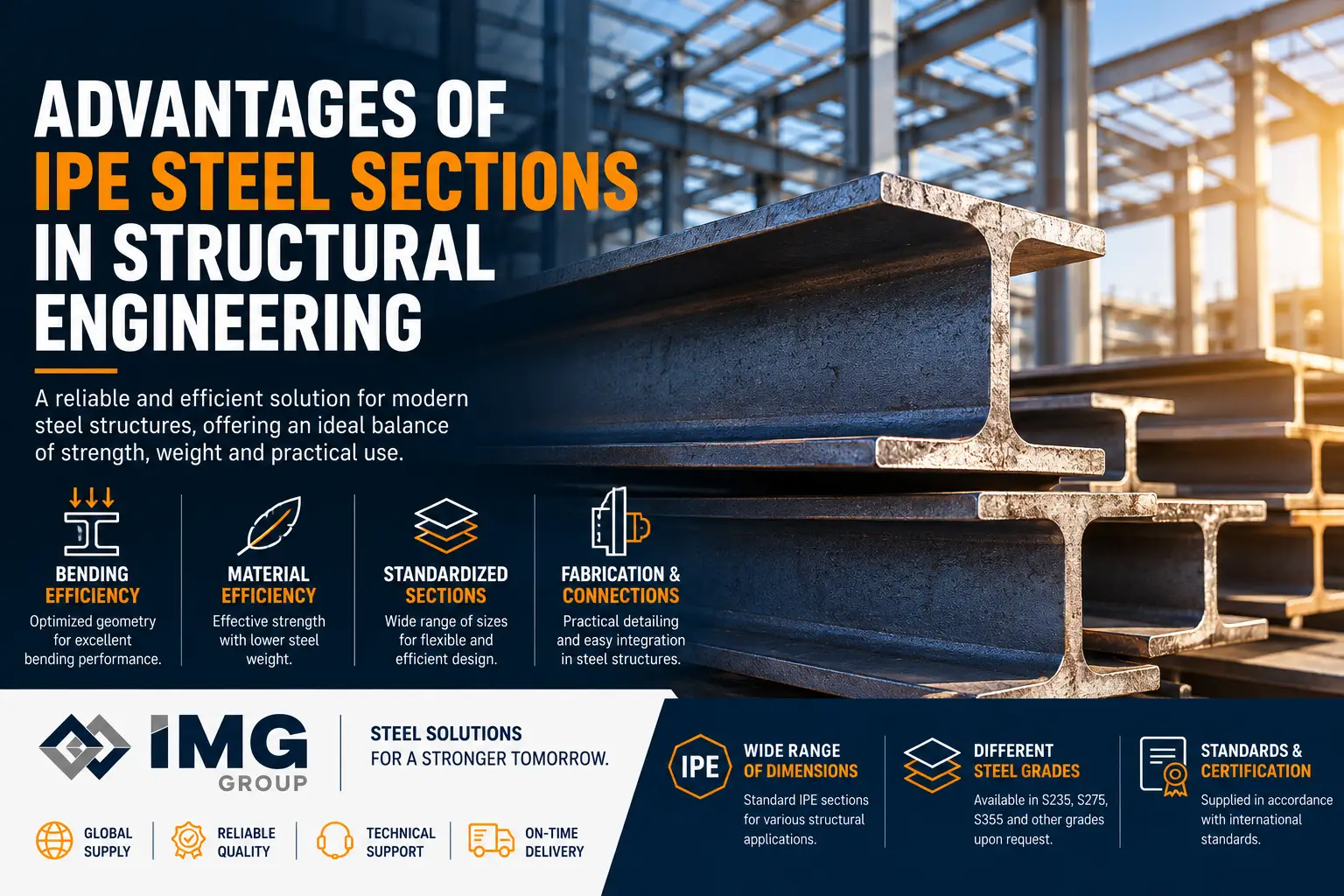
Structural steel design involves trade-offs between loadbearing capacity, stiffness, material efficiency, manufacturing requirements and overall project cost. IPE steel profiles are one of the standardised sections available to structural engineers and are frequently used in buildings, industrial facilities, infrastructure, platforms, supporting frames and many other steel structures.
The structural efficiency of an IPE section is inherently related to the specific I-shaped geometry. Most of the material is in the upper and lower flanges, distant from the neutral axis . The web joins the two flanges and is a major contributor to shear resistance . This distribution makes economical use of steel for IPE sections, especially in applications where bending about the primary axis is the dominating design condition.
Material efficiency is especially crucial in projects that have hundreds or thousands of structural parts. The selection of an appropriate section can meet the strength, stiffness, stability and serviceability requirements without the superfluous tonnage of steel. Reducing structural weight may also affect transportation, handling, manufacturing, lifting and installation needs.
Another key benefit is standardisation. IPE steel sections are manufactured in a broad range of standard sizes with established dimensions and section qualities. Engineers can select a suitable section for a certain structural application by taking into account criteria such as cross sectional area, mass per metre, moment of inertia, section modulus and radius of gyration. It also allows for cooperation across teams in engineering, procurement, fabrication and construction.
Just because IPE sections are popular does not mean they are the optimal solution for any structural member. Profile selection can be influenced by span, loading conditions, deflection restrictions, lateral-torsional buckling, connection design, steel grade, fire protection, corrosion exposure and fabrication requirements. For some applications, sections like HEA or HEB, channels, hollow sections or other structural steel products can be more appropriate.
Hence, the knowledge of the benefits of IPE steel sections in structural engineering involves more than the mere observation of their normal I-shaped geometry. The actual significance of their work is in the relation between the cross-sectional design, structural performance, standardised attributes, material usage and practical manufacture.
In this article we will look at how IPE sections are constructed, why their shape is structurally efficient, where they are widely used, how they compare with other structural steel sections and which variables should be considered when selecting the proper IPE section for a project.
What Is an IPE Steel Section?
IPE steel section is a common hot-rolled structural steel section with an I-shaped cross-section and parallel flange surfaces. The term “IPE” is often used to refer to a European series of I-sections which are designed to give efficient structural performance, particularly in applications where bending about the principal axis is the predominant design criterion.
It is a cross-section with two horizontal flanges and a vertical web connecting them. Although the form is rather simple, it is the distribution of material inside the section that makes the IPE-sections so effective as structural members.
Because the flanges are positioned away from the neutral axis of the section, they contribute to a significant portion of the resistance to bending moments. The web links the two flanges and provides a considerable contribution to shear resistance whilst maintaining the overall geometry of the section. This approach permits to provide structural performance without the uniform distribution of the same amount of material over the cross-section.
Standardized Dimensions and Section Properties
IPE steel sections are produced in standard sizes, and are typically designated by names such as IPE 100, IPE 200, IPE 300, IPE 400 and bigger sections. The number in the designation is normally about equal to the nominal section depth in millimetres, although actual measurements must always be checked from the relevant section tables.
With increasing section size further changes include in overall depth, flange width, web thickness, flange thickness, cross-sectional area and mass per metre. These dimensional variations directly affect structural parameters like moment of inertia, section modulus, radius of gyration, and buckling resistance.
Standardisation has a practical advantage of importance . Engineers can pick sections from standard structural tables rather than generating a fresh cross-section for every use. Fabricators and procurement teams can also work to internationally recognised section designations which simplifies specification, sourcing and project coordination.
Dimensional and sectional parameters of IPE products are usually referred to EN 10365 for European structural steel sections.
IPE Is a Section Type, Not a Steel Grade
Note that the IPE is not the steel grade.
IPE is about geometry and standard series of sections. The material to be used in the fabrication of that section is specified individually. IPE sections are supplied in structural steel grades S235, S275 or S355 depending on the project requirements and applicable standards.
Hence, the designation IPE 300 alone does not provide complete information about the material.
Two IPE sections may have the same nominal dimensions but are made of different grades of steel, and hence have differing strength-related material qualities.
The full specification should therefore consider both factors for structural design and procurement:
Section designation + steel grade
For example, choosing an IPE section with the correct structural steel grade enables the engineer to match established geometric qualities with the needed mechanical properties of the material.
The difference between section geometry and material strength is important in determining the benefits of IPE steel sections. The efficiency is not only due to the strength of the steel itself but also to the distribution of that material in the I-shaped cross-section relative to the forces operating on the structural element.
Why the IPE Cross-Section Is Structurally Efficient
The IPE steel section derives its structural efficiency mainly from the distribution of material in the cross-section. The I-shaped geometry is such that a large part of the material is in the upper and lower flanges, far away from the neutral axis, rather than near to the center of the section.
This arrangement is particularly useful if a structural member is loaded in bending about its primary axis. Under bending, one flange is mainly in compression and the other flange is mainly in tension.
The web joins the two flanges and transfers the shear stresses . It also keeps the two flanges at the correct distance from each other .
This can give the IPE geometry a considerable bending resistance and bending stiffness without the quantity of steel that would be required if the same material were spread out in a less efficient way.
Moment of Inertia and Bending Performance
A critical property that affects how a section behaves is its second moment of area, also called its moment of inertia. This geometric feature is connected with the distribution of cross-sectional area relative to a specific axis.
More material distant from the neutral axis increases the moment of inertia about the neutral axis. The somewhat deep geometry of an IPE section therefore assists it to withstand major-axis bending and to control deflection.
This relation can be reduced to:
Section Properties → Moment of Inertia → Bending Stiffness → Structural Efficiency
However, a deeper section does not inevitably mean that a certain IPE size is appropriate for a project. The necessary portion must be checked for bending resistance, shear resistance, deflection, stability, support conditions and any applicable design criteria.
The Structural Role of the Flanges and Web
The flanges and web act in a complimentary fashion.
The flanges are quite far from the neutral axis and provide a significant contribution to bending resistance. The distance between the flanges can have a significant effect on the bending characteristics of the section.
Meanwhile the web plays an important role in transmission of shear stresses and connecting the compression and tension flanges into a single structural segment. The thickness and depth also play a role in the local stability and the overall behaviour of the member.
This separation of structural functions can account for the common use of I-shaped sections for sections and other members when bending predominates.
Efficient Does Not Mean Efficient in Every Direction
An important limitation of the IPE geometry is that its structural properties are not equal about both principal axes.
IPE sections are considerably more efficient in bending about their major axis than about their minor axis. Their open cross-section also provides different torsional behaviour from closed sections such as SHS or RHS.
Consequently, lateral stability can become an important design consideration. A long, insufficiently restrained IPE section may be susceptible to lateral-torsional buckling, even when the cross-section itself has adequate bending resistance.
The spacing of lateral restraints, loading position, span, support conditions, connection details, and overall structural arrangement can therefore influence the usable capacity of an IPE member.
This is why the advantage of an IPE section should not be reduced to a simple claim that it is “strong for its weight.” Its real engineering advantage is more specific: the I-shaped geometry distributes steel efficiently for structural applications dominated by major-axis bending while maintaining a relatively economical section weight.
That combination of geometry, bending performance, standardized properties, and material efficiency forms the basis for the main advantages of IPE steel sections in structural engineering.
Main Advantages of IPE Steel Sections
IPE steel sections are well known in the discipline of structural engineering since they are a good compromise between structural performance, section weight, standardisation and ease of manufacture. Their geometry is particularly useful in situations dominated by bending and the standardised section series allows engineers to select an appropriate size for unique project requirements.
The benefits of IPE sections should however always be evaluated considering the whole structural system. Their function depends on span , direction of force , lateral restraint , connections , steel grade and other design factors .
High Bending Efficiency
One of the most important features of IPE steel sections is their good behaviour in bending about the principal axis.
The top and bottom flanges are positioned distant from the neutral axis so as to be effectively used in resisting tensile and compressive stresses resulting from the bending moments. The web maintains the spacing of the flanges and contributes significantly to shear resistance.
This material configuration allows the IPE sections to acquire a valuable bending resistance without the need for steel to be evenly distributed along the cross section.
This design may be a practical structural solution for sections supporting floor loads, roof loads, equipment loads, or other largely vertical activities.
Favorable Strength-to-Weight Performance
Structural efficiency isn’t just about increasing load bearing capacity. In many projects, engineers are trying to meet performance requirements while trying to keep a lid on the total amount of steel.
IPE sections lend themselves nicely to this purpose, as the shape concentrates material where it is beneficial in bending performance. A favourable relationship between mass per metre and structural capacity may be achieved by a suitable selection of IPE section.
This may have practical repercussions beyond the usage of material. Lower structural weight may minimise the overall tonnage to be carried, handled, lifted, constructed and installed.
The effect is particularly significant in large projects where the same or comparable portions are repeated hundreds of times over structural elements.
Nevertheless, the lightest piece that meets a fundamental strength calculation is not inevitably the optimum choice. The ultimate section size can be determined by deflection, lateral torsional buckling, vibration, connections, fire design and other considerations.
Standardized Dimensions and Predictable Section Properties
A further important advantage of IPE steel parts is standardisation.
IPE sections are supplied in standard sizes with defined dimensions and section qualities. For each segment, engineers can work with known values of features such as:
- mass per metre,
- cross-sectional area,
- moment of inertia,
- section modulus,
- radius of gyration,
- web and flange dimensions.
This simplifies the structural calculations and comparison, but also establishes a consistent technical language amongst engineers, steel suppliers, fabricators, contractors and procurement teams.
Standardised section designations can simplify material specifications and decrease misunderstanding during sourcing, particularly for international projects.
Fabrication and Connection Practicality
The geometry of IPE sections also offers practical advantages in manufacture.
Their comparatively basic web-and-flange configuration for many typical structural connections to be designed with plates, bolts, welds, stiffeners and other ordinary steelwork components.
Therefore, section-to-section and section-to-column connections can be produced by known fabrication processes.
The flat web provides a convenient surface for different connection arrangements. The flanges can be incorporated into moment-resisting or supporting elements depending on the structural design.
Standard dimensions also make planning for fabrication easier. The section sizes and geometries are specified in advance, which allows for a systematic arrangement of cutting, drilling, welding, assembly and quality-control procedures.
This does not mean that every IPE connection is intrinsically straightforward. High loads, moment connections, concentrated forces, complex geometry, or specialised seismic requirements may need the use of additional plates, stiffeners, or carefully constructed connection details.
These features together make IPE steel sections to combine effectively bending performance, material efficiency, standardised qualities and fabrication practicality. Such advantages are particularly noticeable when IPE sections are used as sections and other structural members where their cross-sectional geometry is well suited to the governing load conditions.
IPE Steel Sections and Structural Members
The geometry of the IPE steel sections is particularly suitable for the usage of sections. In many structural systems the sections are principally called upon to resist the bending and shear due to vertical stresses. This is very much in line with the properties of the IPE section, which has substantially higher stiffness and bending resistance along its major axis than about its minor axis.
For this reason, IPE sections are widely utilised for floor systems, roof structures, industrial platforms, supporting frames, mezzanines, equipment supports, as well as for many other typical steel constructions.
IPE Sections in Beam Applications
If an IPE section is utilised as a beam, the loads acting on the structure will generate bending moments and shear forces throughout its length. Flanges are the main elements for absorexample stresses due to bending, whereas the web is important for shear transfer.
The somewhat deep section design permits IPE beams to reach useful bending stiffness, without excess of material in the entire cross-section. This is one of the reasons they can provide an efficient solution for medium and longer spans depending on the loading conditions and structural arrangement.
But the beam selection is not only on bending resistance Deflection is a common and crucial serviceability criteria. The beam can be sufficiently resistant to the loads it is subjected to, but its deformation can be more than the one allowed by the design requirements.
Thus, the chosen IPE section is subject to both ultimate and serviceability limit states in accordance with the relevant structural design standards.
Lateral-Torsional Buckling Must Be Considered
Lateral-torsional buckling is a key design consideration for IPE sections.
IPE is an open section and a section loaded about its major axis may become unstable if the compression flange is not adequately constrained. The member may move laterally and twist before the complete bending resistance of the cross section is available.
The risk is a function of a number of parameters, such as the unrestrained length of the section, the position of the load, the moment distribution, the conditions of support, the features of the cross section, and the presence of lateral restraints.
In some situations the restraint may be provided by floor systems, supplementary sections, bracing or other structural components. In some cases extra stabilisation may be required.
This explains why selecting an IPE section only by glancing at a table of bending capacities can lead you astray. The member shall be examined as part of the total structural system.
Applications Beyond Conventional Sections
Although section applications are strongly associated with IPE sections, their use is not limited to horizontal members.
IPE sections can also be incorporated into frames, equipment supports, platforms, secondary structural members, and other load-bearing systems. They may also be used as columns in suitable applications, provided that the section satisfies the relevant compression and buckling requirements.
However, the geometry that makes IPE efficient for major-axis bending does not automatically make it the most efficient choice for every column.
Columns are strongly influenced by axial compression, effective length, slenderness, buckling about both principal axes, and connection conditions. In applications where substantial axial loads or greater resistance about the minor axis are important, wider-flange sections such as HEA or HEB steel sections may offer different structural advantages.
Section Selection Depends on the Structural System
You can not pick an IPE 200 or IPE 300 or IPE 400 only because you utilised it in a similar area in another project. Changes in stress, support conditions, lateral restraint, steel quality or serviceability requirements may mean that various sections are necessary even for structures with comparable spans.
Selection process may need to consider bending moment, shear force, deflection, lateral-torsional buckling, local resistance, connections, vibration, fire requirements, corrosion protection, and manufacturing circumstances.
Therefore, the main advantage of IPE steel sections is not that they are a universal solution for sections and structural members. An advantage of these systems is that they provide a standardised and materially efficient structural alternative when the geometric layout matches the governing load criteria.
This differential is especially essential when comparing IPE sections with other popular structural steel sections such as HEA, HEB, channels and hollow sections.
IPE vs. Other Structural Steel Sections
IPE steel sections are one of several standardized section families available for structural design. Their relatively narrow flanges and comparatively deep cross-section make them particularly efficient in many section applications, but other section geometries may provide advantages when the governing loads or structural requirements are different.
For this reason, comparing IPE steel sections with HEA, HEB, channel, and hollow sections should not be approached as a question of which section is universally stronger. The relevant question is which geometry uses steel most efficiently for the specific function of the structural member.
IPE vs. HEA and HEB Sections
IPE, HEA and HEB are all common hot rolled structural sections although with quite different cross sectional proportions.
IPE sections have also very shallow flanges compared to their depth. This makes the geometry of IPE sections particularly ideal for members where major axis bending is prominent. The HEA and HEB sections have broader flanges and varying proportions of the web and flanges giving them distinct characteristics in relation to their primary axes.
These changes can affect the resistance to bending, behaviour in buckling, weight of the section, design of connections and performance under axial compression.
Thus, IPE sections are often used for sections, while HEA and HEB sections are used for columns, frames and members where axial compression or performance about both primary axs is more significant.
This is not an inviolable rule. The final selection of the member shall always be based on structural calculations and the unique requirements of the member.
IPE vs. UPN and UPE Channels
UPN and UPE are open channel sections with a web and two flanges on the same side. Their geometry is well suited for secondary framing, edge members, supports, bracing systems and many other structural or manufacturing uses.
But a channel is not symmetrical around both primary axes, but an IPE section is. This influences its centroid, its shear center and its behaviour when subjected to eccentrically applied loads.
IPE sections thus offer a more direct solution for a large number of typical section applications needing symmetrical major-axis bending. Channels can be especially useful where their open geometry allows them to be easily attached to another structural element or where the project will notably benefit from a channel-shaped section.
IPE vs. Hollow Sections
Square Hollow Sections (SHS), Rectangular Hollow Sections (RHS) and Circular Hollow Sections (CHS) have a closed cross section with the material distributed around it. This means that they have other structural features compared to open IPE sections.
Closed hollow sections often have a much better torsional behaviour than open I sections and can be efficient if loads are acting in several directions. Due to their geometry, they are also attractive for columns, trusses, frames and architectural constructions and applications where an exposed appearance is vital.
IPE sections, however, concentrate material in the flanges to provide an efficient performance in major-axis bending. This can provide an efficient use of steel for a traditional section that is mostly supporting vertical loads.
Another big difference is connections. The web and flanges of an IPE section are open and provide suitable surfaces for many traditional bolted and welded connections. The limited access to the inside of the hollow part can need different connecting techniques.
Selecting by Structural Function, Not Section Name
The main differences can be summarized as follows:
| Section Type | Typical Structural Characteristic | Common Consideration |
|---|---|---|
| IPE | Efficient major-axis bending | Sections and bending-dominated members |
| HEA / HEB | Wider flange geometry | Columns, frames and combined loading applications |
| UPN / UPE | Open channel geometry | Secondary structures, supports and connection-oriented applications |
| SHS / RHS / CHS | Closed cross-section | Torsion, multidirectional loading, columns and exposed structures |
These features should be seen as generic propensities of engineering rather than selection rules.
The ideal structural section depends on the load direction, bending moments, axial pressures, shear, torsion, buckling length, lateral restraint, connections, fabrication requirements and the overall structural arrangement.
IPE steel sections are a particularly efficient solution if their major-axis bending efficiency can be fully exploited. In such situations the standard geometry might provide a favourable connection between structural performance and weight of section, an important consideration not only for engineering design, but also for total steel tonnage and project economies.
Weight, Cost and Material Efficiency of IPE Steel Sections
The economic worth of an IPE steel section can not be determined simply comparing the price per tonne of steel. Structural engineering influences the overall tonnage of steel, manufacture, transport, lifting and installation, based on the quantity of material necessary for the design criteria.
This makes the link between structural performance and mass per metre (kg/m) very significant when selecting an IPE section.
Why Section Weight Matters
The theoretical mass per metre for each standard IPE size is known. The increase in the section dimensions and thicknesses usually increases the section mass and thus its structural qualities.
For a single section a difference of few kilogrammes per metre may seem rather insignificant. In a major industrial building, warehouse, platform, or infrastructure project with hundreds of structural members, however, that variation can represent a significant shift in overall tonnage of steel.
The lower tonnage may also minimise material consumption and affect transportation and site handling requirements. It may impact on crane capacity, erection operations and other project logistics.
However, a reduction in section weight is of little benefit unless the member chosen still satisfies all the necessary structural criteria.
The Lightest IPE Section Is Not Always the Most Economical
While the lightest section to resist the calculated bending moment may appear to be the cheapest option, structural design is far more than simple bending resistance.
A lighter IPE section may be governed by excessive deflection or lateral-torsional buckling. It may require additional lateral restraints, more complex connections or other structural measures to offset the saving in lighter steel weight. For this reason, engineers should consider the cost implications of the complete structural system rather than optimising individual sections in kg/m only.
In some cases a slightly heavier section may simplify connections, reduce the need for additional bracing, improve serviceability performance or make fabrication and erection more straightforward.
Standardized Sections Support Material Optimization
The IPE series offers the advantage of several standardised section sizes with known geometric and structural features.
Engineers can compare various sections and assess the effect of variations in mass per metre on changes in moment of inertia, section modulus, shear resistance and other parameters.
Thus, it is possible to identify parts that comply with structural requirements without the use of extra material.
The relationship can be simply expressed as:
Section Selection → kg/m → Total Steel Tonnage → Fabrication → Transport → Installation → Total Project Cost
So the goal is not necessarily to minimise the first value in this sequence. Instead, the section selection should lead to an efficient result for the whole project.
Steel Grade Can Also Influence Material Efficiency
The steel grade is another element in the optimisation process. Use of a higher strength structural steel may allow use of a different size section, depending on the controlling design criteria.
But better yield strength does not indicate that a smaller IPE section may always be used.
Where the bending resistance is solely limited by material strength, there is room for optimisation with higher-strength steel. However, the scope for weight reduction may be more limited if the design is controlled by deflection, stability, lateral-torsional buckling, vibration or some other stiffness-related criterion.
It is consequently suggested that steel grade and section size should be considered jointly, rather than separately.
In the end, the most inexpensive IPE part is not the lightest alternative or the section with the lowest price per metre. It is the section that meets the requisite strength, stiffness, stability, serviceability, connection and manufacturing requirements with an efficient use of steel.
The main design criteria of the project are analysed all together to determine the optimal section of the project and the question arises on how to choose the correct IPE steel section for a particular structural application.
How to Select the Right IPE Steel Section
Selecting the appropriate IPE steel section is not just a matter of choosing a section based on span or nominal size. The member selected must meet the structural requirements of the project but also offer an optimal compromise between steel weight, fabrication, connections and installation. An
IPE section that performs well in one structure may not be suitable for another, even where the spans appear similar. Loads, support conditions, lateral restraint, steel grade, serviceability requirements and the overall structural system can all have a major influence on the section required.
Design Loads and Load Combinations
The first step in the selection process is to decide what loads the structural member will have to carry.
These can be permanent loads from the structure itself, imposed loads, equipment loads, snow, wind and other actions defined by the applicable design standard depending on the project. The applicable load combinations are then utilised to calculate design impacts such as bending moments, shear forces and axial forces.
Adequate resistance to these actions shall be provided for an IPE section under the design conditions required. But opposition is not enough to complete the selecting process.
Span, Deflection and Serviceability
The span has a significant impact on the needed IPE size. With increasing section spans, the bending forces and deformation may become increasingly significant.
This makes deflection one of the important criteria in the selection of IPE section. Even if a section has sufficient bending resistance, it may not be acceptable because the deformation exceeds the serviceability limit.
Excessive deflection can adversely damage floors, roofs, facades, equipment, finishes and other elements supported by the steel structure. In some situations, vibration may also need to be evaluated.
For this reason, section stiffness and moment of inertia are just as significant as strength.
Stability and Lateral Restraint
The stability of the member must also be considered.
An IPE section with an insufficiently restrained compression flange can be susceptible to lateral-torsional buckling. Similarly, an IPE member subjected to compression must be checked for buckling about the relevant axes.
The effective or unrestrained length, support conditions, bracing arrangement, loading position, and section properties can all influence stability.
A larger IPE section is therefore not automatically the solution to every stability problem. In some structures, modifying the restraint or bracing system can significantly change the behaviour of the member.
Connections and Fabrication Requirements
The chosen piece must also be efficient with the connection system.
Section-to-column connections, section-to-section connections, base features, end plates, stiffeners, fasteners and welds could alter the practicality of a specific IPE size. The web and flange dimensions must be such that there is sufficient space for the required connection details and the forces may be safely transferred.
You should also consider fabrication early on. Other aspects that may influence the overall suitability of a section are cutting, drilling, welding, surface treatment, transport lengths and erection procedures.
An optimum structural member which leads to an unnecessarily complex production or erection may not be the most economical alternative for the whole project.
Steel Grade and Project Requirements
The IPE designation determines the section geometry. The steel grade needs to be provided individually.
Varied grades like S235, S275 and S355 have varied strength characteristics and may affect the section needed by the structural calculations. The applicable grade shall be determined as per the applicable product standard, design requirements, fabrication methods and project specifications.
There may be other project-specific criteria such as corrosion protection, fire protection, impact qualities, surface condition, dimensional tolerances and material documentation.
So, for example, specifying merely “IPE 300” for purchase is not enough. The whole demand should define the necessary section, steel grade, appropriate standard, length, quantity, and any extra technical or documentation needs.
Ultimately, choosing the optimum IPE steel section involves matching the section geometry and material qualities to the actual behaviour required from the structural element. The aim is not to select the largest, strongest or lightest section but to select the IPE section that will meet the strength, stiffness, stability, serviceability, fabrication and economic criteria of the project in the most effective way possible.
The Structural Advantages of IPE Steel Sections
IPE steel sections are frequently used in structural engineering, since the geometry of these sections offers a good compromise between bending behaviour, the weight of the structure, standardisation, ease of production and the overall efficiency of the material.
The sections have a characteristic I-shaped cross-section, meaning that a large amount of the steel is situated in the flanges, far from the neutral axis. This configuration makes IPE sections exceptionally effective in resisting major axis bending, the web also contributing significantly to shear resistance and tying the two flanges into one structural element.
This structural efficiency is why IPE sections are commonly utilised in sections, floor systems, roof structures, industrial buildings, platforms, supporting frames, equipment structures and other steel construction applications.
Another great benefit of standardisation is there. IPE sections are available in a wide range of sizes which are recognised and have defined dimensions, theoretical mass per metre, section area, moment of inertia, section modulus and other engineering qualities. This would allow structural engineers to systematically analyse alternatives and will facilitate communication between designers, steel suppliers, fabricators, contractors and procurement teams.
But the benefits of IPE sections do not mean it is a universal answer.
A member that is efficient for major-axis bending may need to be checked again if minor-axis bending, axial compression, torsion, or lateral instability are considerable. The ultimate choice of section might be influenced by span, loads, deflection, lateral-torsional buckling, restraint circumstances, connections, steel quality, manufacturing requirements, corrosion protection and fire design.
Therefore, the material efficiency should be examined in terms of the whole construction. The aim is not only to select the lightest possible IPE part. Neither is it always superior engineering to pick a bigger or greater strength portion. The correct solution is the section that satisfies the specified strength, stiffness, stability, serviceability and fabrication requirements and is economical in steel.
There is also an economic aspect to this distinction. Optimized section selection can influence not only steel tonnage but also fabrication, transportation, lifting, erection, and connection requirements. For projects with hundreds or thousands of structural elements, relatively slight changes in kg/m can be important on a project-wide basis.
In the final analysis, the advantage of IPE steel sections for structural engineering is that they combine standard geometry with efficient structural performance. These cross-sections can provide a practical and inexpensive solution for a wide variety of steel structures, where the features of the
IPE cross-section correlate to the governing loads and structural system.
IMG Group provides IPE steel sections in various sizes and structural steel grades for construction, industrial, infrastructure and international engineering applications. The IPE steel supply can be adapted to project-specific requirements, with section size, steel grade, quantity, length and quality documents aligned with engineering specifications and procurement demands.