


Blog
Round vs Square Aluminium Handrails: How to Choose in 2026

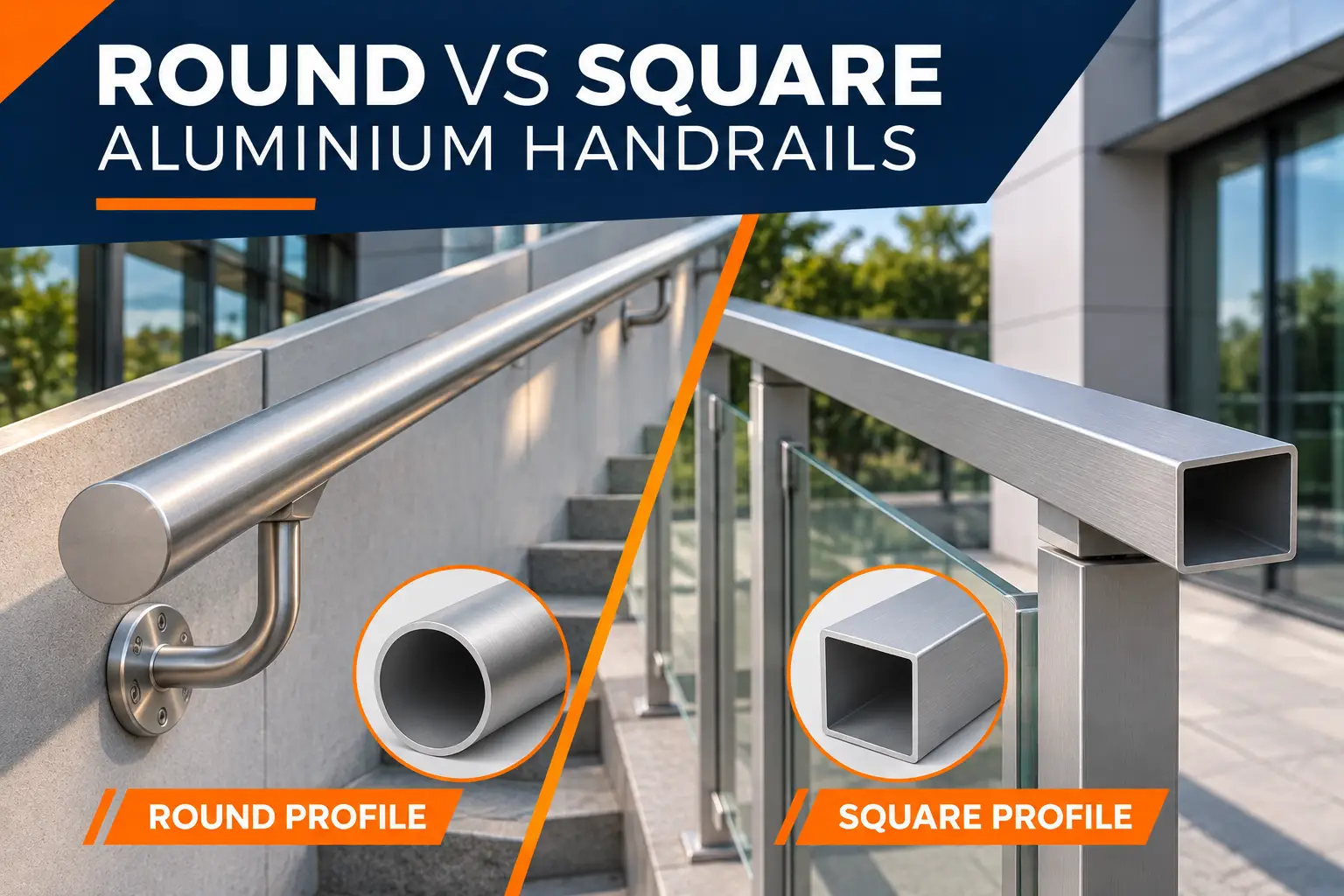
Choosing a handrail profile is not just a question of which shape looks better. Handrails in residential, commercial, industrial and public settings are meant to provide safety to users, accessibility and the overall look of a structure. The cross-sectional geometry can influence their grip comfort, their connection to supporting components and their performance under load.
Among the available options, round aluminium handrails and square aluminium handrails are widely used because they offer different combinations of functionality, aesthetics and installation flexibility. Round profiles are often associated with comfortable gripping and smooth architectural lines, while square profiles are frequently selected for their geometric appearance and compatibility with contemporary railing systems.
However, neither shape is the best choice for every application, automatically. The correct choice depends on the purpose of use, applicable building regulations, dimensions of the profile, material properties, support arrangement and environmental conditions.
This guide compares round and square aluminium handrails, discusses their practical differences and looks at the factors that should affect choice of profile for architectural and structural applications.
What Are Round and Square Aluminium Handrails?
Aluminium handrails are components designed to provide support and guidance for people using stairs, ramps, walkways and other circulation areas. They may be installed directly onto walls or incorporated into larger railing and guardrail assemblies.
The terms round and square refer to the cross-sectional geometry of the handrail profile. Although both types can be manufactured from aluminium alloys, their shapes influence how they are handled, connected and integrated into a finished structure.
Round Aluminium Handrails
A round aluminium handrail is circular in cross-section and is usually made as a hollow tube or as part of a specially designed extrusion.
The curve delivers consistent grip geometry throughout the entire circumference. Therefore round profiles are so popular for staircases, access ramps and other places where users need a continuous handhold.
Round profiles are also used in architectural railing systems where the smooth look fits in well with many building styles.
Depending on the application, the handrail may be secured to brackets, posts or other supporting members by means of mechanical fasteners, welded joints or compatible fittings.
Square Aluminium Handrails
A square aluminium handrail has a square cross-section with generally four flat faces and corners that may be sharp, chamfered or rounded depending on the product design.
Square profiles are often used in modern architectural projects where straight lines and geometric forms are the main design elements.
They can be incorporated into square post railing systems, rectangular frames and other angular structural elements.
However, the application of a square profile for a handrail that is to be grasped must be carefully considered. Its size, corner shape and distance from adjacent surfaces can affect comfort of grip and accessibility compliance.
Therefore the use of square aluminium profiles as top rails or guardrail members should not be assumed to satisfy the requirements for a dedicated handrail.
Round vs Square Aluminium Handrails: Key Differences
Although round and square aluminium handrails can serve similar architectural purposes, their practical characteristics are not identical.
| Feature | Round Aluminium Handrails | Square Aluminium Handrails |
|---|---|---|
| Cross-sectional shape | Circular | Square |
| Grip characteristics | Continuous curved gripping surface | Flat surfaces with corners |
| Architectural appearance | Smooth, curved and versatile | Angular, geometric and contemporary |
| Common applications | Stairs, ramps, wall-mounted handrails and railing systems | Architectural railings, balconies and modern railing assemblies |
| Connection details | Often use curved saddles or round-profile fittings | Can use flat-faced brackets and square-profile fittings |
| Profile orientation | Circular section has equal bending properties in all directions | Bending properties depend on the cross-section and loading orientation |
| Accessibility considerations | Often easier to configure as a graspable handrail | Requires closer attention to grip dimensions and corner geometry |
| Finishing options | Anodising, powder coating and other suitable treatments | Anodising, powder coating and other suitable treatments |
The largest difference is that the handrail geometry influences the user interaction as well as the structure design.
Round profiles often offer a more natural handhold as the user’s fingers can wrap around a continuous curved surface. Square profiles have a different architectural appearance but may require further evaluation when the rail needs to act as a compliant gripping surface.
But you can’t tell how well it will perform structurally from its shape alone. Wall thickness, profile dimensions, aluminium alloy, support spacing and connection details all influence resistance and stiffness of the finished assembly.
Grip Comfort, Safety and Accessibility
The primary difference between round and square handrails is how users interact with their surfaces.
A handrail is not just any horizontal architectural element. It has to reliably support people in stair climexample, ramp descending or moving in areas where balance assistance is needed in many applications.
Why Round Handrails Are Common for Stairs and Ramps
Curved handrails are widely used in circulation areas, as their rounded surfaces enable users to wrap their fingers around the profile.
This can give a comfortable and secure gripping arrangement when the diameter, mounting height and clearance are suitable.
The continuous round surface also avoids the sharp corners that are present in some square profiles. This may be more comfortable for repeated use, especially in buildings with high pedestrian traffic.
But not all round tubes are suitable for use as a handrail.
A diameter that is too large may be difficult to grip and a diameter that is undersized may not meet the applicable requirements. The correct dimensions depend on local building and accessibility codes.
For projects subject to accessibility standards, designers must check handrail diameter or gripping profile, wall clearance, continuity and termination details are permitted before selecting a product.
Can Square Aluminium Handrails Be Used Safely?
Square aluminium profiles can be used in railing assemblies, but depending on the design, they may not be suitable as specific handrails.
Because of the flat surfaces and distinct corners, some of the square parts might not be as comfortable to grip as round profiles of an appropriate size.
This does not mean that noncircular handrails are prohibited. Some building codes allow noncircular gripping profiles provided the dimensional and clearance characteristics are defined.
However, a large square top rail, designed for appearance only, may not provide an acceptable handhold.
In these cases, the designer may opt to add a separate round handrail to the square railing system.
This ensures that the architectural structure can maintain its angular appearance and offers a gripping element that meets the relevant accessibility requirements.
It is particularly important to distinguish between a handrail and a guardrail. A handrail is intended to help users . A guardrail is intended to mainly reduce the risk of falling from an elevated edge . In some assemblies both functions are performed but each applicable requirement must be met.
Structural Strength and Profile Geometry
The structural performance of an aluminium handrail is not only dependent on the shape of the cross section, round or square.
Both geometries can offer enough resistance if designed correctly, but they have different mechanical properties according to the dimensions of the section and the distribution of material.
Bending Resistance and Stiffness
Under lateral or vertical forces a horizontal handrail will have bending moments and deflection between its support points.
The resistance to these effects is a function of the profile cross-sectional properties.
Two parameters that are especially important are the second moment of area, which affects bending stiffness, and the section modulus, which affects bending stress and resistance.
For a simplified elastic bending state:
σ = M / W for bending stress
Where σ is the bending stress, M is the applied bending moment, and W is the elastic section modulus about the appropriate bending axis.
A profile with a larger section modulus will usually carry a given bending moment with less elastic bending stress, assuming the material is the same and the structural assumptions are appropriate for the comparison.
The advantage of round hollow sections is that they have uniform bending characteristics in all directions through the center of the circular cross-section.
The bending properties of square hollow sections are identical about the two principal centroidal axes, although the structural behaviour under combined loading and local effects is influenced by the actual geometry and the connection arrangement.
So it would be wrong to say that round profiles are always stronger than square profiles or vice versa.
To be able to make a meaningful comparison you need the actual outside dimensions, wall thickness, aluminium alloy and loading conditions.
Wall Thickness and Support Spacing
Another important consideration when choosing aluminium handrails is the wall thickness.
Too thin-walled a profile may suffer from excessive deformation or local damage, especially around brackets, posts or fixing points.
However, the increase in wall thickness also increases the material consumption and weight.
The distance between supports is no less important. A longer span between brackets or posts on a handrail will typically experience more bending and deflection under similar loads.
So the same aluminium profile may be suitable for one support arrangement, but not for another.
For both round and square aluminium handrails the entire assembly must be considered: profile, brackets, posts, fasteners and supporting structure.
Aluminium Alloys, Surface Finishes and Corrosion Resistance
Architectural railing systems often feature aluminium as a favoured material due to its relative lightness, corrosion resistance and the fact that it can be produced in many different methods.
Aluminium extrusion also enables the production of profiles of various dimensions and geometries.
The properties of the finished handrail however depend on the alloy and temper selected.
Choosing the Appropriate Aluminium Alloy
Aluminium alloys of the 6xxx series find frequent application in architectural extrusions.
6063 aluminium is often linked with architectural profiles due to its extrusion properties and capability to be finished in decorative surface finishes.
6061 aluminium is another alloy to be used for structural applications where its mechanical properties and manufacturing characteristics are suitable.
The actual strength of a profile is a function of alloy and temper as well as effects of fabrication and joining processes.
Therefore, material specifications should not be based on alloy number alone. Also to be taken into consideration are the required temper, mechanical properties, manufacturing method and applicable product standards.
Anodised vs Powder-Coated Aluminium Handrails
We have round and square aluminium handrails available in a range of surface finishes.
Anodising gives a controlled oxide coating on the surface of aluminium and can improve durability and appearance if properly specified.
Powder coating offers a wide choice of colour and finish options, and is often used for architectural applications where the handrail needs to match other elements of the building.
For example, black powder-coated square aluminium handrails are common in modern building design, while satin-finished or anodised round profiles can offer a more understated appearance.
The chosen finish should be appropriate for the environment of exposure, the look desired, the anticipated maintenance and the coating specification.
Corrosion resistance is of special importance in coastal or industrial environments. Aluminium usually resists atmospheric corrosion well, but durability problems may still arise in aggressive environments, or where connections are unsuitable or detailing is poor.
Where aluminium is connected to stainless steel or other metals the risk of galvanic corrosion should be assessed especially where moisture or salt is present.
Installation and Connection Differences
Installation requirements can also play a role in the decision between round and square aluminium handrails, particularly in projects where long runs of railing, corners or more complex architectural layouts are involved.
Connecting Round Aluminium Handrails
Round profiles often require special fittings to match the round surface.
These may include wall brackets, post-mounted saddles, elbows, end caps and mechanical connectors, depending on the system.
Round handrails may be particularly suitable for continuous gripping arrangements. Matching curved fittings may facilitate smooth transitions around changes in direction.
But the quality of these transitions depends on the design of the fitting and the method of installation.
Where a continuous handrail is required, joints should not form unnecessary projections or interruptions that interfere with the grasp.
Connecting Square Aluminium Handrails
Flat exterior surfaces on square profiles can simplify some bracket and connection geometries.
Their sharp angles can also tie in visually with square posts and rectangular structural frames.
This makes square aluminium profiles interesting for modular railing systems with repetitive geometric elements.
But corners and changes in direction require proper fittings or fabrication details. Badly designed joints can create visible misalignment or uncomfortable edges.
The system design can be made using round or square profiles and can be assembled by mechanical connections or by welding.
When welding aluminium the influence of heat on the material properties is to be considered. For some heat-treated alloys, welding can reduce strength in the heat-affected zone. Thus, design of connections and structural verification should consider the applicable material condition.
Maintenance and Long-Term Performance
It is not just the cross-sectional shape that determines the maintenance required, but rather the finish, exposure conditions, the connection details and the quality of the installation.
Round handrails have a smooth continuous surface. Square profiles can have corners and flat upper faces where dirt or water can accumulate depending on orientation and detailing.
In either case, proper drainage, fastening components, and accessible inspection points can help ensure long-term durability.
Regular inspection should include looseness, surface damage, corrosion around dissimilar-metal contacts, and other signs of deterioration.
Aesthetic Differences: Modern Architecture vs Practical Design
Apart from structural and functional issues, the appearance of the handrail is often a key factor in the choice of material.
Round and square aluminium profiles create very different visual effects even when they are made from the same alloy and are finished in the same colour.
Round Handrails for Smooth Architectural Lines
Round aluminium handrails generally provide a more pleasant visual impression.
The curved geometry can be a perfect complement to staircases, ramps, pedestrian walkways and architectural environments that call for smooth transitions.
They can also work well with glass balustrades and minimalist structures as the shape provides a visual continuity without pronounced edges.
Round profiles are a good starting point for a project when user comfort and a continuous gripping surface are important.
Square Handrails for Contemporary Structures
Square aluminium handrails are a popular choice for modern architecture that features straight lines, sharp angles and distinct structural elements.
They can easily blend with square posts, rectangular frames, and geometrical details on the facade.
Dark powder-coated square profiles are common in contemporary residential and commercial railing designs.
However, visual compatibility should not be more important than functional requirements.
A separate compliant handrail may be needed if the square top rail does not meet the applicable gripping requirements.
So the most successful architecture is not the one in which shape comes first, but the one that brings together appearance, safety and structural performance.
Cost and Material Efficiency: Which Profile Is More Economical?
Cost of round vs square aluminium handrails? The shape alone will not be the difference in cost.
The final price is influenced by a number of factors, including alloy specification, wall thickness, profile dimensions, extrusion complexity, surface treatment, quantity of order and installation requirements.
Standard round tubes may be readily available in certain sizes while square hollow sections may have advantages when integrated into compatible modular railing systems.
Availability is subject to market and supplier though.
The cross-sectional properties required for the project also affect the material efficiency.
If an additional bracket is required or the spacing of the supports or connections are more complicated then the profile with the lower weight per metre may not be the most economical solution.
Similarly a heavier profile could be justified if the overall structural layout becomes more simple and the performance requirements are met.
Therefore the evaluation for commercial and industrial projects should consider the total installed system and not only the unit price of the aluminium profile.
The final cost can be affected by transport, fabrication, surface finish, connection components and installation labour.
How to Choose Between Round and Square Aluminium Handrails
The intended use of the finished system determines the most suitable handrail profile.
Round aluminium handrails can be a practical choice for staircases and ramps and in circulation areas where a secure and comfortable handhold is essential, provided their size and fixing details meet the relevant accessibility requirements.
Square aluminium profiles may provide stronger visual compatibility with the surrounding structure for contemporary architectural railings, balconies and geometric guardrail assemblies.
But the design needs to differentiate between a decorative or protective top rail and a designated graspable handrail.
The structural requirements also need to be evaluated before a final decision can be made.
All of the profile dimensions, wall thickness, alloy and temper, support spacing, applied loads and connection details must be coordinated to ensure the assembly performs as intended.
Environmental exposure is another factor. For outdoor installations, special consideration may be required for surface treatment, drainage, fastening materials and corrosion protection.
Standardisation can also help improve manufacturing and installation efficiency for projects with repeated railing sections. The use of compatible profiles and connection components can minimise the unnecessary complexity of fabrication and ease the assembly at site.
Ultimately, the decision should be based on the entire railing system, not just the look of a single aluminium tube.
Conclusion: Round or Square Aluminium Handrails?
Comparison of round vs square aluminium handrails doesn’t lend itself to a one-size-fits-all answer.
Aluminium continuous round handrails offer a curved hand grip surface and are often used for stairways, ramps and other applications where comfortable hand support is important.
Square aluminium handrails give a geometric look which is particularly appropriate for modern architectural railing systems and angular structures.
Both profiles can provide a reliable performance if their dimensions, material properties, connections and supporting arrangements are well designed.
The trick is to choose the geometry that meets the function desired, while also being compliant to the applicable structural, accessibility and durability requirements.
For architects, contractors, railing manufacturers and procurement teams, considering such factors early in the project can help to avoid compatibility issues, unnecessary fabrication work and unsuitable material choices.
IMG Group is conscious of the importance of selecting the aluminium profiles according to the specific technical requirements of each project. In a project where round or square aluminium sections are required, the consideration of factors such as profile dimensions, material specifications, surface finish and supply consistency should be taken together.
Looking for aluminium profiles for your next project? Contact IMG Group to discuss your technical requirements and explore suitable aluminium profile supply options.