


Blog
What Are HEB Profiles? Types, Sizes and Structural Applications in 2026

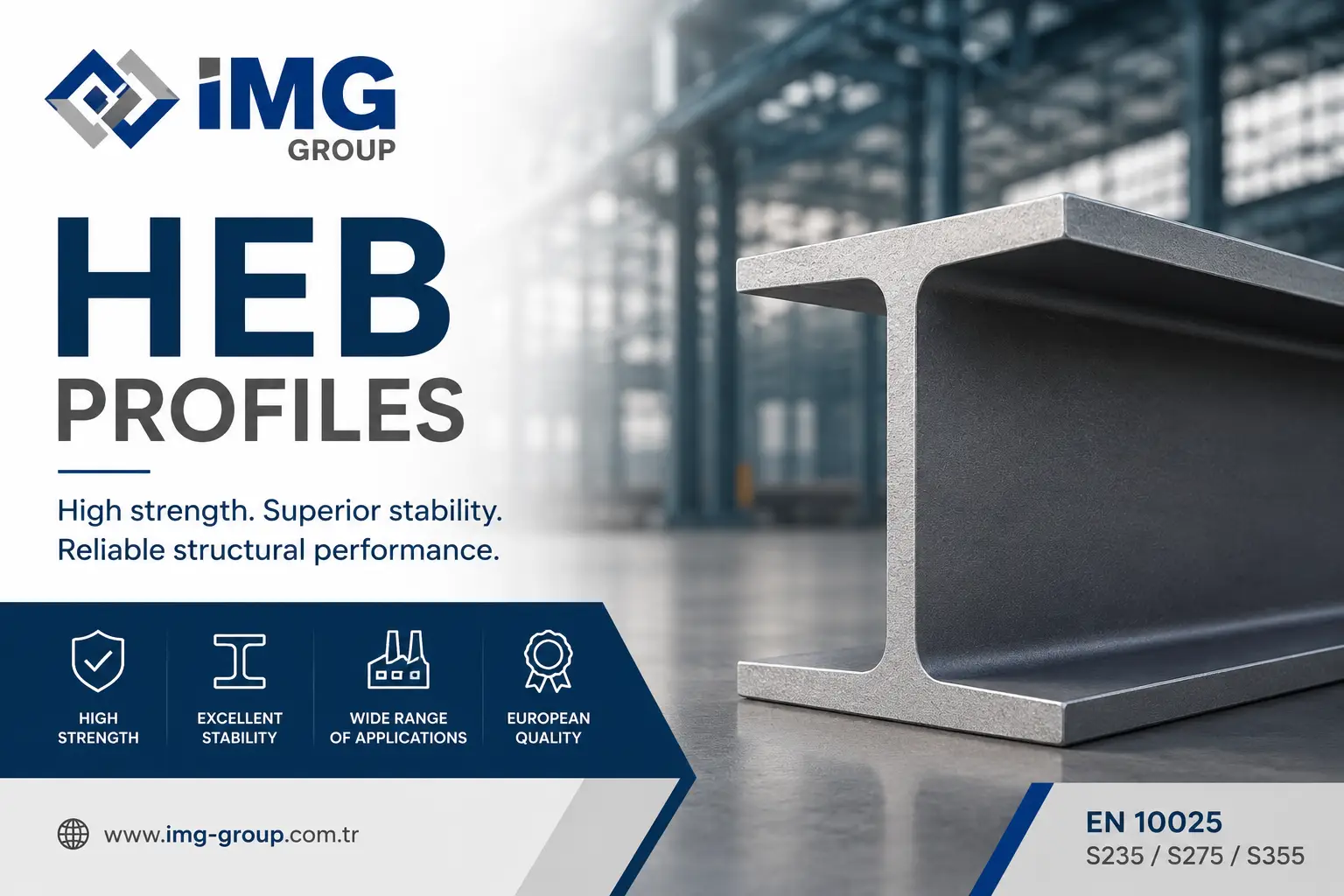
HEB profiles are among the most commonly used structural steel profiles for projects that require high strength, outstanding stability and dependable long term performance. HEB profiles are made with a wider flange and thicker web than lighter types of profiles. This enables them to carry higher structural loads while still providing excellent rigidity. These properties make them a popular choice for columns, primary beams, transfer structures and other critical load-bearing elements in modern steel construction.
Manufactured to European standards and typically available in steel grades such as S235, S275 and S355 (EN 10025), HEB profiles are widely used in industrial, commercial and infrastructural projects. Its strength, durability, ease of fabrication and flexibility allow engineers to design safe and efficient structures that can withstand demanding service conditions. In manufacturing facilities, warehouses, bridges, energy plants or large commercial developments, HEB profiles deliver reliable structural performance for the life of a project.
HEB profiles are often compared with HEA profiles and IPE profiles, but each profile type is designed for different structural requirements. The appropriateness of the profile is determined by factors such as load capacity, span length, connection design, and overall structural arrangement. Understanding HEB profile properties and applications enables engineers, fabricators and project managers to make informed decisions while optimising both performance and cost.
This guide will tell you what HEB profiles are, what their dimensions and technical specifications are, their advantages and common structural applications, compare them with other European structural steel profiles and give you practical advice on how to choose the right HEB profile for your next construction or industrial project.
What Are HEB Profiles?
HEB profiles are standardised European structural steel profiles with an H-shaped cross-section designed to provide high load-bearing capacity and excellent structural stability. HEB profiles have wider flanges and a thicker web than lighter profiles, allowing them to withstand higher bending moments, compressive forces and axial loads. Their strong geometry makes them one of the most common choices for heavy duty structural applications where strength and durability are essential.
HEB profiles are produced according to European standards and are normally made from structural steel grades to EN 10025, such as S235, S275 and S355. These steel grades offer different levels of strength and mechanical properties, so engineers can select the right material for the project. These standards, along with the tight dimensional tolerances, ensure that HEB sections provide consistent quality and reliable structural performance in a wide variety of applications.
One of the typical features of HEB profiles is the balanced design of the cross-section. Its flanges are relatively thick, providing greater resistance to bending, while the reinforced web increases the profile’s ability to efficiently transfer vertical and horizontal loads. Thus HEB profiles are particularly suited for structures with high static or dynamic loads because they are more rigid than lighter types of profiles.
Compared with other types of profiles, the HEB profiles are more often used as structural columns, main beams, transfer beams and supporting members in steel construction due to their higher load-carrying capacity. They are common in industrial facilities, logistics centers, commercial buildings, bridges, manufacturing plants, energy projects and infrastructure projects where structural safety and long-term reliability are critical.
Another major advantage of the HEB profiles is their good compatibility with fabrication. They are easy to cut, drill, weld, bolt, galvanise or coat to meet specific project requirements. This versatility simplifies fabrication and installation, aiding engineers to achieve efficient structural solutions without sacrificing strength or durability.
Today, HEB profiles are considered as one of the basic profiles of structural steel which are used in modern construction. Their combination of high mechanical performance, dimensional consistency and compliance with the European standards, make them a reliable solution to projects that require both structural efficiency and long service life. Knowing these characteristics is the first step in choosing the proper HEB profile for any engineering application.
HEB Profile Dimensions and Technical Specifications
HEB profiles come in standard sizes according to European standards, which ensures compatibility in structural design, fabrication and construction projects. Their regular geometry enables engineers to make accurate structural calculations and fabricators to produce uniform steel assemblages with uniform connection details. This dimensional consistency is one of the reasons why HEB profiles are extensively specified in commercial, industrial and infrastructure projects throughout Europe and many international markets.
HEB profiles are available in a wide range of sizes, typically from HEB 100 up to HEB 1000, although availability can vary depending on the manufacturer and regional supply. Larger profile sizes increase the section height, flange width, web thickness, flange thickness, and weight. Profiles with a greater size have more structural capacity and stiffness, so they can be used in applications with greater spans, heavier loads or more demanding engineering requirements.
The structural behaviour of a HEB profile is determined by several key dimensions. The section height affects its resistance to bending and its overall rigidity, while the flange width adds stability and helps the profile to effectively distribute loads. The web thickness increases shear resistance and the flange thickness increases the resistance of the profile to bending moments and concentrated loads. Together these geometrical properties allow the HEB profile to perform reliably over a wide range of loading conditions.
Another important specification is the weight per metre, which is different for different profile sizes. While heavier HEB profiles generally provide higher load bearing capacity, they also affect costs of transportation, handling, fabrication and installation. So, in addition to the performance of the structure, engineers consider weight to strike an efficient compromise between strength and project economics.
In addition to their physical dimensions, the HEB profiles are defined by a number of important cross-section properties, such as cross-section area, second moment of area (or moment of inertia), section modulus and radius of gyration. These engineering values are important for structural analysis as they describe the behaviour of the profile under bending, compression and buckling loads. These properties are used by structural engineers to check that steel structures are safe, stable and fit for purpose.
The mechanical behaviour of a HEB profile is also dependent on the steel quality chosen. Profiles in S235, S275 or S355 structural steel according to EN 10025 have different yield strengths and mechanical properties. By selecting the appropriate steel grade and the correct profile size, designers can optimise structural performance and meet project specifications and applicable building codes.
The HEB profiles are available in standard dimensions, but the right size should be selected based on detailed design calculations not on visual estimation or experience from previous projects. All of these influence the final choice of profile : applied loads , span length , support conditions , connection details , service requirements , etc. For this reason, HEB profiles should always be specified as part of a complete structural design prepared according to the engineering codes and project requirements in question.
Benefits of HEB Profiles
HEB profiles are very popular in structural engineering because they combine high strength with great stability and long-term durability. Due to their strong cross-sectional design, they can carry much higher loads than lighter structural profiles, making them a dependable choice for projects where safety and structural integrity are paramount. Used for industrial facilities, commercial buildings and infrastructure developments, HEB profiles offer the strength necessary for demanding engineering needs.
One of the most important advantages of HEB profiles is their high load-bearing capacity. The larger flanges and thicker web distribute the structural forces more efficiently, so the profiles can resist heavy bending moments, axial loads and compressive forces. This makes them particularly well suited for columns, primary beams and other structural members that carry large loads throughout a building or industrial structure.
The HEB profiles also show good structural stability. The H-shaped balanced design reduces the risk of over deflection and enhances the overall rigidity in both static and dynamic loading conditions. Hence, HEB profiles are often specified by engineers for structures with long spans that require reliable performance or those subjected to continuously varying loads.
Another great advantage is their versatility in structural applications. HEB profiles are used in a wide range of projects: warehouses, workshops, bridges, substations, logistics centers, renewable energy facilities, etc. Their standardised dimensions allow them to be used with common structural connections and they can be easily incorporated in simple and complex steel structures.
From the point of view of manufacturing, HEB profiles are very practical. They are easily cut, drilled, welded, bolted, galvanised and coated using standard steel fabrication techniques. This flexibility allows for easier manufacturing and installation, reduces production time and helps contractors maintain uniform construction quality.
Also the HEB profiles are very durable when combined with an appropriate corrosion protection system. Their resistance to moisture, chemicals and harsh environmental conditions can be significantly enhanced by hot dip galvanising, protective coatings or special paint systems. This makes HEB profiles an excellent choice for indoor and outdoor applications, including projects situated in demanding industrial or coastal environments.
Moreover, they are in accordance with contemporary engineering standards. HEB profiles are produced according to EN 10025 and are available in the standard structural steel grades S235, S275 and S355. This standardisation gives engineers, fabricators and project owners confidence in the specification of materials and compliance with European construction requirements.
Structural design efficiency with HEB sections. Their high strength enables engineers to meet the required load bearing performance without unnecessarily increasing the number of structural members. In many cases this leads to more efficient use of steel, easier fabrication and more efficient construction processes, ultimately enhancing technical performance and overall project efficiency.
Common Structural Applications of HEB Profiles
HEB profiles are used in a wide range of structural applications where high strength, stability and long term reliability are required. They are able to carry heavy loads and still retain their rigidity . Which makes them one of the most versatile structural steel profiles in modern construction . Where high load bearing performance is required without compromising on structural efficiency, engineers will often specify HEB profiles for their projects.
Industrial buildings are one of the most common uses of HEB profiles. Manufacturing plants, production facilities and heavy industrial complexes often require structural members that can support overhead cranes, heavy equipment and large roof systems. Thanks to the high load capacity of HEB profiles, these structures can safely withstand permanent and operational loads for many years of service.
HEB profiles are also popular in warehouses and logistics centres. Distribution centers today are usually built with expansive floor space and few interior columns, so they can hold as much as possible and allow for a range of operations. HEB profiles can carry large loads over long spans which means engineers can design efficient structural systems that have fewer supporting members but are still stable.
Commercial buildings commonly specify HEB profiles for primary structural frames, transfer beams and heavily loaded columns. Structural members are required for supporting multi-storied and complex architectural arrangements in many office buildings, shopping centers, exhibition halls, sports facilities and the like. HEB profiles are robust and stiff, which makes them perfect for these applications that demand a lot.
HEB profiles are also widely used in infrastructure projects. Steel profiles in bridges, transport terminals, railway facilities and public buildings must safely withstand constant traffic loads, environmental forces and long-term fatigue. The standardised dimensions and predictable structural behaviour of HEB profiles make them a reliable option for infrastructure projects where safety and durability are paramount.
Another important field of application is the energy sector. HEB profiles are often used for power plant, renewable energy facilities, substations and heavy equipment support structures. Their ability to support high static and dynamic loads makes them ideal for supporting turbines, transformers, process equipment and other critical infrastructure in the production and distribution of energy.
HEB profiles are also equally important in heavy engineering and machinery support structures. Industrial platforms, maintenance structures, conveyor systems and foundations of equipment are subjected to concentrated loads and continuous operational stress. HEB profiles have a very strong geometry that provides the stiffness and structural integrity needed in these demanding environments.
HEB profiles are manufactured in standard sizes and are compatible with standard manufacturing processes, and can be integrated into a broad variety of structural systems. Whether welded or bolted, the dimensional uniformity of these products simplifies fabrication and installation, enabling contractors to maintain construction quality and project efficiency.
HEB profiles are among the most reliable structural steel profiles on the market today, and this is evidenced by the wide range of applications. But choosing the right profile is much more than a question of standard size. The load requirements, the span lengths, the steel grades and the project specific design criteria all have to be carefully evaluated.
How to Choose the Right HEB Profile
HEB profiles are used in a wide range of structural applications where high strength, stability and long term reliability are required. They are able to carry heavy loads and still retain their rigidity . Which makes them one of the most versatile structural steel profiles in modern construction . Where high load bearing performance is required without compromising on structural efficiency, engineers will often specify HEB profiles for their projects.
Industrial buildings are one of the most common uses of HEB profiles. Manufacturing plants, production facilities and heavy industrial complexes often require structural members that can support overhead cranes, heavy equipment and large roof systems. Thanks to the high load capacity of HEB profiles, these structures can safely withstand permanent and operational loads for many years of service.
HEB profiles are also popular in warehouses and logistics centres. Distribution centers today are usually built with expansive floor space and few interior columns, so they can hold as much as possible and allow for a range of operations. HEB profiles can carry large loads over long spans which means engineers can design efficient structural systems that have fewer supporting members but are still stable.
Commercial buildings commonly specify HEB profiles for primary structural frames, transfer beams and heavily loaded columns. Structural members are required for supporting multi-storied and complex architectural arrangements in many office buildings, shopping centers, exhibition halls, sports facilities and the like. HEB profiles are robust and stiff, which makes them perfect for these applications that demand a lot.
HEB profiles are also widely used in infrastructure projects. Steel profiles in bridges, transport terminals, railway facilities and public buildings must safely withstand constant traffic loads, environmental forces and long-term fatigue. The standardised dimensions and predictable structural behaviour of HEB profiles make them a reliable option for infrastructure projects where safety and durability are paramount.
Another important field of application is the energy sector. HEB profiles are often used for power plant, renewable energy facilities, substations and heavy equipment support structures. Their ability to support high static and dynamic loads makes them ideal for supporting turbines, transformers, process equipment and other critical infrastructure in the production and distribution of energy.
HEB profiles are also equally important in heavy engineering and machinery support structures. Industrial platforms, maintenance structures, conveyor systems and foundations of equipment are subjected to concentrated loads and continuous operational stress. HEB profiles have a very strong geometry that provides the stiffness and structural integrity needed in these demanding environments.
HEB profiles are manufactured in standard sizes and are compatible with standard manufacturing processes, and can be integrated into a broad variety of structural systems. Whether welded or bolted, the dimensional uniformity of these products simplifies fabrication and installation, enabling contractors to maintain construction quality and project efficiency.
HEB profiles are among the most reliable structural steel profiles on the market today, and this is evidenced by the wide range of applications. But choosing the right profile is much more than a question of standard size. The load requirements, the span lengths, the steel grades and the project specific design criteria all have to be carefully evaluated.
HEB Profiles vs HEA Profiles vs IPE Profiles
The HEB profiles, HEA profiles and IPE profiles are some of the most commonly used structural steel profiles in Europe. All of them are designed to carry structural loads but each profile has a different cross sectional geometry and is meant for specific engineering applications. Knowing these differences enables engineers and project managers to select the most efficient profile for a given structure.
HEB profiles are designed for applications where high load-bearing capacity and excellent structural stability are required. They have wider flanges and thicker webs which give them greater resistance to bending and compression than the lighter profile types. These features are suitable for heavily loaded columns, main beams, transfer beams, industrial buildings, bridges and other structures where the strength is a main design consideration.
HEA profiles are similar to HEB profiles, but they are lighter in weight for the same nominal size. They are a cost effective solution for structures with moderate loading conditions due to their thinner flanges and lower weight. Engineers often specify HEA sections for commercial buildings, warehouses, office developments and general structural applications where the reduced self weight allows a more efficient overall design without compromising structural safety.
IPE profiles are very different from HEB and HEA profiles. They have narrower flanges and a relatively slender cross section. This makes them especially efficient in resisting bending for beam applications. IPE profiles are not generally used as heavily loaded columns but as floor beams, roof beams, secondary structural members and as framing members in residential, commercial and industrial buildings. They are also lighter, making them easier to transport, fabricate and install.
The choice of one or the other of these profile types is dictated by the structural requirements of the project. HEB profiles are often the preferred choice for maximum strength, rigidity and load-bearing capacity. If the main objective is to reduce the structural weight and still maintain a reliable performance, HEA profiles could be a more economical alternative. The IPE profiles are usually the most suitable for beam applications where the main design criterion is efficient bending behaviour.
There is no one structural steel profile that is better than any other. Each profile is intended for efficient use in specific loading conditions and structural configurations. The most appropriate solution should always be determined on the basis of structural calculations, applicable design norms and technical requirements of the project. The right choice of profile not only provides structural safety, but also promotes material efficiency, ease of fabrication and cost optimisation of the entire project.
With this knowledge, engineers can specify the most appropriate structural steel profile for each application. Finally, we will conclude with the main features of HEB profiles and discuss their continued importance in today’s steel construction.
Abstract
HEB profiles are among the most reliable structural steel profiles used in modern construction, providing the strength, stability and durability needed for demanding engineering applications. The H-shape geometry with high load bearing capacity and good bending and compression resistance makes them a preferred solution for projects where structural performance and long-term reliability are important.
HEB profiles are made to EN 10025 and available in structural steel grades such as S235, S275 and S355, and are widely used in industrial facilities, commercial buildings, bridges, infrastructure developments and energy projects. Their standardised dimensions and uniform mechanical properties enable engineers to design safe, efficient, and code compliant steel structures for a broad spectrum of applications.
Selecting the appropriate HEB profile is more than just picking a standard size. The most suitable profile for a project depends on various factors including load conditions, span length, steel grade, exposure to environmental conditions and fabrication requirements. The HEB profiles, correctly defined by structural calculations and engineering standards, represent the best compromise between strength, safety and cost.
We have in IMG Group HEB profiles of high quality, which correspond to European standards and satisfy the needs of industrial, commercial and infrastructure projects. Our experienced team can help you to choose the right structural steel profiles for building construction, manufacturing facilities, renewable energy projects or large scale engineering developments. Whatever you need structural steel profiles for, we can help you select the right solution for your technical and commercial requirements.