


Blog
How to Select Steel Profiles for Ground-Mounted Solar Farms in 2026

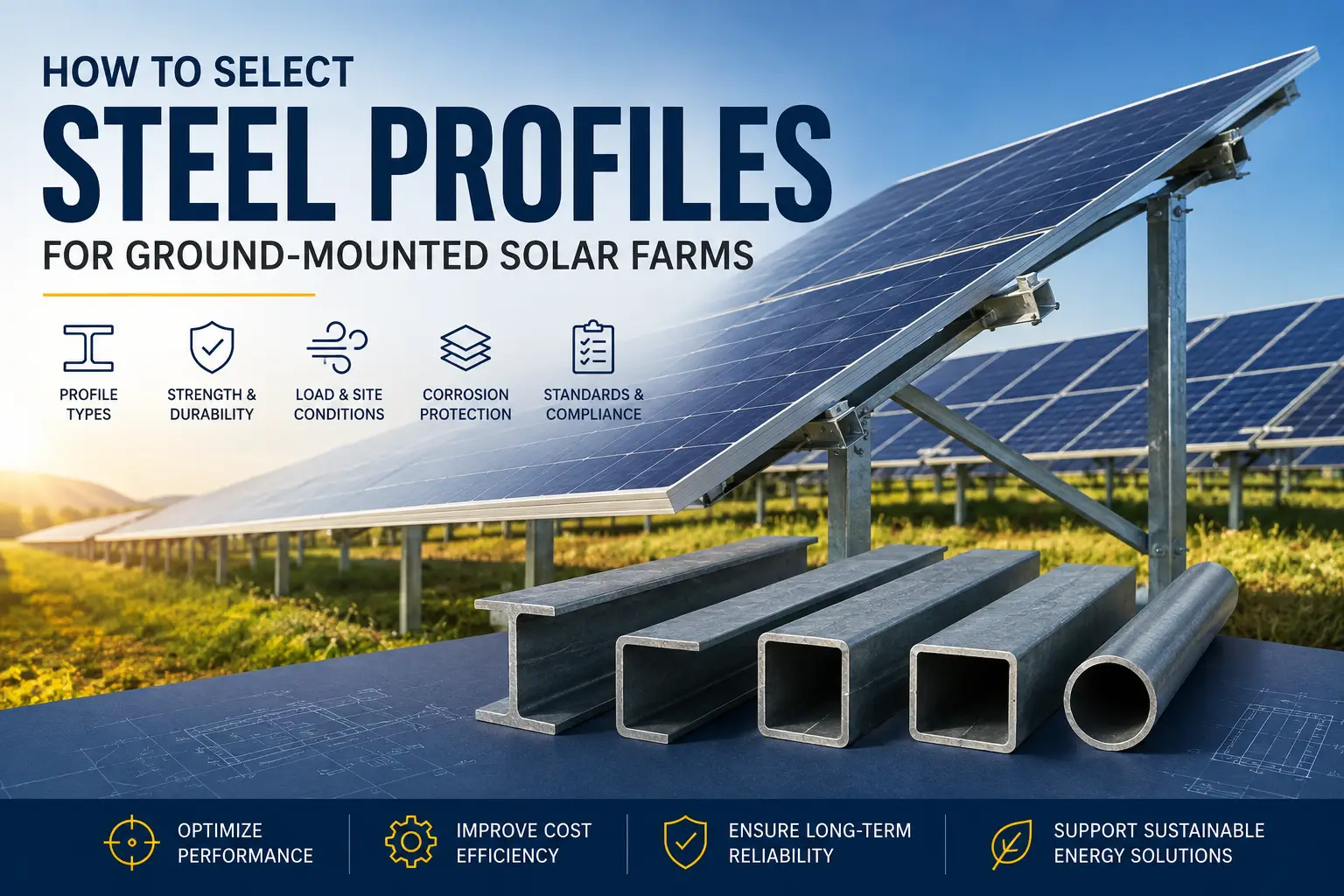
As the world moves towards renewables, the ground-mounted solar farms are getting bigger and more complex. Utility-scale photovoltaic (PV) projects are expected to operate reliably for decades while maximising energy production across a wide range of environmental conditions. The achievement of these goals depends not only on the performance of the solar modules and electrical equipment, but also on the quality of the structural support system that carries them.
All ground-mounted solar farms depend on a precision engineered steel framework designed to withstand wind, snow, seismic forces, thermal expansion and continuous loads that are generated throughout the life of the system. The structural steel profiles in this framework are directly responsible for the safety, durability, installation efficiency and long-term maintenance costs of the entire project. During the engineering phase of a well designed PV system, inappropriate steel profiles can create unnecessary structural challenges.
Therefore, the choice of steel profiles is much more than just choosing a standard structural section. Engineers need to consider the loading conditions, the foundation design, the soil characteristics, the corrosion risks, the span lengths, the design standards to be used and the type of mounting system to be used. These factors impact not only structural integrity of the installation, but also the total lifecycle cost and return on investment of the installation.
Modern solar farms can be made up of a variety of structural components including HEA profiles, HEB profiles, IPE profiles, UPE profiles, steel hollow sections, spiral foundation pipes, torque tubes and bespoke cold formed steel members. Each component has a particular structural function and selecting the right profile for the right application is essential to achieve an efficient and reliable support system.
This guide addresses the selection of steel profiles for solar farms mounted on the ground, including the most common types of profiles, the engineering factors influencing the choice of profile, corrosion protection measures, applicable European standards and best practices for the design of durable and cost-effective solar mounting structures. These principles will help EPC contractors, structural engineers, project developers, procurement professionals and other industry stakeholders to make informed decisions that will support the long-term success of utility-scale solar projects.
Why Steel Profile Selection Matters in Ground-Mounted Solar Farms
The structural performance of a ground-mounted solar farm is a function of the combined behaviour of all elements of its support system. Photovoltaic modules generate electricity, however, it is the steel structure beneath them that keeps the installation stable, safe and operational for its design life. This is why the selection of the appropriate steel profiles is one of the most important engineering decisions made during the planning and design phases of a solar project.
Unlike conventional steel structures, solar mounting systems are always subjected to changing environmental conditions. Every day, variable loads act on the support structure from wind, snow, temperature fluctuations and ground movement. The forces are transmitted via the steel profiles to the foundations, and it is the task of the structural framework to ensure the integrity of the installation and the precise positioning of the solar modules.
The proper profile selection begins with the understanding of the structural demands of the project. Each profile must provide adequate strength and stiffness while being as material-efficient as possible. Oversized profiles increase the steel consumption, transport costs and installation time, while undersized profiles may lead to excessive deflection, reduced structural stability or even premature failure during extreme loading conditions. The goal is not to choose the biggest steel profile, but to choose the most appropriate profile for each structural element.
The construction efficiency is also affected by the choice of steel profiles. Standardised profiles, suitable for modern fabrication and connection methods, facilitate manufacturing, transportation and on-site assembly. Efficient profile selection leads to fewer structural components, less installation time and reduced total project costs, without compromising structural safety.
Another big issue is durability, over the long term. Ground-mounted solar farms are usually designed for a lifespan of more than 25 years with little maintenance. Structural steel profiles must therefore preserve their mechanical performance after long exposure to rain, humidity, ultraviolet radiation and, in some places, coastal salt or industrial pollutants. The choice of the right profile and the use of an effective corrosion protection system help increase the service life and reduce the maintenance requirements during the entire operational life of the solar farm.
From an economic point of view, the selection of the steel profile has a direct effect on the total cost of ownership. * Material costs are just one part of the investment. Transportation, fabrication, installation, maintenance and possible future repairs all contribute to the total lifecycle cost of the structure. Good profile selection is a matter of balancing these factors, so that project developers are able to optimise the structural performance and long-term financial returns.
But, every project has its own environmental conditions and engineering requirements, so there is not a single steel profile that works for every solar farm. The engineers should take into account the structural loads, soil conditions, foundation systems, mounting configurations, corrosion exposure, and the applicable design criteria to choose the best solution.
Main Structural Components of Ground-Mounted Solar Farms
A ground mounted solar farm is an engineered structural system where each component serves a specific function. Engineers use different structural members, not only one type of steel profile, to safely transfer the loads from the photovoltaic modules to the foundations. It is important to understand the role of each component to be able to choose the most suitable steel profile for a project.
Support Posts
Main vertical load bearing members of ground mounted solar structure are the support posts. They transfer the weight of the entire mounting system, PV modules, wind loads and snow loads directly to the foundations or driven piles. During their service life, these members are subjected to compression, bending and lateral forces and must therefore have adequate strength and stiffness under all conditions of use.
Depending on the project requirements, the support posts can be made of HEA profiles, HEB profiles, hollow structural sections or specially designed cold-formed steel profiles. The final choice is based on the structural calculations, foundation design, the soil conditions, and the expected environmental loads.
Primary Beams
The support posts are joined by primary beams to form the main horizontal framework of the solar mounting structure. Their main role is to distribute loads evenly across the support system, while maintaining the integrity of the entire structure.
These members are mainly resistant to bending Engineers often specify IPE profiles , HEA profiles or HEB profiles depending on span length and loading requirements . “Selecting the correct beams minimises movement of the structure and keeps the photovoltaic modules in exactly the right position for the life of the project.
Secondary Rails
Secondary rails provide the direct connection between the steel structure and the photovoltaic panels. These members support individual solar modules while maintaining the required spacing and alignment specified by the mounting system manufacturer.
Although secondary rails carry lower structural loads than primary beams, they must still provide adequate rigidity to prevent excessive movement caused by wind or thermal expansion. In many projects, galvanized cold-formed steel sections are preferred because they combine low weight, good corrosion resistance, and fast installation.
Bracing Members
Bracing members increase the overall stability of the support structure by resisting lateral forces generated by wind and other dynamic loading conditions. Without adequate bracing, even properly sized beams and columns may experience excessive movement under changing environmental loads.
Depending on the structural configuration, engineers may specify UPE profiles, angle bars, hollow structural sections, or custom bracing components. Properly designed bracing systems improve structural rigidity while reducing stress concentrations throughout the steel framework.
Foundation Elements
The performance of any solar mounting system ultimately depends on how structural loads are transferred into the ground. Foundation elements are therefore just as important as the steel profiles used above ground.
Ground-mounted solar farms commonly utilize driven steel piles, spiral foundation pipes, or reinforced concrete foundations, depending on soil conditions and project requirements. Selecting the appropriate foundation system ensures that vertical loads, uplift forces, and overturning moments are safely transferred to the ground while minimizing long-term settlement.
Torque Tubes (Solar Tracker Systems)
Torque tubes are the most important structural part in solar tracker systems with a single axis. Several photovoltaic tables are connected by these tubular steel members, which rotate simultaneously with the tracking system as it follows the sun throughout the day.
Unlike conventional beams, the torque tubes must sustain continuous torsional loading and maintain very precise alignment along the entire tracker row. Their stiffness directly affects tracking accuracy, structural stability, and the long-term reliability of the mechanical drive system. So, to guarantee smooth operation and minimise structural fatigue for decades to come, it’s essential to select the correct diameter, wall thickness, and steel grade.
These structural elements together constitute a complete support system capable of withstanding environmental loads and maintaining photovoltaic modules in the ideal position. Each element serves a different structural purpose, so engineers seldom use one profile type for the entire installation. Instead, they blend different steel profiles to achieve the optimal compromise between strength, durability, constructability and cost effectiveness.
Key Engineering Factors for Selecting Steel Profiles
The choice of the appropriate steel profile for a ground-mounted solar farm is a question of a holistic engineering approach and not just a profile with the highest load capacity. The final design is dictated by the environmental conditions of the project, structural requirements and economic constraints. The goal is to have a structure that is safe, durable, cost effective and capable of maintaining reliable performance over its expected service life.
Structural Loads
The first stage of profile selection is to determine the loads, which the support structure has to carry. Engineers take into account the self-weight of steel structure, photovoltaic modules, mounting components and cable systems, external loads such as wind, snow, maintenance activities and, where appropriate, seismic actions.
Wind load is often the dominant design criterion for ground-mounted solar farms of these. Big photovoltaic arrays create high uplift and lateral forces that may affect the steel structure and the foundation system. Choosing profiles with sufficient rigidity reduces the deflection of the structure and keeps the exact positioning of solar modules for various wind conditions.
Foundation Design and Soil Conditions
Ground conditions cannot be separated from structural performance. The type of foundation and the steel profiles that will be required for the support structure are influenced by the soil bearing capacity, settlement characteristics, groundwater levels and geotechnical stability.
Construction on firm ground can be accelerated and concrete use reduced through the use of driven steel piles or helical foundation pipes. In more difficult soil conditions , foundations may need to be reinforced or structural members may need to be heavier to distribute loads more effectively .
Since the interaction of the foundation and steel structure is very important, geotechnical investigations should always be performed before the final profile selection.
Span Length and Structural Configuration
The size of profile required is directly affected by the spacing of the support posts. Longer spans produce larger bending moments and structural deflection, necessitating the use of larger or more robust steel profiles to ensure adequate stiffness.
Longer span lengths can reduce the amount of foundations needed across the solar farm, but can often increase the loading on the primary structural members. Instead, engineers try to find the best compromise between the cost of the foundation and the cost of the steel.
Steel Grade Selection
Choosing the right steel grade is just as important as choosing the right profile geometry. Structural steel manufactured to EN 10025, including S235, S275 and S355, has different mechanical properties for different engineering applications.
For some applications, higher strength grades, such as S355, can increase the load bearing capacity or reduce the weight of the steel. However, the selection of the steel grade has to be evaluated together with the requirements of the fabrication, welding procedures, project specifications and general structural design and not just the strength.
Corrosion Protection
Since ground-mounted solar farms are outdoors and are expected to last for decades, corrosion protection is one of the most important design considerations. Structural steel is invariably exposed to moisture, ultra-violet rays, temperature fluctuations and, in some locations, coastal salt spray or industrial pollutants.
That’s why steel profiles are often protected with hot-dip galvanising according to EN ISO 1461. In extremely aggressive environments, extra protective coating systems may be specified to further extend service life and lower maintenance requirements.
Choosing corrosion resistant structural components early in the project greatly improves lower lifecycle costs and improved long term reliability.
Installation Efficiency
Profile selection is also influenced by construction efficiency. Standardised structural profiles allow easier fabrication, transport and assembly on-site, and reduce installation time and labour costs.
EPC contractors can accelerate construction without compromising structural quality by using profiles that integrate seamlessly with bolted connection systems and modular mounting structures. This is especially true for utility scale solar farms that require the installation of tens of thousands of structural components on tight project schedules.
Lifecycle Cost
Never select a profile solely on the basis of the material price. The total cost of a solar mounting structure includes the cost of fabrication, transportation, installation, maintenance and long-term operational performance.
A structurally optimised design often reduces lifecycle costs, even with slightly higher initial material costs. Selecting high quality, well designed steel profiles contributes to the reduction of long-term maintenance, increases the service life and maximises the return on investment for the solar project.
These engineering factors are closely interrelated, and therefore the choice of steel profiles should be based on detailed structural calculations, and not on standard assumptions. The most successful ground-mounted solar farms achieve an efficient balance between structural performance, durability, constructability, and long-term economic value.
Fixed-Tilt vs Single-Axis Solar Tracker Systems
One of the most critical choices in the design of a ground-mounted solar farm is the choice of mounting system. Today, utility-scale photovoltaic projects use either fixed-tilt structures or single-axis solar tracker systems. Both systems are intended for safe support of photovoltaic modules, but the structural behaviour is quite different, which directly affects the type and dimensions of the steel profiles used.
Fixed-Tilt Structures
The modules in a fixed-tilt system remain at a constant tilt angle throughout the year. The structural system is relatively simple. There are no moving parts, therefore its main purpose is to resist the static loads of the environment, such as wind, snow and the selfweight of the installation.
This simpler configuration allows engineers to optimise the steel structure for material efficiency and ease of installation. Support posts, primary beams and bracing members are designed for site-specific loading conditions and the lack of moving parts usually means lower maintenance and long-term operating costs.
Fixed-tilt systems are common for commercial and utility-scale solar farms where reliability, speed of construction and lower front-end investment are the primary goals.
Single-Axis Solar Tracker Systems
Single-axis tracker systems enhance energy production by rotating photovoltaic modules continuously throughout the day to track the sun’s movement. This increases the annual energy yield but also introduces additional structural and mechanical challenges to be considered in the profile selection.
Unlike fixed structures, tracker systems are subject to repeated operational movement in addition to environmental loads. Components like torque tubes, solar tracker tubes, bearings and drive mechanisms are subjected to constant cyclic loading during many years of operation. Therefore structural members must be stiffer, but also keep precise alignment over long rows of tracker.
Wind loading is more complex for tracker systems. The aerodynamic forces acting on the structure are changing continuously as the modules are changing orientation during a day. In severe weather conditions the tracker systems are normally moved to a stow position that is intended to minimise wind exposure but the underlying steel structure still has to be able to withstand large uplift and lateral forces safely.
For these reasons, engineers often specify heavier support members or higher strength steel grades in tracker installations than would be needed for similar fixed-tilt systems.
Structural Considerations
Though the operating principles of the two systems are different, the engineering objective is the same: to maintain structural stability while minimising material usage and lifecycle costs.
Fixed-tilt systems generally have simple structural configuration, less mechanical components and less maintenance. They are often chosen for projects where performance predictability and construction efficiency are key.
In contrast, single axis tracking systems need a more sophisticated structural design. The interaction of the support posts, torque tubes, solar tracker tubes and the tracking mechanism needs to be investigated in detail to ensure precise movement, fatigue resistance over the long term and reliable operation over the whole life of the system.
Choosing the Right System
There is no single solution that is better than all the rest. The suitable system depends on the particulars of the project, such as land availability, climate, wind conditions, expected energy production, investment strategy, and maintenance objectives.
Choosing the right steel profiles is critical to structural performance whether a project employs fixed-tilt or single-axis tracker technology. Well-designed support structures enhance installation efficiency, increase service life, reduce maintenance costs and help maximise the long-term return on investment of ground-mounted solar farms.
European Standards and Corrosion Protection Requirements
The long-term performance of a ground-mounted solar farm depends not only on the structural design but also on the quality of materials and manufacturing processes used during the project. Steel sections exposed to outdoor environments for decades must meet accepted engineering standards that ensure uniform mechanical properties, reliable fabrication and effective corrosion protection. Meeting these standards lowers risks in construction and enhances the safety, durability and service life of solar mounting systems.
EN 10025 – Structural Steel Grades
EN 10025 is one of the most important standards for structural steel. It defines the technical delivery conditions for hot-rolled structural steel products. It specifies the mechanical properties, chemical composition and quality requirements for structural steel grades that are commonly used in solar projects such as S235, S275 and S355.
The selection of steel profiles manufactured according to the standard EN 10025 guarantees predictable structural behaviour and provides engineers with trustworthy material properties for structural calculations. This uniformity becomes critical for utility-scale solar farms where thousands of structural components are required to work together in unison across the entire installation.
EN 1090 – Fabrication and CE Compliance
EN 10025 describes the steel and EN 1090 describes the requirements for manufacturing and execution of components of structural steel.
It covers factory production control, welding procedures, dimensional tolerances, inspection processes and quality management systems. Structural elements manufactured in accordance with EN 1090 bear CE marking, which proves their compliance with the European requirements applicable to the construction of steel structures.
EN 1090 has become the standard for structural steel and aluminium components. Specifying EN 1090 compliant components benefits EPC contractors and project developers by helping to ensure consistent fabrication quality, easier installation and full traceability throughout the supply chain.
EN ISO 1461 – Hot-Dip Galvanizing
Corrosion protection is an important aspect of structural design as ground-mounted solar farms are exposed to the permanently outdoor environment. The most common solution is a hot dip galvanising according to EN ISO 1461.
This standard prescribes requirements for galvanised coatings applied to fabricated steel products including coating thickness, surface quality, inspection and acceptance criteria. A durable layer of zinc protects the underlying steel from corrosion for many years even in harsh environmental conditions, if the steel profile is properly galvanised.
Hot-dip galvanised structural steel is a great balance of durability, maintenance and lifecycle cost for most utility-scale photovoltaic projects.
Selecting the Right Corrosion Protection System
Hot-dip galvanising is appropriate for most solar projects but environmental conditions should always be evaluated prior to the selection of the final corrosion protection system.
Solar farms near the coast are under constant attack from salty air, while industrial areas may have airborne chemicals that accelerate corrosion. Fertilisers, humidity and other contaminants in an agricultural environment can also create an aggressive environment.
In such cases, the engineer may specify additional protective coating systems or increased thickness of galvanising to achieve the desired service life. Choosing the correct protection scheme during design will help to minimise future maintenance without affecting the structural integrity of the mounting system.
Why Standards Matter
Conformity to recognised European standards is far more than just regulatory compliance. Certified structural steel provides consistent material quality, predictable fabrication, enhanced traceability and increased confidence at every step of a project from engineering and procurement to construction and long-term operation.
“These standards reduce technical risks and facilitate lower maintenance costs and improved lifecycle performance of utility-scale solar farms expected to operate for more than twenty-five years.
However, even if high quality materials are specified, engineering decisions in the profile selection are still critical. In our final section, we will look at the main principles for selecting steel profiles and how the right structural solution contributes to the creation of safer, more cost-effective and durable ground-mounted solar farms.
Conclusion
Choosing suitable steel profiles for a ground mounted solar farm is a critical engineering decision having a direct effect on the structural safety, construction efficiency and long term project performance. Each structural component, including support posts, main beams, torque tubes and foundation elements, should be selected according to its particular function, the anticipated loading conditions, and the environmental obstacles that the installation will encounter during its operational lifetime.
Choosing profiles successfully is much more than simply comparing dimensions or steel weights. Engineers must consider structural loads, span lengths, soil conditions, mounting system configuration, steel grades, corrosion protection and applicable European standards as part of a comprehensive design process. These factors combine to form a support structure that offers reliable performance, while optimising material usage and life cycle costs.
The long-life and quality of structural materials is essential for utility solar projects, with certified structural steel produced to EN 10025, fabricated according to EN 1090 and EN ISO 1461 hot-dip galvanised, providing the peace of mind that comes with a consistent structural quality. Together with precise engineering calculations and the right choice of profile, these norms help to ensure the safety and efficiency of solar mounting systems for decades to come.
At IMG Group we provide renewable energy projects with high quality structural steel solutions such as HEA Profiles, HEB Profiles, IPE Profiles, U Profiles, Hollow Sections, Spiral Foundation Pipes, Solar Tracker Tubes, Torque Tubes, Magnelis C Profiles and a wide range of steel components for PV systems. Thanks to our industry expertise and certified materials, we enable EPC contractors, engineers and project developers to create high-performance, cost-effective and long-lasting ground-mounted solar farms that are tailored to the needs of modern renewable energy infrastructure.