


Blog
What Are HEA Profiles? Types, Sizes and Structural Applications in 2026

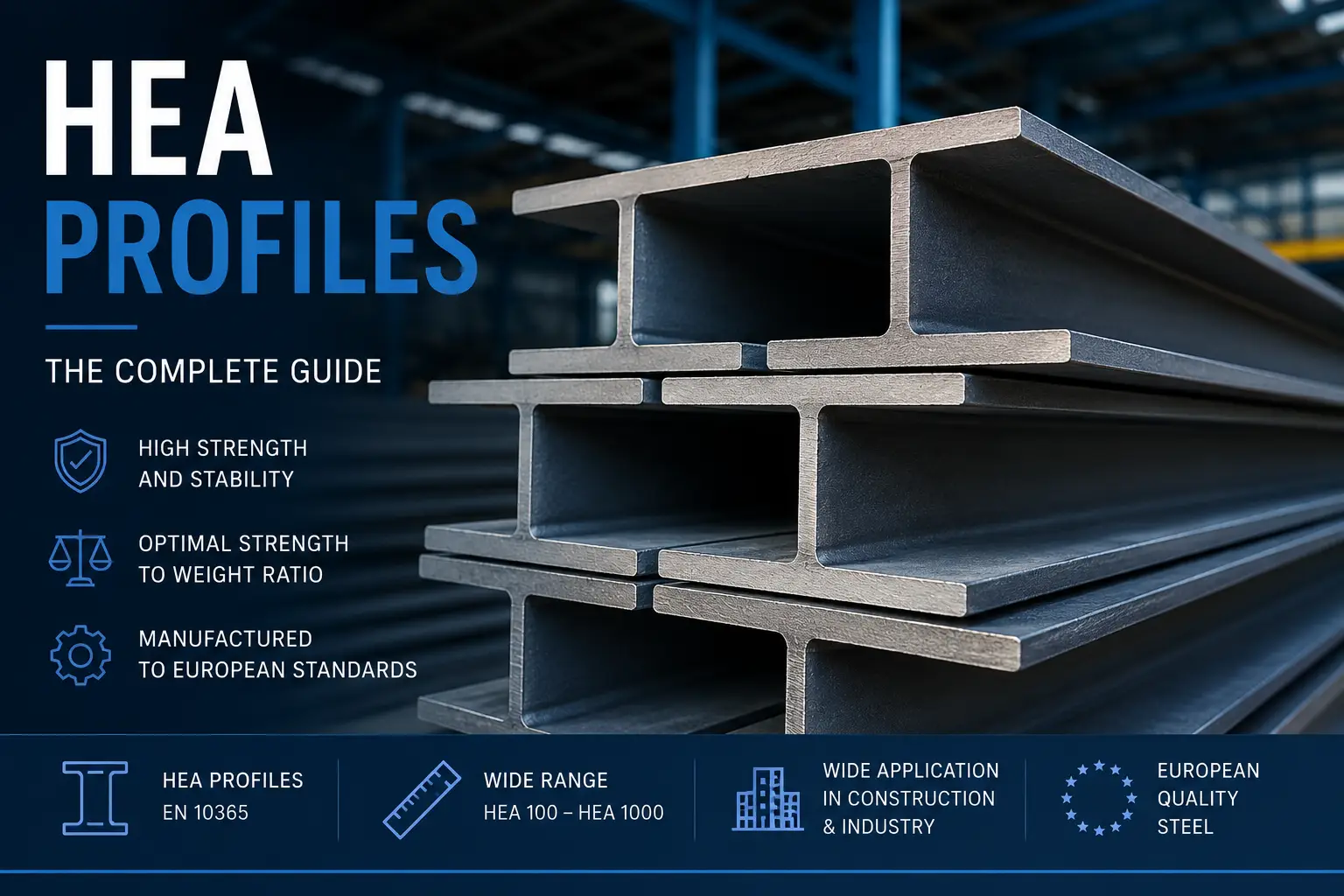
In Europe, HEA profiles rank among the most widely used structural steel profiles and constitute important load-bearing elements of commercial buildings, industrial plants, infrastructure projects and renewable energy systems. HEA profiles with wide flanges, optimised cross-sectional geometry and excellent structural performance provide an optimum balance between strength, stability and material efficiency. Their versatility has made them a favourite choice for structural engineers seeking reliable solutions for a wide range of applications.
HEA profiles are produced by the hot-rolling process and are generally available in steel grades such as S235, S275 and S355. HEA profiles made according to the European standards ensure uniform dimensions, mechanical properties and production quality. They are of standard design, allowing for simplified engineering calculations, fabrication, transportation and on-site assembly, all of which contribute to the efficiency and cost-effectiveness of construction projects.
HEA profiles are one of the defining characteristics that carry substantial structural loads while remaining a relatively lightweight section compared with heavier alternatives. This efficient strength to weight ratio enables the engineers to design resilient steel structures without adding material consumption unnecessarily. As a result HEA profiles are widely used in steel frame buildings, warehouses, manufacturing plants, bridges, mezzanine floors, equipment support structures and solar mounting systems throughout Europe and global markets.
HEA and IPE profiles are often compared with HEB profiles, each series of profiles being developed for different structural requirements. Choosing the right profile is not just about choosing a larger section, but depends on applied loads, span lengths, connection details, deflection limits and project specifications. Knowledge of the differences is a prerequisite for safe, economic and standards-compliant structural designs.
In this guide, you will learn what HEA profiles are, how they are classified, their standard sizes and technical characteristics, where they are most commonly used, the engineering advantages they offer and the key factors to consider when choosing the right HEA profile for your project. We will also compare HEA profiles with HEB and IPE profiles to help you select the best structural solution for your specific application.
What Are HEA Profiles?
HEA profiles are European standard structural steel profiles with a unique H-shaped cross-section, designed for a high load-bearing capacity and an efficient weight-to-strength ratio. They are widely used in structural engineering as columns, beams and main load carrying structures in commercial, industrial and infrastructure projects and are part of the European wide flange profile family.
The major feature of HEA profiles is their balanced geometry. HEA profiles have wider flanges compared to conventional I-shaped profiles and a lighter cross-section than HEB profiles, enabling them to offer superior structural performance without unnecessary weight. This makes them especially suitable for projects where strength and material efficiency are important design considerations.
HEA profiles are manufactured by hot-rolling and comply with European dimensional standards, guaranteeing uniform geometry and reliable structural performance. Standard dimensions allow engineers, fabricators and contractors to utilise components fully compatible with prevailing structural design practices and fabrication techniques.
HEA profiles are commonly available in structural steel grades such as S235, S275 and S355, with the different grades having varying mechanical properties to meet different project requirements. The proper steel grade selection depends on factors like structural loads, environmental conditions, fabrication requirements, and applicable design standards.
Key Characteristics of HEA Profiles
HEA profiles are one of the most specified steel sections in Europe, with a number of structural advantages. The wide flanges ensure good resistance to bending forces . The thickness of the web is optimised to transfer the load efficiently to the overall structure . Engineers can achieve good structural performance with this balanced design without using excessive steel.
Another important characteristic is versatility. HEA sections can be welded, bolted, cut, drilled, galvanised or coated by normal steel fabrication procedures and are therefore suitable for both workshop fabrication and erection on site. They also have standard dimensions which makes it easier for structural detailing and less complex fabrication.
Such features make HEA profiles a popular choice for projects requiring reliable structural performance, long service life and compliance to European standards for construction.
European Standards for HEA Profiles
HEA profiles are produced according to the standard European norms defining their dimensions, tolerances and technical specifications. The dimensions of HEA profiles are specified in EN 10365 . Manufacturing tolerances are normally covered by EN 10034 . The structural steel used to manufacture these profiles is usually supplied according to EN 10025, which specifies mechanical properties and steel grades such as S235, S275 and S355.
The standards are intended to give the user the assurance that HEA profiles supplied by different manufacturers have consistent dimensions, provide a predictable structural performance and can be used in engineering calculations based on the Eurocodes. This degree of standardisation is one reason why HEA profiles are widely used in Europe and international construction markets.
HEA profiles, similar to HEB profiles, have an H-shape appearance, but the dimensions, weight and structural performance of HEA profiles vary significantly depending on the size of the profile. In the next section we will review the typical size range, technical specifications and engineering properties that influence profile selection.
HEA Profile Sizes and Technical Specifications
HEA profiles are offered in a variety of standard sizes, allowing engineers to choose the optimal section for projects ranging from small commercial buildings to large industrial facilities and infrastructure developments. Every profile has standardised European dimensions, allowing the designer to accurately calculate the structural performance and maintain compatibility with fabrication and construction practices for international markets.
The HEA series generally starts at HEA 100 and extends to HEA 1000 (availability varies by manufacturer and demand in region). The higher the profile designation, the bigger its dimensions, cross-sectional area, weight and structural capacity. Bigger profiles can take higher bending moments, shear forces and axial loads and are used in more demanding structural applications.
Engineers do not just choose a profile based on its overall height. Instead they look at a number of technical properties together to determine if a section can safely carry the loads required and also meet serviceability requirements. Each property plays a part in the overall structural behaviour of the profile and how it will perform under different loading conditions.
Understanding HEA Profile Dimensions
Each HEA profile is defined by a set of standardised dimensions that directly affect structural performance.
The overall height is the depth of the profile and it has a great influence on the bending resistance. In general, the deeper the section, the stiffer it is and the better it is for longer spans.
The flange width provides lateral stability and distribution of load. Wide flanges are one of the features that distinguish HEA sections. They provide better resistance to bending and also give easy surfaces for connections by bolts and welding.
The thickness of the web is responsible for transfer of shear forces between the flanges and the thickness of the flanges contributes to the resistance of the profile to the compressive and tensile stresses created during the structural loading. The balance of these dimensions allows HEA profiles to achieve efficient structural performance with no excessive material usage.
Mechanical Properties That Influence Structural Design
Each HEA profile is defined by a set of standardised dimensions that directly affect structural performance.
The overall height is the depth of the profile and it has a great influence on the bending resistance. In general, the deeper the section, the stiffer it is and the better it is for longer spans.
The flange width provides lateral stability and distribution of load. Wide flanges are one of the features that distinguish HEA sections. They provide better resistance to bending and also give easy surfaces for connections by bolts and welding.
The thickness of the web is responsible for transfer of shear forces between the flanges and the thickness of the flanges contributes to the resistance of the profile to the compressive and tensile stresses created during the structural loading. The balance of these dimensions allows HEA profiles to achieve efficient structural performance with no excessive material usage.
Why Technical Data Tables Matter
Standard HEA dimensions are publicly available, but professional structural design should never rely solely on the profile designation. For example, a section labelled as HEA 300 may look adequate just by its size, but its real-world behaviour must be confirmed by rigorous engineering analysis and manufacturer data.
For this reason, before choosing a profile, engineers refer to complete tables of technical data that include dimensional data, mechanical properties, sectional characteristics and permissible tolerances. These tables ensure that each HEA profile meets the structural, economic and regulatory requirements of a given project.
Choosing the right HEA profile is only one element of the design process. Equally important is understanding where these profiles are most beneficial in actual construction. In the next section, we will review the most common structural applications of HEA profiles in commercial, industrial, infrastructure and renewable energy projects.
Common Structural Applications of HEA Profiles
HEA profiles are widely used in structural engineering due to their excellent combination of strength, stability and material efficiency. They are light compared to many other structural profiles, while still carrying large loads thanks to their balanced cross-section, and are ideal for a variety of construction and industrial projects.
HEA profiles are amongst the most specified structural steel profiles throughout Europe, from commercial buildings and manufacturing facilities to infrastructure developments and renewable energy projects. Their standard dimensions, ease of fabrication and compatibility with modern engineering practices make them a reliable solution for new construction and structural renovation projects.
Commercial and Industrial Buildings
The main application of HEA profiles is commercial and industrial buildings. They are often used as primary beams, columns and structural framing members in office buildings, shopping centers, logistics facilities, warehouses and manufacturing plants.
Its relatively low self-weight for supporting large floor loads allows engineers to design open interior spaces with fewer supporting columns. This flexibility in design is especially advantageous in industrial buildings where it is essential to have clear production areas and efficient material handling.
Steel Frame Structures
HEA sections are important parts of steel frame construction systems. They are frequently integrated into the main structural frame of buildings, safely transferring loads from floors, roofs and walls to the foundation.
HEA profiles with their standardised dimensions in Europe can be perfectly combined with connection plates, bolted joints, welded assemblies and other structural components. This makes fabrication easier and speeds up installation on construction sites.
Infrastructure and Civil Engineering Projects
Many infrastructure projects require structural elements that are able to support heavy and variable loads for long service lives. HEA profiles are quite often used in bridges, transportation facilities, utility structures, industrial platforms and public infrastructure where structural reliability is important.
engineers can carry out accurate structural analyses and satisfy stringent safety requirements due to their predictable mechanical properties and compatibility with European design standards
Renewable Energy and Solar Mounting Systems
With investments in renewable energy on the rise across Europe, HEA profiles are increasingly being used in the construction of solar mounting systems, equipment support frames and utility-scale photovoltaic (PV) installations.
Depending on the project design, HEA profiles can be the main structural elements supporting mounting systems, inverter platforms, transformer structures, maintenance walkways or any other auxiliary steel framework. Their high structural capacity and durability make them ideal for outdoor environments where long-term performance and low maintenance are essential.
Machinery Support Structures and Industrial Equipment
Industrial facilities often need heavy-duty support structures for production equipment, conveyors, processing units and mechanical installations. The HEA profiles are rigid enough to reduce the deflection of the structure to a minimum and to safely carry concentrated loads of equipment.
Wide flanges facilitate the attachment of base plates, brackets and mechanical connections, allowing engineers to develop strong support systems that can be adapted to meet changing production needs.
Why Engineers Frequently Specify HEA Profiles
The application of HEA profiles is not restricted to one industry. Their popularity is not due to the above, but rather due to the fact that they can be reliably used in a wide variety of structural applications with an efficient balance of strength, weight and fabrication costs.
HEA profiles provide a standardised structural solution for multi-story commercial buildings, industrial production facilities, logistics warehouses and renewable energy projects. This allows engineers to have predictable performance, efficient material use and long-term durability.
Their versatility is not the only reason they are so widely used. In the next section we will explore the engineering benefits that make HEA profiles some of the most efficient structural steel profiles for modern construction projects.
Advantages of HEA Profiles
Profiled steel sections have become one of the most widely used structural steel sections, since they offer good structural performance with material efficiency. The balanced geometry of the trusses enables engineers to reach high load capacity without adding unnecessary overall weight to a structure. It results in better performance structurally, as well as more economical fabrication, transportation and installation.
For projects where a careful balance of strength, cost and ease of construction is required, HEA profiles can often provide an ideal solution compared with heavier structural profiles designed for similar purposes. Their standardised dimensions and compatibility with European design standards increase their value in a wide range of construction sectors.
Excellent Strength-to-Weight Ratio
One of the main advantages of using HEA profiles is the high strength per weight. Their cross-sectional design places material where it is most effective structurally, enabling the profile to effectively resist bending and compression without wasting steel.
This efficiency translates to lighter structural frames, lower transportation costs and easier handling on site for a large number of commercial and industrial projects while still achieving the necessary level of structural safety.
High Structural Stability
The HEA profiles have wide flanges which provide an excellent bending resistance and improve the overall stability of structural members. This characteristic makes them especially suitable for beams and columns subjected to large vertical loads and bending moments.
Their predictable structural behaviour also makes engineering calculations easier, allowing designers to optimise member sizes in accordance with Eurocode requirements and project-specific design criteria.
Easy Fabrication and Installation
HEA profiles are designed to be easily integrated into modern steel fabrication processes. They can be cut, drilled, welded, galvanised, painted and bolted using standard manufacturing techniques and so can be produced in workshops and assembled on site.
Their standard sizes also facilitate connection detailing and improve compatibility with plates, stiffeners, base plates and other structural elements. This results in decreased fabrication time, more efficient installation and often shorter overall project schedules.
Wide Availability Across International Markets
HEA profiles are a European standard profile and are widely available from steel service centers and suppliers in Europe and many international markets. The availability of this material is widespread, so contractors and fabricators can source replacement material or additional quantities without much concern for compatibility.
Standardised profiles also facilitate procurement in multinational construction projects, since the structural components produced at different locations adhere to the same dimensional specifications and quality requirements.
Long Service Life
HEA sections made of appropriate structural steel grades and protected by suitable surface treatments such as galvanising, painting or other corrosion protection systems can offer decades of reliable service.
Their robustness makes them an ideal choice for challenging environments such as industrial plants, infrastructure projects, logistics hubs, and renewable energy sites where long-term structural performance is important.
Cost-Effective Structural Solution
When choosing the most economical structural profile it is not simply a matter of choosing the lightest section. Engineers must consider the cost of materials, the fabrication complexity, the transportation, installation, and long-term maintenance.
HEA profiles often provide an excellent balance between structural capacity and overall project cost. Their economical use of steel, ease of fabrication, and ready availability help to keep down construction costs while providing a high degree of structural reliability. They deliver the performance necessary for many commercial and industrial projects without the extra weight and cost of heavier structural profiles.
These advantages make HEA profiles applicable to a wide variety of applications, but careful engineering evaluation is still necessary to choose the right profile. In the next section we will discuss the important considerations engineers make in selecting the appropriate HEA profile for a particular structural project.
How to Choose the Right HEA Profile
One of the most important decisions in structural steel design is the selection of a suitable HEA profile. The selection of a larger profile than necessary may increase material cost, transportation cost and fabrication time, while the selection of an undersized profile may cause structural safety problems and failure to meet design specifications. This is why structural engineers consider a number of technical factors when deciding on a HEA profile for a project.
It’s more of a selection process than a profile dimension comparison. Each structural member shall be able to safely resist the loads to which it will be subjected during its service life and at the same time satisfy the requirements of the applicable design standards. Therefore, the best HEA profile is the one with an acceptable structural performance and efficient material utilisation.
Evaluate Structural Loads
The first step to select a profile is to determine the loads that the structural member must carry. Dead loads, live loads, wind loads, snow loads, seismic forces and equipment loads influence the necessary structural capacity.
The magnitude and combination of these loads determine the bending moments, shear forces and axial loads acting on the member and, in turn, determine the appropriate size of the HEA profile.
Consider Span Length and Deflection
The profile must be able to carry the applied loads, and it must be stiff enough to prevent excessive deflection. Even if the load bearing capacity seems sufficient, long spans generally require stiffer profiles.
Serviceability requirements are particularly important in office buildings, industrial facilities, mezzanine floors and commercial structures where excessive deflection can affect structural performance and the comfort of the occupants.
Select the Appropriate Steel Grade
The mechanical properties of the steel directly affect the structural capacity. The most common grades of structural steel to supply HEA profiles are S235, S275 and S355, which differ in yield strength and design capabilities.
The use of higher strength steel grades may enable engineers to reduce section sizes for some applications . The final choice is not just a function of steel grades but the overall structural design .
Assess Environmental Conditions
Always consider the operating environment when selecting a profile. Structures exposed to humidity, marine environments, industrial pollutants or aggressive weather may need additional corrosion protection for long-term performance.
Engineers may specify hot-dip galvanising, protective paint systems, weather resistant steel or other corrosion protection methods for a given project to increase the service life of the structure.
Review Connection Design
The performance of a structural member depends not only on the profile but also on the connection to the surrounding structure. Bolted and welded joints should be capable of transferring forces safely through the structural members without creating weak points in the system.
The flange width and web dimensions of HEA profiles are generally suitable for connection detailing, but all joints have to be designed according to the relevant engineering standards.
Design in Accordance with Eurocodes
The selection of the structural profile must always be done in accordance with the relevant European design codes, particularly Eurocode 3 (EN 1993) for steel structures. The standards establish how to verify resistance, stability, serviceability and safety of the structures when subjected to different loads.
The engineer does detailed structural calculations using standardised design procedures . The engineer does not simply select a profile based on experience or visual comparison . This guarantees that the chosen HEA profile complies with technical requirements and regulatory obligations.
The choice of the appropriate HEA profile is ultimately an engineering decision which depends on structural analysis, project specifications and the applicable design standards. A good choice of profile leads to better structural efficiency, efficient usage of material, and safer and economical construction.
The last step in the understanding of the HEA profiles is the comparison with other common European structural profiles. In the next section, we will discuss the differences between HEA profiles, HEB profiles and IPE profiles, and where each profile performs best and when it should be chosen.
HEA Profiles vs HEB Profiles vs IPE Profiles
All three profiles belong to the European family of hot-rolled structural steel profiles. Therefore HEA profiles are often compared with HEB profiles and IPE profiles . They may look alike at first sight but each profile series is designed for different structural needs. They are very different in terms of dimensions, weight, load carrying capacity and typical applications. Selection of a profile is an important part of the structural design process.
The choice of HEA, HEB and IPE profiles is not only a matter of selecting the strongest section. Engineers consider structural loads, span lengths, connection details, material efficiency and project economics before deciding which profile offers the best overall solution.
HEA Profiles vs HEB Profiles
The HEA and HEB profiles have the same H-shaped cross-section but HEB profiles are significantly heavier and more robust. They have thicker flanges and webs, which gives them a higher load bearing capacity and greater resistance to bending and compression.
Enhanced structural strength of HEB profiles makes them best suited for columns under heavy loads , transfer beams , industrial structures , bridges and other applications where maximum structural capacity is required .
But HEA profiles provide a more efficient compromise between strength and weight. The lighter cross-section uses less steel but offers excellent structural performance for most commercial, industrial and infrastructure projects. This makes HEA sections a good choice where structural efficiency and cost savings are important.
In many building projects, the engineer will first determine if a HEA section can safely satisfy the design requirements before considering the heavier HEB option.
HEA Profiles vs IPE Profiles
Both types of profiles are widely used in structural steel construction but HEA profiles and IPE profiles have different geometries.
IPE profiles have a reduced flange width and a more slender cross section, and are especially suitable for applications where the resistance against bending in one of the main directions is the main design requirement. They are widely used for floor beams, roof structures, secondary framing and light steel construction.
The HEA sections have much wider flanges with the added advantage of stability and the ability to withstand combined loadings. Their geometry also provides more versatility for bolted and welded connections, making them suitable for primary structural members carrying large vertical loads.
Therefore, IPE profiles are often chosen for secondary structural systems, while HEA profiles are more often used for primary framing, columns and major load bearing elements.
Which Profile Should You Choose?
There is no one “better” structural profile. The correct choice is purely a function of the engineering requirements of the project.
For efficient combinations of strength, stability and material economy HEA profiles are frequently the most practical solution. Their balanced design makes them suitable for a wide range of commercial, industrial and infrastructure applications.
HEB sections are generally more resistant to heavy loads and severe structural situations, where maximum structural capacity is needed and the extra weight can be accepted.
In projects where lighter structural systems or long span beams are required, where it is important to reduce the weight, IPE profiles are often the most economical solution.
Ultimately, the choice of profile should be dictated not by its size or appearance, but by structural calculations according to Eurocode 3 (EN 1993) and the performance requirements of this or that project.
Conclusion
One of the most versatile and commonly used structural steel profiles in modern construction is the HEA profile. They have an optimised geometry, an efficient strength-to-weight ratio, and are compliant with European standards. They are an excellent choice for commercial buildings, industrial facilities, infrastructure projects and renewable energy developments.
HEA profiles provide the reliability, durability and engineering performance needed for demanding applications – from primary structural frames and columns to equipment support structures and solar mounting systems. Their standardised dimensions also facilitate design, fabrication and installation, helping engineers optimise both structural performance and project costs.
However, the choice of the proper HEA profile is not simply a matter of choosing a standard size. A safe, economic and compliant design is achieved through a careful study of the structural loads, span lengths, steel grade, environmental conditions, connection detail and relevant Eurocodes. It is also important to be aware of how HEA profiles compare with HEB and IPE profiles, so that engineers can specify the most suitable section for each application.
IMG Group produces high quality HEA profiles according to European standards for construction, industrial, infrastructure and renewable energy projects in Europe and the Balkans. Whether you are looking for standard structural steel profiles or complete steel solutions for your next project, our experienced team can help you to find the right product for your technical and commercial requirements.