


Blog
Magnelis vs Hot-Dip Galvanized Steel in 2026

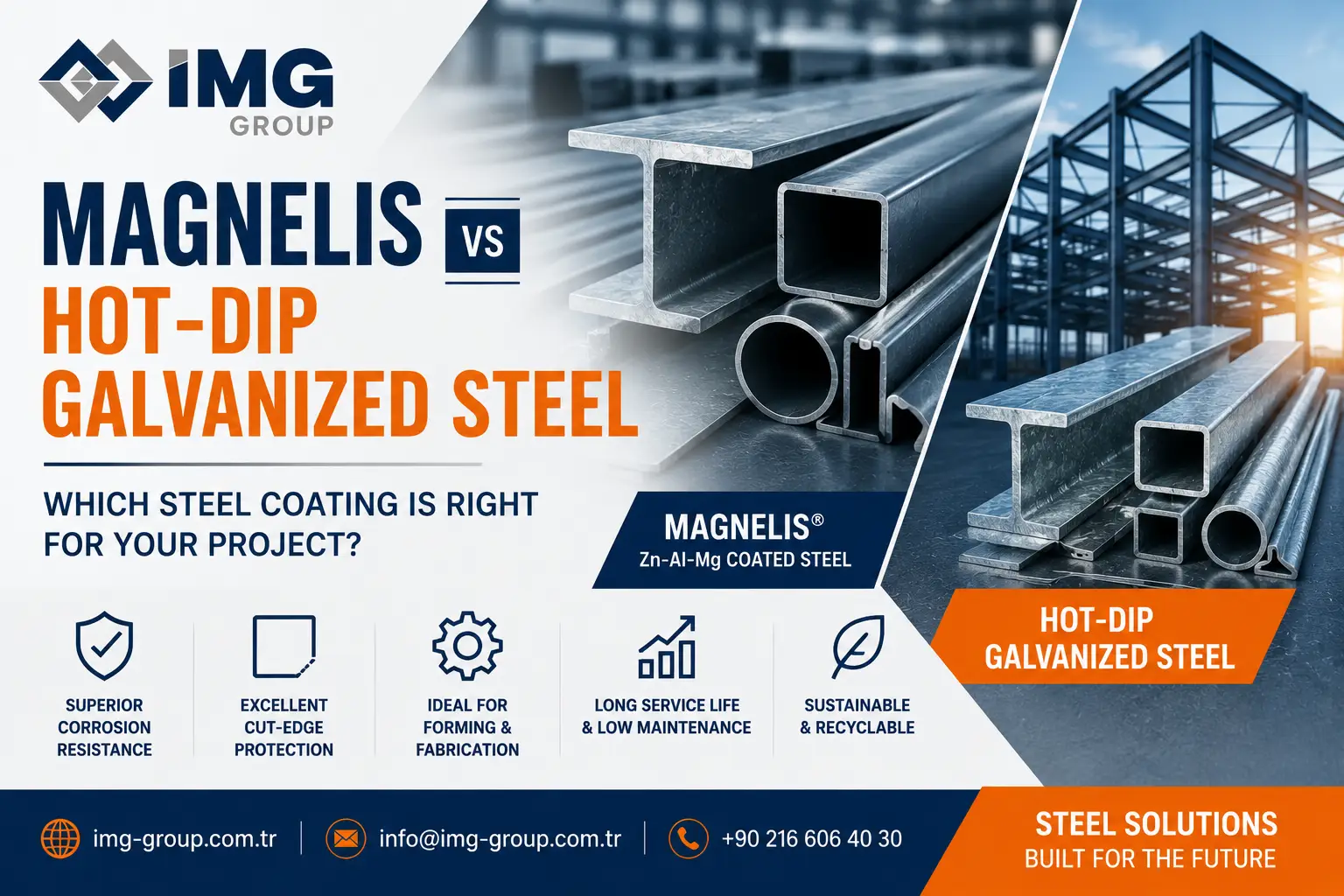
Steel structures are rarely faulty because steel is an unsuitable material for the task. Instead, the challenge often lies in protecting steel from the environment for as long as the structure is intended to serve. Rainfall, temperature variations, salt, industrial emissions, and agricultural chemicals are examples of factors that can substantially contribute to corrosion. This is why corrosion protection often plays a vital role in steel material selection.
Two corrosion protection options are often considered for steel structures exposed to the elements. These are Magnelis® and hot-dip galvanized steel. The differences primarily concern the corrosion-protection mechanisms that distinguish their applications. Namely, both products were created to address similar needs but in slightly different ways.
Hot-dip galvanised steel is a construction material with a history of serving the construction industry for more than a century. Magnelis® is a zinc-aluminium-magnesium-coated flat steel product, especially suited for applications where enhanced corrosion resistance, improved processing characteristics, and cutting-edge protection are desired. The differences become apparent when comparing the technical specifications and characteristics.
Primarily, the choice between hot-dip galvanised steel and Magnelis® depends on the application. If the steel structure will be exposed to severe weather conditions, or if it comprises a considerable number of cut, punched, bent, or formed elements (such as solar mounting structures), choosing the appropriate steel protection becomes more important. Structures such as agricultural buildings or other infrastructure objects with a substantial number of steel components can also be considered a category of application.
Therefore, the actual question is not which of the two options is better but which steel protection is more appropriate for the intended application. The answer lies in the correlation between the manufacturing process and the characteristics of hot-dip galvanized steel and Magnelis®.
What Is Magnelis Steel?
Magnelis is a metallically coated flat carbon steel, produced by ArcelorMittal. The coating is composed of 93.5% zinc, 3.5% aluminium, and 3% magnesium and is applied to both sides of the steel coil via a continuous hot-dip galvanising process. The addition of aluminium, and in particular magnesium, modifies the metallic coating’s response to corrosion.
Magnelis is not another galvanised steel. Rather, it is a steel from the Zn-Al-Mg family of metallic coatings. This difference is justified by the alloy’s beneficial effect on steel’s corrosion resistance.
When exposed to the atmosphere, Magnelis forms a dense layer of corrosion products, which reduces the corrosion rate to a considerable extent. ArcelorMittal attributes this to the 3% magnesium in the composition, which improves the coating’s protective properties.
At the same time, the coating’s value is underscored by its ability to heal itself, which is especially important for fabricated products. Shear cutting or piercing of steel sheets necessarily removes some steel material, disrupting coating continuity and exposing the steel to environmental action. Magnelis, however, overcomes this problem through the coating’s self-healing properties, explained by the migration of corrosion products to the injury site. This is where the coating’s “healing” takes place: it is prevented by the formation of a film on the freshly cut steel edges, slowing the corrosion process. It should be noted that the term “self-healing” is misleading: the coating is not regenerated, but the appearance of the cut edges is modified, thus protecting them.
The ability to heal is of particular interest in the context of Magnelis, as it is used to produce profiled sheets and other steel products with many cutouts and cut edges. Solar mounting structures, in particular, involve a considerable number of notched and profiled steel sheets of various shapes and sizes. Processing such elements becomes significantly more convenient when using steel sheets with a coating that will protect the cut edges from corrosion.
In addition, Magnelis can be formed using standard equipment, and processing technologies such as bending, profiling, stamping, and welding are available, so Magnelis can be used to manufacture both industrial equipment and structures.
The protective properties of Magnelis are of particular interest in aggressive environments, particularly chloride- and ammonia-containing media. This is why this coating is used in solar power equipment, public utility buildings, farm buildings, and industrial buildings, as well as other objects subjected to prolonged exposure to the weather.
Finally, the importance of Magnelis should be seen in comparison with other galvanised steels. Coatings are traditionally applied to steel via hot-dip galvanisation, a technology that differs significantly in billet preparation.
What Is Hot-Dip Galvanized Steel?
Hot-dip galvanising coats steel with zinc. The post-fabrication finishing process involves dipping the steel component in a bath of molten zinc to create the desired shape.
This is critical because hot-dip galvanising after fabrication means the finished component can be hot-dipped rather than starting with hot-dipped steel and then cutting and forming it. Beams, brackets, frames, columns and other fabricated steel components can be galvanised after cutting, drilling and welding.
As the steel component is immersed in the bath, zinc reacts with the steel to form a metallurgically bonded coating that provides a protective barrier and sacrificial anode protection.
Scope: This document specifies the general properties and test methods of hot-dip galvanised coatings applied by immersion in a melt of zinc on fabricated iron and steel articles. The standard distinguishes between articles made of sheet metal and hot-dip galvanised articles. The latter is out of scope of ISO 1461. (ISO)
This is important because it highlights the difference between hot-dip galvanised components and Magnelis.
Magnelis is a continuous coating process for flat steel. Hot-dipping is a traditional process, performed after fabrication is complete. In essence, the two methods differ in both the steel products they can produce and their place in the production chain.
After fabrication, hot-dip galvanising provides significant benefits for large structural steel components, weldments and other complex steel components that have been welded or formed. It has been used in construction, infrastructure, industrial facilities, and outdoor structures for decades, and the steel industry has well documented its performance characteristics.
However, there are also disadvantages to sending steel components through a hot-dip galvanising process after fabrication is complete. Additional manufacturing and logistics considerations are also required, depending on the component size relative to the galvanising equipment, as well as
drainage and venting requirements.
This is where the comparison with pre-coated Zn-Al-Mg products comes in handy. One is not better than the other; they are simply two different ways of solving the same problem.
Magnelis vs Hot-Dip Galvanized Steel: Key Differences
In simple terms, both products protect steel from corrosion. However, that is where the similarity ends. The differences begin with the coatings and extend to production, fabrication, and corrosion-protection procedures.
Coating Composition and Production Process
Magnelis is a metallic coating containing zinc, 3.5% aluminium, and 3% magnesium. The coating is applied to flat steel products in a continuous process while they are in that form and can then be cut, bent, punched, profiled or worked into other shapes.
Conventional batch hot-dip galvanising typically reverses the manufacturing sequence. In other words, steel is fabricated and then galvanised. According to ISO 1461, hot-dip galvanising is “the process of applying a coating of zinc to fabricated iron or steel articles by dipping them in a pot of molten zinc.” (ISO)
This difference has important implications.
A manufacturer of thousands of formed parts may well benefit from starting with a corrosion-resistant pre-coated material. By contrast, a fabricator that primarily welds products together may find it more efficient to build the welded structure, and then hot-dip galvanise the finished item.
Corrosion Resistance
Both coatings effectively protect steel, but they differ in corrosion resistance.
The Magnelis layer is made up of a mixture of zinc, magnesium and aluminium. According to ArcelorMittal, this layer is denser, which makes it more reliable at withstanding corrosion. The passage states that it is most effective in aggressive environments, such as ones with chloride and ammonia salts.
The galvanised layer is less dense, and its effectiveness depends on the coating thickness, the corrosiveness of the environment, installation conditions, and the shape of the steel parts. This is why the level of protection cannot be accurately determined based on the coating name alone. A building in an inland area will have different requirements than a solar panel track near the ocean or steel construction exposed to agricultural ammonia.
Cut-Edge Protection
Cut edges are one of the most obvious differences between the two approaches.
As Magnelis® is typically formed after coating, blanking or punching can expose the steel substrate. The Zn-Al-Mg coating protects the exposed edges by forming corrosive products from the coating surrounding the cut edge.
Hot-dip galvanised steel is typically trimmed, drilled, and welded before entering the zinc bath in the hot-dip process. The final article is then formed and finished, including coating all exposed edges and surfaces.
The practical difference between the two methods is therefore not only about what protects the exposed edges but also when the exposure happens.
That difference can be decisive in choosing materials for different applications.
Fabrication and Processing
For high-volume manufacturing, fabrication efficiency can be as important as corrosion performance.
Magnelis can be formed by conventional means such as bending, drawing, profiling, stamping, and welding. Because the corrosion resistance comes directly from the steel, manufacturers can form finished parts without additional post-fabrication galvanising steps.
Hot-dip galvanising adds another step to the manufacturing process, but that can be a benefit. Entire welded assemblies or structural frameworks can be made and then galvanised as finished items.
The choice would likely depend on the particular application.
A roll-formed solar mount rack produced in very high volumes is fundamentally a different manufacturing challenge than a welded product or large support structure made in lower volumes. It would be a mistake to evaluate each option against the other when it comes to the fundamental question of corrosion protection. In short, how the product is fabricated before installation is a critical factor in choosing between Magnelis and hot-dip galvanising.
Where Is Magnelis Commonly Used?
Magnelis is especially suitable for areas where steel parts are exposed to the outdoors throughout their service life.
Its combination of corrosion resistance, formability, and cut-edge protection makes this steel ideal for projects that require fabricating a large number of light steel parts subject to prolonged outdoor exposure.
One of the first fields to adopt this standard was the photovoltaics industry – one of the largest producers of steel products.
Photovoltaic installations, both ground- and roof-mounted, involve the production of thousands of mounts, rails, purlins and other parts and details placed under the influence of weather conditions – temperature changes, moisture and, in coastal areas, salt.
In addition, solar panel systems involve a considerable amount of shearing, punching and forming operations.
Supplied as steel coil with a pre-applied coating, Magnelis can be a good solution for the solar panel industry because it reduces the number of galvanised parts produced separately and then painted.
This is because the coating of Magnelis steel offers sufficient corrosion resistance even at cut edges.
Another industry that can benefit from Zn-Al-Mg coated sheets is agriculture, where livestock buildings, greenhouses, storage buildings, farm equipment, and other structures are widely used.
These types of buildings and machines are subject to extreme temperature variations and often have an aggressive microclimate.
These conditions shorten the service life of steel parts and therefore require enhanced corrosion protection.
By using Magnelis sheets, you can significantly reduce downtime for farm equipment caused by metal corrosion.
Industrial facilities and infrastructure objects are another area of application for Magnelis.
Industrial buildings and structures involve cable trays, safety railings, brackets, technical ventilation, and many other details.
Moreover, steel parts in industrial buildings are often formed into complex shapes.
Thanks to its high formability, Magnelis enables mass production of such parts.
Cold-formed profiles made of Magnelis are especially advantageous for those who want to use light steel structures for their high strength.
Besides, the choice of the thickness of the base steel allows achieving the necessary values of the profile’s rigidity and strength.
Zinc-magnesium coated steels are especially promising for use in lightweight structures.
Cold-formed steel profiles are increasingly used in the construction of all types of buildings because they allow structures to be designed with a reduced profile cross-section while maintaining high strength.
This makes them a good choice for projects where structural weight is a critical factor.
Finally, the advantages of Magnelis steel are not a reason to replace traditional galvanised sheet steel in all areas of the steel industry.
Where Is Hot-Dip Galvanized Steel Commonly Used?
Hot-dip galvanising is a well-established corrosion protection technique for structural steel, generally used when the fabricated item is formed before being coated.
Take, for instance, fabricated structural steel – columns, beams, brackets, frames, and supports. First, they need to be cut, drilled, and welded. Then the finished product can be processed through hot-dip galvanising, which protects all surfaces and edges, including welds.
Because of this, hot-dip galvanised steel is common in buildings and structures, industrial buildings, bridges, roads, barriers, transmission towers, electrical utilities, and other overhead ground structures.
It is mostly used for relatively large, heavy fabricated items rather than rolled forms; therefore, such projects may find it more convenient to process finished products rather than, for example, starting with hot-dip galvanised sheet steel and working with it during fabrication.
Another advantage is the overall know-how in the field: engineers, steel fabricators, and contractors are familiar with the technology and its intricacies. Various international standards, including ISO 1461, regulate requirements for the coating of fabricated iron and steel articles. Therefore, the design office can confidently rely on standard hot-dip galvanising practice to meet all requirements.
However, the construction of the part is also significant, since it must be subjected to hot-dip galvanising. It is vital to ensure free movement of liquid zinc over all surfaces and the possibility of complete drainage of metal from hollow sections during the galvanising process. In addition, the size of the structure may be important, since individual large assemblies made by welding may exceed the dimensions of the existing galvanising bath.
Thus, when designing structures, hot-dip galvanising should not be considered only as an end-use coating option. In many ways, the design capabilities of hot-dip galvanising dictate the rules for fabricating structural steel. For traditional structures, this method remains relevant and convenient because it is used to make steel products that are then subjected to hot-dip galvanising.
Magnelis or Hot-Dip Galvanized Steel: Which Should You Choose?
There is no single answer to this question without knowing what it is and where it is to be made.
If the project is a large series of cold-formed, punched, or profiled parts, Magnelis offers significant benefits. The material is ready to enter the form line with its protective coating intact, and the behaviour at cut edges is often particularly relevant when a part has many holes or exposed edges.
This makes it particularly attractive for applications such as solar mounting systems and other large volume industrial components.
By contrast, if the project is largely welded fabrications of heavy steelwork or other complex assemblies, it may make more sense to complete the fabrication and weld work before applying a hot-dip galvanised coating.
The location of the structure and its exposure to the elements is also a relevant consideration. A building structure in the middle of the country will have very different corrosion challenges than one close to the coast, in an agricultural region, or in an industrial area. The effects of atmosphere, chlorides, humidity, chemicals and the anticipated service life should also be considered.
The likely service life influences the economics of the choice, since the reduced initial cost of hot-dip galvanised steel is not always the cheapest option if frequent maintenance and repainting are required. Looking at the overall lifecycle cost of a structure or equipment is often more useful than comparing the purchase cost of steel.
Finally, a company’s ability to produce the chosen solution may also be important. A fabricator with a roll forming line will have much to gain by being able to buy pre-galvanised material. By contrast, a steelwork fabricator used to making welded assemblies for batch hot-dip galvanising has less to gain from the switch.
In some cases, standards or client specifications may dictate the choice, since some contracts specifically require hot-dip galvanised steel after fabrication, or specify Zn-Al-Mg coatings or steel with defined corrosion resistance.
That is why it is a good idea to start any comparison between Magnelis and hot-dip galvanised steel by asking these basic questions:
- What is the component to look like?
- How is it to be manufactured?
- Where will it be installed?
- How long is it likely to last?
- How much maintenance can it realistically be expected to need?
With these factors in mind it is often possible to see which route offers the most value.
Selecting the Right Corrosion Protection for Your Project
Magnelis and hot-dip galvanised steel are not two options in which one must be better than the other, but rather two completely different approaches to the same final goal. The goal is to protect the steel and meet the requirements of the final product.
Magnelis combines a zinc-aluminium-magnesium coating with the versatility of a pre-coated flat steel product. This makes it a good option for formed parts and products where cut edges, complexity and/or production economy are a consideration.
Hot-dip galvanising, on the other hand, protects formed and welded articles by coating the steel after fabrication is complete. This makes it a great option for standard structural and infrastructural products, as it allows for the final product to be fully welded and assembled before being subjected to the hot-dip galvanising process.
The choice between the two methods is not set in stone, and can rather be determined by looking at the project as a whole.
Aspects such as environmental exposure, steel geometry, assembly process, corrosion resistance requirements, project lifespan, relevant standards and economy should be considered when choosing the steel and coating method that best suits a given project.
A solar rail produced in tens of thousands can use a different coating method than a heavy support frame welded together for a specific application. Both methods, however, are valid, as they consider the final product’s requirements.
IMG Group offers Magnelis, hot-dip galvanised steel and a wide variety of structural steel products for the renewable energy, construction, industrial and infrastructure industries. By looking at a project as a whole, we can choose the best materials based on the production method and project requirements, ensuring the best possible steel solution for both the client and the final product.