


Blog
What Is Galvanised Steel Sheet? Types, Uses & 2026 Guide

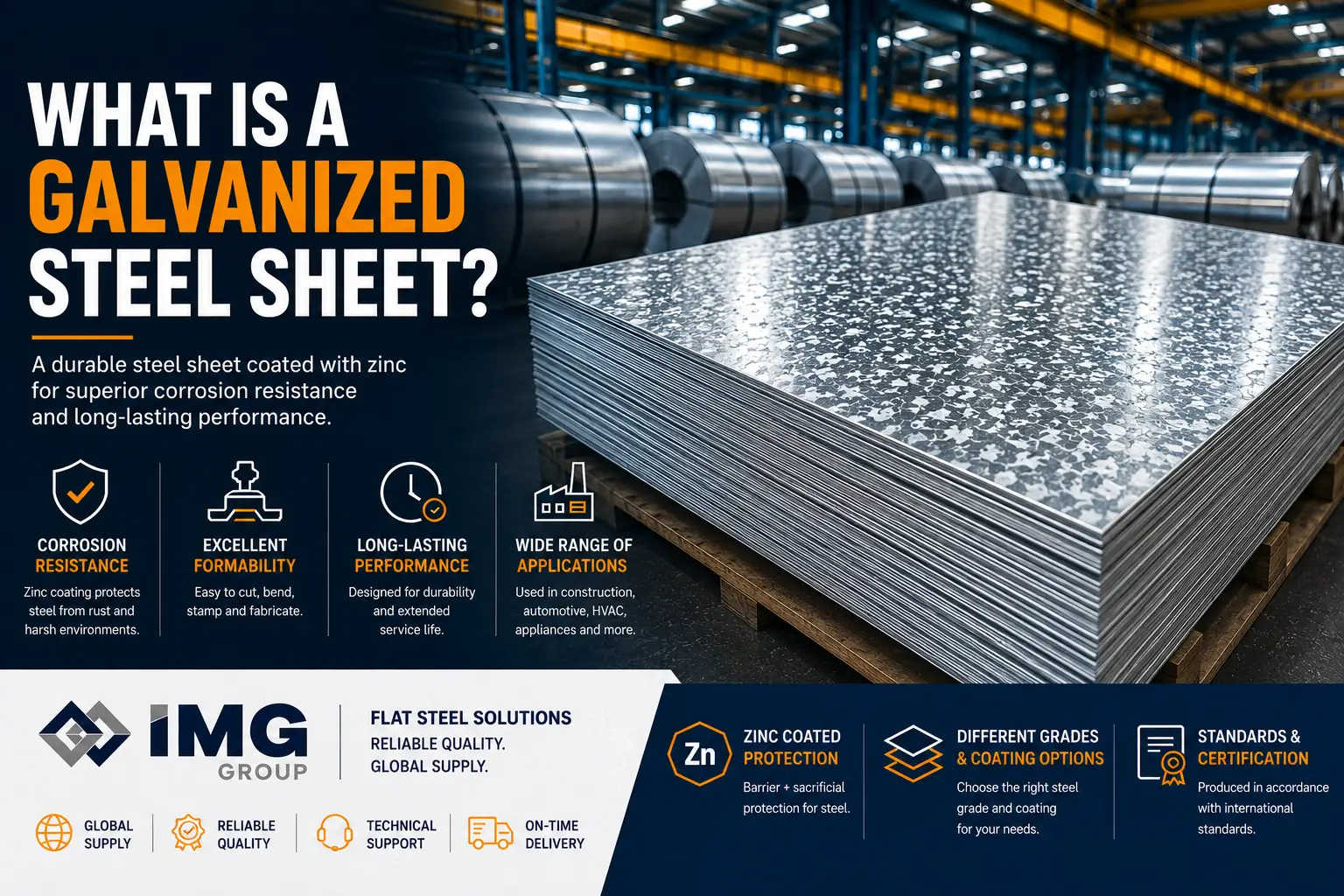
Steel is robust and adaptable, and relatively easy to work with. But it has one glaring weakness: if left exposed to moisture and air, it can rust. Substituting steel with another material is neither practical nor inexpensive for many common uses. A better method is to safeguard the steel itself.
Here is where galvanised steel sheet comes in.
Galvanised steel sheet is basically a steel sheet coated with a protective zinc coating. The zinc coating acts as a barrier between the steel and the environment, helping to slow down the process of corrosion. More crucially, zinc can still provide sacrificial protection when small parts of the steel are exposed.
The mechanical qualities of steel and corrosion protection of zinc have created a common material, galvanised sheet, for use in all building, manufacturing, automobile production, HVAC systems, household appliances, agricultural equipment and many other industries.
But not every galvanised steel sheet is the same. Coating method, zinc coating mass, steel grade, thickness, surface condition, forming requirements and environment in which the material will be utilised can all affect the suitable product for a given application.
Knowing the differences helps a lot in specifying the proper material as opposed to just asking for “galvanised sheet”
How Is Galvanised Steel Sheet Made?
Galvanising relies on a simple concept: cover steel with zinc before rust can destroy the underlying metal. But the success of the technique depends on a tightly regulated process to ensure the coating is evenly applied across vast volumes of sheet steel in industrial manufacturing.
Galvanised steel sheet is normally produced on a continuous hot-dip galvanising line.
The procedure starts with steel strip delivered in coils. For an effective zinc coating, the surface must be clean and adequately prepared. Surface preparation is an important aspect of the production process. Oils, oxides and other impurities might interfere with the adhesion of the coating.
The prepared steel strip is then dipped into a bath of molten zinc. Excess zinc is blown off when it leaves the bath. The coating thickness is controlled, usually by accurately controlled air knives. The coated strip is then chilled and may be subjected to additional surface treatments depending on the desired finish and ultimate use.
The outcome is a continuous zinc coating adhered to the surface of the steel.
This procedure should not be confused with batch hot-dip galvanising of a steel component already produced, dipped in molten zinc. Both techniques use zinc to preserve steel but the process of production and common applications are different.
The coating is applied to the steel when it is still in coil or sheet form using galvanised sheet. The material can then be cut, bent, stamped, roll shaped or otherwise produced to the necessary component.
This makes galvanised sheet especially useful for high volume manufacturing where the same part needs to be made over and over again efficiently.
How Does the Zinc Coating Protect Steel?
It is tempting to think of zinc as just a coating that keeps water away from steel. It undoubtedly does that , however galvanised steel receives more than a physical barrier .
The barrier protection is provided by the zinc coating, which separates the surface of the steel from moisture, oxygen and other environmental factors which cause corrosion.
If that barrier stayed intact throughout the life of the product, the principle would be simple. But in practice, steel sheets are cut, drilled, shaped, transported, placed and occasionally scratched. This allows small sections of the underlying steel to be exposed.
Here another key advantage of zinc is at work.
Zinc is more electrochemically active then steel. When zinc and exposed steel are together under certain conditions, the zinc corrodes preferentially and helps protect the steel. This is frequently called sacrificial or cathodic protection.
This is one of the key reasons for the difference in behaviour between galvanised steel and steel covered by merely a normal barrier coating.
The intensity and duration of the protection still depend on real operating conditions. Factors influencing corrosion rates include coating thickness, humidity, pollutants, chlorides, temperature, component design, and chemical exposure.
A galvanised sheet in a generally dry building, therefore, may behave quite differently to the same material in a location near the seaside.
Therefore, defining galvanised steel must always be more than just confirming the presence of zinc on the surface.
Galvanised Steel Sheet Grades and Coating Designations
When ordering galvanised steel sheet, two different specifications are commonly spoken about at the same time – the properties of the base steel and the properties of the zinc coating.
Don’t get them confused.
The steel itself can be chosen based on the mechanical qualities necessary for forming or structural performance. For example, a part that is going to be subject to severe bending or deep drawing may need to have different material qualities than a sheet that is used for a structural purpose.
The name of the coating affords independent information on the metallic coating.
Typical designations for coated steel products include Z100, Z140, Z200 or Z275. The figure is the nominal total coating weight on both sides of the sheet, in grams per square meter, and is subject to the requirements and tolerances of the relevant product standard.
Generally, the greater the coating mass, the more zinc that is available to protect the steel. This can help to achieve longer corrosion protection, but it is not always essential or technically desirable to only choose the greatest attainable coating mass.
The right specification is dependent on the formulation of requirements, welding, appearance, dimensional factors, environment, service life and cost.
European galvanised flat steel goods are supplied under standards like EN 10346, depending on the product and the intended application. When ordering material, the standard, steel grade, coating designation and surface specifications should be explicitly specified.
This avoids a common procurement difficulty where two providers may both quote “galvanised sheet” but are actually proposing materials of differing grades, coating masses, or surface properties.
Where Is Galvanised Steel Sheet Used?
The reason why galvanised sheet is so readily available is because it lends itself to an extraordinarily large range of manufacturing procedures.
Galvanised sheet finds usage in construction for roofing and cladding components, purlins, light steel framework, ventilation systems, cable management devices, flashing and various secondary building elements.
The automotive sector utilises a lot of zinc-coated sheet for body panels and structural parts where corrosion protection has to be balanced with forming and welding capability.
In manufacturing, galvanised steel can be found in electrical cabinets, equipment housings, storage systems, shelving, ductwork, machinery components, and fabricated enclosures.
In construction galvanised sheet is used in roofing and cladding components, purlins, light steel framing, ventilation systems, cable management products, flashing and a lot of secondary building elements.
Zinc-coated sheet has found wide application in the automotive sector for body panels and structural parts where corrosion resistance is required together with formability and weldability.
You will find galvanised steel in manufacturing in electrical cabinets, equipment housing, storage systems, shelves, ductwork, machinery components, and manufactured enclosures.
It is especially common in agricultural applications where steel parts are often exposed to dampness and harsh weather conditions on a regular basis.
Renewable energy has also opened up another important avenue of application. Solar projects need much of corrosion-resistant steel to hold up and support components. Depending on structural design, ambient circumstances, manufacturing methods and the corrosion protection requirements of the project, galvanised materials can be employed in these systems.
The material is well-suited to so many industries, because it comes with corrosion protection already inherent in the steel product. It can be processed by high volume procedures already used by manufacturers without the need for a separate protective coating for each finished part.
That doesn’t mean that galvanised sheet is right for every environment, but it does mean it’s a viable starting point for a very wide range of products.
Galvanised Steel Sheet vs Cold-Rolled Steel Sheet
Galvanised steel sheet and cold rolled steel sheet are commonly compared as they are direct equivalents. In actuality the difference is not nearly that straightforward.
The steel is treated by cold rolling and the metallic coating added for corrosion protection is galvanising. In fact, the substrate of a galvanised product may have been cold rolled prior to the coating step.
In normal business parlance, the term “cold-rolled sheet” usually refers to uncoated cold-rolled material when used by the buyer, not zinc-coated galvanised sheet.
Cold-rolled steel without a coating is desired for its smooth surface, dimensional correctness, and ability to be formed and finished. But, without further protection, carbon steel in the open is still susceptible to corrosion.
Galvanised sheet has an added protectant of zinc, making it more suitable for many applications where the completed part will be exposed to moisture or to the atmosphere.
So the proper choice relies on what occurs next.
If a component will be painted or coated after manufacturing and will be used in a controlled environment then uncoated cold rolled steel may be entirely adequate. If corrosion protection is required from the start and the component is to be produced from pre-coated material, then galvanised steel may be the more efficient alternative.
The selection of materials should be based on the manufacturing process and operational environment, not just on the choice of the product that seems more durable.
Galvanised Steel Sheet vs Magnelis®
Galvanised steel is just one of many metal-coated steels used for corrosion-resistant applications.
Instead of the mostly zinc coating of standard galvanised sheet, Magnelis® is coated with zinc-aluminium-magnesium. The inclusion of aluminium and magnesium alters the corrosion behaviour of the protective layer and can offer advantages in harsh settings and around cut edges.
This makes the comparison particularly essential for solar structures, agricultural applications, infrastructure, and other components that are expected to spend extended durations outdoors.
Conventional galvanised sheet remains a proven and cheap choice for a very wide range of applications. Magnelis may be interesting in situations where the environmental exposure is more demanding, cutting-edge behaviour is especially crucial or the needed corrosion performance may be efficiently obtained with a Zn-Al-Mg coating.
Neither should be chosen just because one is said to be more evolved than the other.
The right comparison must include the real environment, coating specification, manufacturing method, estimated service life, maintenance requirements and total project cost.
What Should You Consider When Selecting Galvanised Steel Sheet?
A decent purchase specification should have a lot more than the phrases “galvanised steel sheet.”
Begin with sheet thickness and size, but don’t stop there. The basic steel grade must have the mechanical qualities necessary for the final part. Formability is especially crucial if the sheet has to be bent, profiled, stamped or drawn significantly.
The identification of the needed zinc coating shall be determined in accordance with the predicted environment and service circumstances.
Surface quality can be equally as important though. A galvanised part within an industrial assembly, out of sight, does not need to have the same surface properties as a visible architectural product.
The ordering of materials must take account of fabrication. The performance of the coated product and ease of manufacture might be affected by cutting, shaping, welding, fastening and painting.
Then the environment.
Is the end result going to be inside? Is it going to rain onto it? Is this place near the sea? Is the steel exposed to industrial contaminants, agricultural chemicals or long term humidity?
These questions can substantially alter the required corrosion protection.
Check the corresponding product standard and documentation. The steel grade, coating designation, dimensions, tolerances, surface requirements and relevant inspection documentation should be agreed before delivery instead of after material arrives.
A detailed specification simplifies the process of comparing quotations and lowers the risk of obtaining a product that is commercially advertised as galvanised steel, but does not match the project specifications.
Is Galvanised Steel Sheet the Right Choice for Your Project?
Galvanised steel sheet is still commonly used because it handles a practical problem efficiently. It is a product with the well-known qualities of steel in combination with a zinc-based corrosion protection that can be manufactured with conventional manufacturing processes.
However, its applicability is application-specific.
The grade of steel must satisfy mechanical standards. The coating should be suited to the environment. All these factors should be evaluated together such as thickness, surface quality, mode of production, standards and intended service life.
For certain uses, no substitute exists for a typical zinc-coated sheet. For more harsh settings, a stronger coating or an alternate metallic coating system (e.g. Zn-Al-Mg) may be necessary. Other projects may find it beneficial to fabricate the uncoated structural steel first and then apply the hot-dip galvanising.
The main thing here is not to choose the product with the longest technical description. It is knowing what the finished component will be required to do, and specifying the steel accordingly.
IMG Group offers galvanised steel sheet and other flat-rolled steel products for construction, manufacturing, industrial, infrastructure and renewable energy applications. With the right combination of steel grade, dimensions, coating specification and technical documentation, galvanised sheet can provide a durable and cost-effective solution for projects from everyday manufactured components to large-scale industrial applications.