


Blog
Difference Between Galvanized Steel and Cold Rolled Steel in 2026

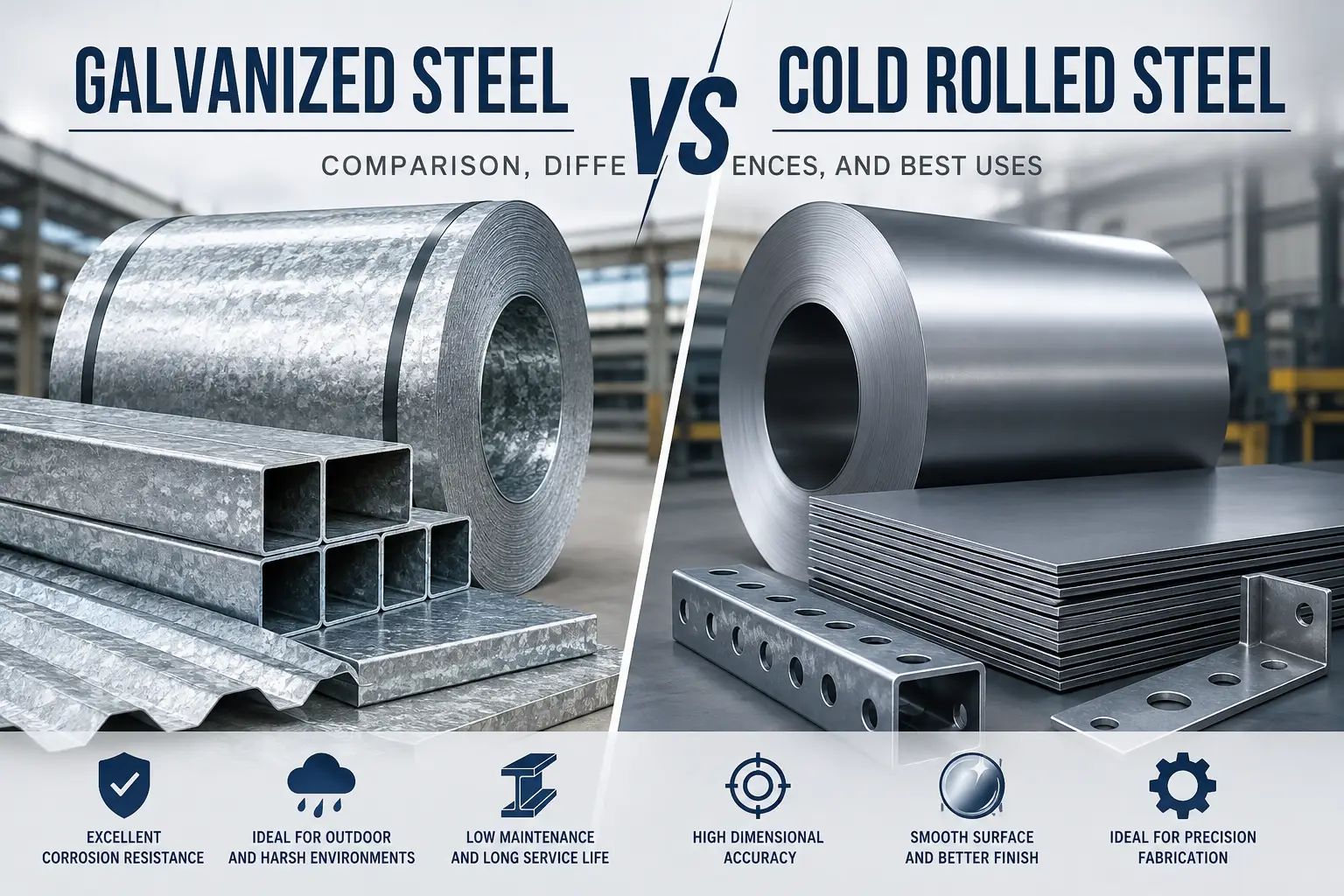
Galvanised steel and cold rolled steel at first glance look very similar. Both are very common in construction, manufacturing, automotive and industrial applications and both do perform very well if chosen for the right purpose. “But while they look alike, these materials are produced by different manufacturing processes and designed to solve different engineering problems.
A common misconception is that galvanised steel and cold rolled steel are competing products. Nor are they in all cases direct substitutes for one another. Cold rolled steel is a manufacturing process that improves dimensional accuracy, surface finish, and mechanical properties. Galvanised steel is steel that has been coated with a protective layer of zinc for increased resistance to corrosion. In fact, a lot of galvanised products are made from cold rolled steel before they are galvanised.
Choosing between these materials is not simply a matter of price or appearance. Engineers, manufacturers and procurement professionals must take into account factors including corrosion exposure, structural requirements, surface quality, fabrication methods, expected service life and maintenance costs. Materials used very well in an indoor manufacturing environment are not suitable for outdoor construction project and vice versa.
Awareness of these differences is crucial for informed buying and engineering decisions. Selecting the wrong material can result in unwanted maintenance, a shorter product life, or increased lifecycle costs. Conversely, the right steel can enhance durability, production efficiency, and long-term performance.
In this guide we will go over the difference between galvanised steel and cold rolled steel, compare the manufacturing process, mechanical characteristics, corrosion resistance, surface finish and typical applications of each, helping you decide which material is the better option for your specific project.
What Is Galvanized Steel?
Galvanised steel is carbon steel that has been coated in zinc for corrosion protection. The zinc coating acts as a barrier between the steel and the environment, considerably decreasing the likelihood of rust caused by moisture, oxygen and other corrosive materials. This added protection makes galvanised steel one of the most popular materials for industrial and outdoor applications where long-term durability is critical.
The most common method of production is hot-dip galvanising, where cleaned steel is dipped into a bath of molten zinc at temperatures of around 450°C (842°F). The zinc bonds metallurgically to the steel surface forming multiple alloy layers providing excellent adhesion and long lasting corrosion resistance during this process. The result is a coating that is much more durable than conventional paints or surface treatments.
For some applications, galvanised steel may also be made by continuous galvanising, in which the steel coils are run through a controlled galvanising line before being made into finished products. It is a common method for sheet steel for manufacturing industries such as automotive, construction, HVAC and household appliances.
One of the best benefits of galvanised steel is sacrificial protection. If the zinc coating is scratched or slightly damaged, the zinc around it will continue to protect the exposed steel by corroding preferentially. This electrochemical property greatly prolongs the service life of the material and reduces the maintenance requirements over time.
Besides corrosion resistance galvanised steel has good mechanical performance and is used in a wide variety of structural and industrial applications. It is widely used in:
- Structural steel components
- Roofing and wall cladding systems
- Solar mounting structures
- Steel pipes and tubes
- Highway guardrails
- Industrial platforms
- Agricultural equipment
- Fencing systems
- Cable trays
- Infrastructure projects
Galvanised steel performs very well outdoors but the main benefit of galvanised steel is not its increased strength. The galvanising process is used to improve durability and corrosion resistance . The mechanical properties of the underlying steel are governed by the base material used prior to galvanising . Depending on the performance requirements of the final product, galvanised steel is therefore produced from different grades of steel and production processes (hot rolled and cold rolled steel).
It is important to understand this distinction because a lot of buyers wrongly believe that galvanising and cold rolling are competitive processes. In fact they deal with different aspects of the behaviour of steel.
What Is Cold Rolled Steel?
Cold rolled steel is steel that has been further processed after it has been hot rolled. Once the steel cools to room temperature, it is passed through a series of precision rollers that decrease the thickness, improve the dimensional accuracy and create a smoother, more uniform surface. Galvanising coats steel with a protective layer of zinc . Cold rolling changes the physical properties of the steel itself .
The cold rolling process results in strain hardening of the material that increases strength and hardness, and tighter tolerances of the thickness than that of conventional hot rolled steel. Therefore, cold rolled steel is often selected for applications where accuracy, uniformity and surface finish are more important than corrosion resistance.
Its most noticeable characteristic is its appearance. Cold rolled steel generally has a smooth, clean, slightly reflective surface that works well for products that will be painted, powder coated or decorated. It is also preferred by manufacturers for parts that require accurate bending, welding, stamping or laser cutting.
Cold rolled steel is often used in industries where small variations can affect assembly or product performance because of its excellent dimensional consistency. Typical applications are:
- Automotive components
- Industrial machinery
- Electrical enclosures
- Office furniture
- Steel cabinets and shelving
- Home appliances
- Precision brackets and fabricated parts
- Metal furniture
- HVAC components
- General manufacturing
Cold rolled steel has one important drawback: it does not offer inherent corrosion protection, but has superior surface quality and improved mechanical properties. The material has no protective coating . Exposure to moisture and oxygen will eventually result in oxidation and rust . With additional surface treatments it can be prevented.
To overcome this limitation, manufacturers often applies protective finishes such as painting, powder coating, electroplating or hot-dip galvanising depending upon the intended application. That’s why it’s entirely possible—and quite common—to find a steel product that has been both cold rolled and galvanised. Galvanised coating offers precision, surface quality and long-term corrosion resistance in the cold rolling process.
This is one of the most common sources of confusion. Many buyers compare galvanised steel and cold rolled steel as if they were competing materials. In fact, these two terms describe two different aspects of steel production. One deals with the processing of the steel and the other with the protection of the steel.
Now that we have looked at each material in isolation the following section compares them side by side and highlights their differences in manufacturing, corrosion resistance, surface finish, strength, cost and typical uses.
Galvanized vs Cold Rolled Steel: Key Differences
Galvanised steel and cold rolled steel are often compared to one another as if they were competing materials, but the comparison is not quite so simple. The two terms describe different properties of steel. Cold rolled steel is a manufacturing process that increases dimensional accuracy and surface finish . Galvanised steel is a protective zinc coating to improve corrosion resistance .
Many galvanised steel products actually start out as cold rolled steel and then go through the galvanising process. So the choice is not always between one material or the other but between different combinations of processing and surface protection, depending on the requirements of a specific application.
The following comparison points out the most important differences.
| Feature | Galvanized Steel | Cold Rolled Steel |
|---|---|---|
| Primary Purpose | Corrosion protection | Precision and surface quality |
| Manufacturing Process | Steel coated with zinc through hot-dip or continuous galvanizing | Steel rolled at room temperature after hot rolling |
| Corrosion Resistance | Excellent | Low without additional coating |
| Surface Finish | Zinc-coated with a matte or spangled appearance | Smooth, clean, and uniform surface |
| Dimensional Accuracy | Depends on the base material | Excellent |
| Mechanical Properties | Similar to the base steel | Higher strength and hardness due to cold working |
| Maintenance Requirements | Low in outdoor environments | Requires painting or another protective coating when exposed to moisture |
| Typical Applications | Outdoor structures, infrastructure, solar systems, fencing, pipes | Automotive parts, appliances, machinery, furniture, precision fabrication |
Corrosion Resistance
The main difference between the two materials is their resistance to corrosion. Galvanised steel is made specifically for applications where exposure to moisture, humidity or outdoor conditions cannot be avoided. Its zinc coating protects the underlying steel against rust, even if it gets scratched slightly during installation or service.
Cold rolled steel does not have any corrosion protection built in, however. Unless painted , powder coated , plated or galvanised after manufacture it will slowly oxidise when exposed to moisture.
Surface Quality
Cold rolled steel has a smooth and consistent surface. This makes it a good choice for products where appearance, paint quality or precision manufacturing are important.
Galvanised steel looks different because of the zinc coating. The surface can be matte or have the typical crystalline “spangle” pattern depending on the galvanising process. There are aesthetic differences, but in the finish you see the main purpose of durability over cosmetic perfection.
Strength and Hardness
Another misconception is that galvanised steel is stronger than cold rolled steel. In fact, the zinc coating has little influence on the mechanical strength of the material.
The work hardening that takes place in the cold rolling process usually makes cold rolled steel a higher yield strength and hardness than regular hot rolled steel. The structural performance of galvanised steel is essentially a function of the properties of the base steel used prior to galvanising.
Cost Considerations
Cold rolled steel is typically cheaper up front than galvanised steel since it doesn’t have the extra protective coating. But material cost should never be considered in isolation.
Because its corrosion resistance is so good, galvanised steel is often more economical over the long haul for outdoor applications where maintenance, repainting and replacement costs are much lower. However, untreated cold rolled steel may need periodic maintenance for protection to achieve a similar lifespan.
Understanding the differences between these materials can help you select the right material for a specific project.
Corrosion Resistance: Which Material Performs Better?
Corrosion resistance is a priority, and the difference between galvanised steel and cold rolled steel is immediately obvious. Both materials can offer similar structural performance based on the base steel grade . However, they have inherently different capabilities of resisting environmental exposure.
Galvanised steel has been specially made to resist corrosion. The zinc coating on the surface of the steel acts as a barrier to the environment around it, and prevents the moisture or oxygen from coming in contact with the base metal. More importantly, zinc provides sacrificial protection, meaning that it corrodes before the underlying steel in the event of a scratch or localised damage. This special property helps to greatly extend the service life of galvanised products, especially when they are used outdoors.
Cold rolled steel, however, offers no inherent corrosion protection. While it may look sanitary and impervious when new, with a smooth surface, moisture, rain or condensation will cause oxidation if the material isn’t given an extra level of protection. This is why cold rolled steel is generally used indoors or on products that will later be painted, powder coated, electroplated or galvanised.
Performance in Different Environments
The environment in which the steel will be used is often the deciding factor when selecting between these materials.
- Outdoor environments: Galvanised steel is typically preferred for structures exposed to rain, snow, humidity or changing weather conditions. It is coated with zinc for long-lasting protection with little maintenance.
- Coastal and industrial areas: Corrosion is increased by salt-laden air or airborne industrial pollutants. Under these conditions galvanised steel performs much better and is widely used for infrastructure, renewable energy projects and industrial facilities.
- Indoor uses: Cold rolled steel performs well in dry, controlled environments where corrosion is not a primary concern. It is also suitable for painted or decorative products due to its superior surface quality.
Maintenance Requirements
Corrosion resistance also directly affects maintenance costs.
The galvanised steel requires little maintenance during its service life. In many applications, periodic visual inspection is often adequate to confirm the integrity of the protective coating. This low maintenance characteristic makes galvanised steel especially attractive for infrastructure, agricultural equipment, solar mounting systems, fencing and other installations where routine maintenance would be costly or impractical.
But if you are going to expose cold rolled steel to moisture, you will need to provide some other protection. Painted or coated surfaces should be inspected regularly and damaged areas may require repair to prevent further spread of corrosion. These maintenance requirements can increase the total cost of ownership over the lifetime of a product.
Lifecycle Performance
Initial material cost is only one side of the coin. A material that costs less to buy may end up costing more if it needs regular maintenance, repainting, or early replacement.
Galvanised steel also has a lower lifecycle cost, as its corrosion resistance translates into lower maintenance needs and a longer useful life for the product. This benefit is even more important for projects that will last for many decades, such as solar farms, industrial facilities, infrastructure, and structural steel applications.
If corrosion is not a concern or if there is some other protective finish that will be applied during the manufacturing process, cold rolled steel is still a great choice. Its precision, clean surface and excellent formability make it indispensable in many manufacturing industries but should not be selected for outdoor exposure without appropriate surface protection.
Corrosion resistance is one of many considerations in choosing materials. Then we compare surface finish, appearance and manufacturing precision, and explain why cold rolled steel is often chosen for products where looks and dimensional accuracy are important.
Surface Finish and Appearance
Corrosion resistance is often the first consideration when selecting between galvanised and cold rolled steels, but for an application where precision, appearance or secondary processing are important, surface finish and appearance are just as important. Different manufacturing processes used to make these two materials produce distinctly different surface properties with more appropriate industries and final applications for each.
Cold Rolled Steel: Smooth and Precise
The surface of cold rolled steel is smooth and uniform. The material is rolled at room temperature under controlled conditions, achieving tight dimensional tolerances and a refined finish that is difficult to obtain by hot rolling alone.
This high quality surface has many practical advantages. Good for painting, powder coating and electroplating and to improve the consistency of welding, laser cutting, bending and stamping operations. Therefore, manufacturers often use cold rolled steel for products that require both appearance and accuracy.
Typical applications include:
- Automotive body panels
- Home appliances
- Office furniture
- Metal cabinets
- Electrical enclosures
- Precision-engineered components
In these industries, cold rolled steel is the material of choice as even minor deviations in thickness or surface quality can affect assembly, finishing or the overall quality of the product.
Galvanized Steel: Protection Before Appearance
Galvanised steel has a very different surface, as it is coated with a protective layer of zinc. Depending on the galvanising process and production process, the surface may be matte, bright or have the familiar crystalline spangle pattern formed as the zinc solidifies.
Galvanised steel is not cosmetically uniform, like cold rolled steel, but its appearance reflects its primary purpose — long term protection, not decorative quality. For structural and outdoor uses, durability is usually much more important than getting a perfectly smooth finish.
Minimised spangle or spangle-free surfaces are also available on modern continuous galvanising processes for a cleaner finish on products that require both corrosion protection and an attractive appearance.
Paintability and Further Processing
Cold rolled steel is often used when the final product is to be given a further decorative or protective coating. Its clean smooth surface offers a uniform surface for paints and coatings to adhere to , providing a high quality finish with minimal surface preparation.
Painting galvanised steel is also possible with good results, but typically requires proper surface preparation and compatible primers for good adhesion of the coating. If these procedures are followed correctly, painted galvanised steel provides the corrosion resistance of zinc and the aesthetic versatility of painted coatings.
Which Surface Is Better?
There is no surface that is always better than the other, it all depends on what you are using it for.
If you need high dimensional accuracy, a nice looking finish and a good surface for painting or precision fabrication, cold rolled steel is usually the better choice.
If durability, weather resistance and low maintenance over the long term are the priority, galvanised steel has a distinct advantage even if it’s less aesthetically pleasing.
The final decision should be based on functional requirements, not just aesthetics. A perfectly smooth surface is of little use if the material is expected to function for decades in a corrosive outdoor environment, just as a precision part used only indoors might not require a galvanised coating.
Strength and Mechanical Properties
Many people think that galvanised steel is stronger mechanically than cold rolled steel due to its zinc protective coating. In fact, the process of galvanising has very little effect on the strength of the structure. The mechanical properties of galvanised steel are largely determined by the grade of the base steel with the zinc coating being applied solely to enhance corrosion resistance.
Cold rolled steel is different, they actually change the mechanical properties of the material when they make it. When the steel is rolled at room temperature it work hardens, resulting in a higher yield strength and hardness and more consistent dimensions. These changes make cold rolled steel especially well suited for applications that demand precision and reliable mechanical performance.
Cold Rolled Steel: Improved Strength Through Processing
Cold rolling is the process of reducing the thickness of the steel below its original hot rolled thickness, resulting in a denser, more uniform material structure. This gives several mechanical advantages:
- Increased yield strength
- Greater hardness
- Enhanced dimensional stability
- Improved consistency between production batches
- Superior performance in precision manufacturing
These properties make cold rolled steel a popular choice for components needing tight tolerances and consistent manufacturing quality. In the automotive industry, electrical enclosures, machinery components, and fabricated products, cold rolling can enhance mechanical characteristics.
Galvanized Steel: Strength Depends on the Base Material
Galvanising can be done on many different grades of steel for varying strengths and structural properties. For example, galvanised structural steel made from higher strength grades will inherently carry more load than galvanised products made from lower strength steels.
The zinc coating itself is relatively thin and does little to the strength of the material. Its main purpose is to protect the base steel from corrosion, not to enhance its mechanical performance.
This difference is especially important in structural engineering. The first step in specifying galvanised steel is to specify the appropriate steel grade based on the required mechanical properties and then specify the galvanising requirements based on the environmental conditions in which the product will be used.
Formability and Fabrication
Mechanical performance is not just strength. Engineers should also take into account the behaviour of the material during the fabrication.
Cold rolled steel provides excellent dimensional consistency and lends itself well to processes such as:
- Accurate bending
- Cutting with a laser
- Die Cutting
- Rolling forming
- Machine work
- Robotic welding
Its smooth surface and predictable mechanical properties permit manufacturers to achieve high production accuracy with minimal variation.
Galvanised steel can also be fabricated successfully, but care must often be taken during welding, cutting, and forming to prevent damage to the zinc coating. In many applications fabrication is completed prior to galvanising to guarantee the protective layer is continuous across the finished component.
Choosing Based on Mechanical Requirements
Cold rolled steel is often the material of choice for projects requiring precision, dimensional accuracy and enhanced mechanical properties.
If the material will be subject to tough outdoor conditions where corrosion resistance is just as important, galvanised steel generally offers the better long-term solution, even if its mechanical properties are similar to those of the underlying steel.
Strength should not be the only consideration in the final analysis. The best material should be determined by a combined assessment of mechanical performance, environmental exposure, manufacturing processes and expected service life.
Applications: Which One Should You Choose?
There is no clear answer of which is better, galvanised steel or cold rolled steel. Everything hinges on the place and application of the steel. The right one is Both materials have great performance but they are intended to solve different engineering problems. The right choice is not a matter of one characteristic, but of evaluating the environmental conditions, the manufacturing requirements, the expected service life, and the maintenance expectations.
Choose Galvanized Steel If…
If corrosion resistance and long-term durability are the primary concerns, then galvanised steel is the best solution. The zinc coating protects the material so it can perform reliably under conditions of moisture, humidity and exposure to weather that would quickly destroy untreated steel.
Galvanised steel is a popular choice for:
- Structural steel for outdoor construction
- Solar mount systems
- Fence and guard rails of steel
- Farm buildings and machinery
- Steel pipes and tuexample exposed to weather
- Roofing and cladding systems
- Industrial platforms and walkways
- Utility & infrastructure projects
In these applications, a smooth surface finish is often less important than lower maintenance and longer service-life. Galvanised steel may cost more initially, but its superior corrosion resistance can lead to lower repair and replacement costs over the life of the product.
Choose Cold Rolled Steel If…
Cold rolled steel is best used for applications where corrosion resistance is less important than precision, dimensional accuracy and surface quality. It has a smooth finish and uniform mechanical properties, suitable for products produced in controlled indoor environments or for parts that will be further coated with protective finishes.
Typical applications are:
- Auto Parts
- Office & Commercial Furniture
- Electrical enclosures and cabinets
- Domestic appliances
- Precision machined parts
- Metal storage and shelving units
- Industrial parts manufactured
- Metalware, for decorative purposes
Cold rolled steel is loved by manufacturers because it cuts, bends, stamps and welds exceptionally well with lasers. It is a great choice for high volume production.
Can You Have Both?
One fact that is often missed is that galvanised steel and cold rolled steel are not mutually exclusive.
Many high quality galvanised products are actually made from cold rolled steel and then galvanised. Here the manufacturers combine the advantages of both processes:
- Cold rolling process guarantees high dimensional accuracy, improved mechanical properties and smooth surface.
- Galvanised coating provides long-term corrosion protection in demanding environments.,
This blend is common in industries requiring manufacturing precision and environmental robustness such as construction, electrical equipment, HVAC, automotive parts, and renewable energy projects.
Making the Right Decision
Before selecting a material, it is helpful to ask some practical questions:
- Will the product be used indoors or outdoors?
- Will it be exposed to moisture, chemicals, or coastal conditions?
- Is surface appearance important?
- Does the application require tight dimensional tolerances?
- Will the steel be painted, powder coated, or galvanized later?
- What are the expected maintenance requirements over its service life?
Getting these questions answered early in the design or procurement process helps ensure that the material selected provides the desired balance of performance, durability, and cost.
In the end, galvanised steel and cold rolled steel are not really competitors. They serve different purposes and in many cases complement each other. Understanding how each material performs helps engineers, manufacturers and buyers make informed decisions that improve product quality, reduce lifecycle costs and result in improved long-term outcomes.
Conclusion: Which Steel Is the Better Choice?
The main thing to understand when comparing galvanised steel and cold rolled steel is that they aren’t competing materials they’re used for different purposes. Cold rolled steel is used for its accuracy, smooth surface and improved mechanical properties and Galvanised steel is used for its excellent corrosion resistance and long term durability . Knowing this difference makes it much easier to choose the right material for a particular application.
Galvanised steel is generally the better choice if your project involves outdoor structures, infrastructure, agricultural equipment, renewable energy systems or any environment exposed to moisture and weather. It is coated with zinc as a protective measure against corrosion, thus reducing the need for maintenance and increasing the service life of the finished product. This makes it a cost-effective solution in the long run.
If, in contrast, dimensional accuracy, surface finish and manufacturing precision are your priorities, then cold rolled steel clearly has advantages. Its smooth surface and uniform mechanical properties make it suitable for automotive parts, industrial equipment, electrical enclosures, furniture and other products manufactured in controlled indoor environments or for further finishing operations.
It is also important to remember that these two processes are often used together and not separately. Many galvanised products start with cold rolled steel, which offers the precision of cold rolling and corrosion protection of a zinc coating. This process enables the manufacturers to achieve high manufacturing quality and excellent long-term durability.
It is more useful to ask “Which steel is best for my application?” than “Which steel is better?” The answer depends on the environmental conditions, fabrication requirements, expected service life, maintenance expectations and project budget. These requirements need to be assessed early in the project in an effort to ensure better performance, lower lifecycle cost and higher reliability in the long run.
At IMG Group we provide quality steel products for construction, manufacturing, infrastructure, renewable energy and industrial projects. Whatever your application requires, whether it is galvanised steel for optimal corrosion protection or cold rolled steel for precision manufacturing, our team can help you select the most suitable material to suit your technical and commercial requirements.