


Blog
Square Hollow Sections (SHS): Uses and Structural Benefits – 2026 Guide

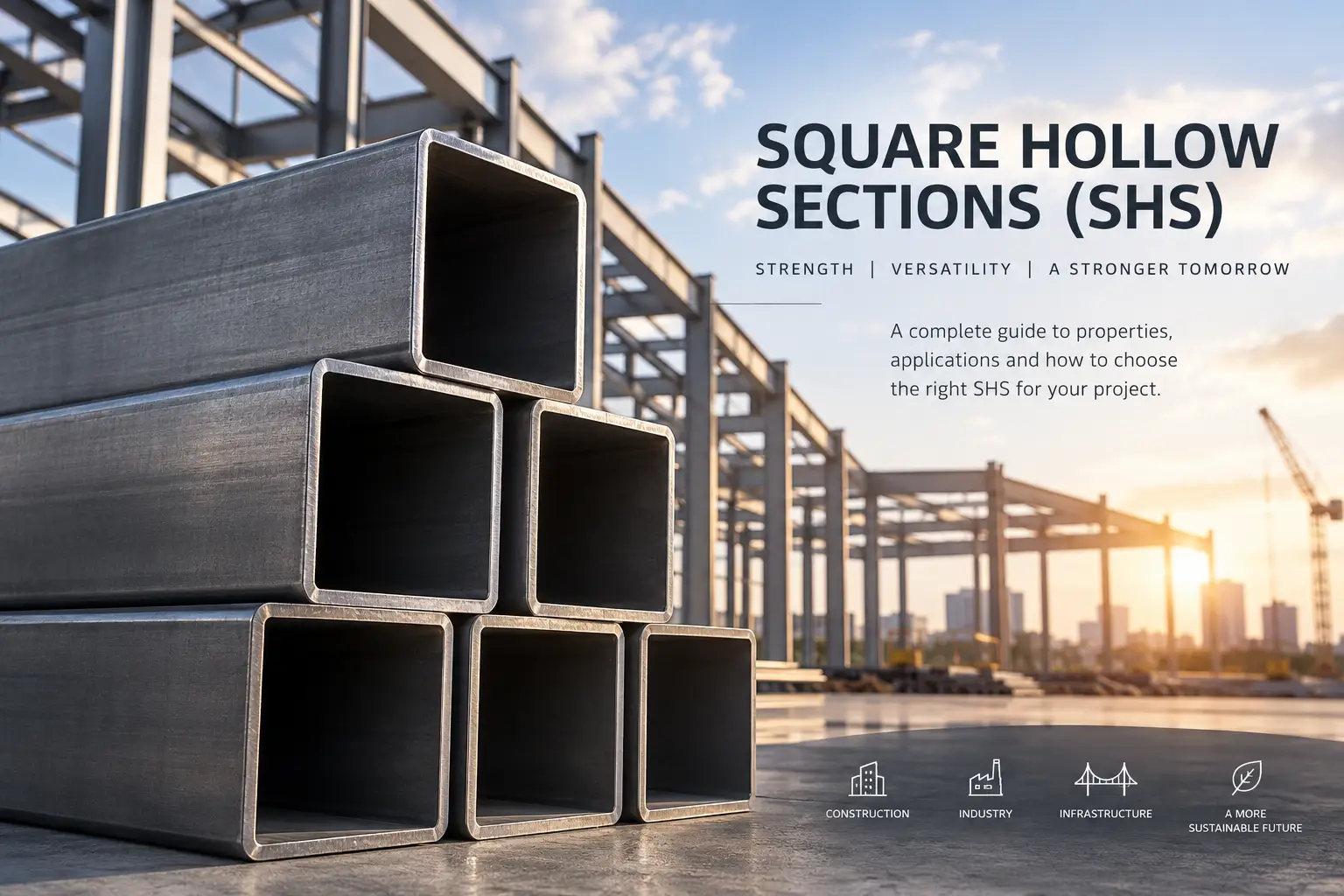
Amongst the array of structural steel sections available in the market today, Square Hollow Sections have amassed a degree of popularity for their ability to facilitate structural simplicity, versatility and strength. With a rectangular hollow cross-section, square hollow sections offer an array of benefits in terms of reduced structural complexity, optimized load bearing capacity as well as torsional rigidity.
As the construction industry continues to evolve, the need for construction projects to become stronger, lighter, more economical and easier to fabricate has increased tremendously. Square Hollow Sections fulfill all these requirements by offering a combination of light weight and high strength. Being hollow structural sections, SHS have a higher torsional rigidity and have gained popularity as building materials for a wide range of applications including commercial, industrial, infrastructural and even renewable energy projects.
While choosing the right SHS for a particular project is relatively easier, ensuring that all requirements in relation to dimensions, structural performance, steel grade, manufacturing process, welding, coatings and global standards are met can be difficult. Having an overview of the factors that need to be taken into account when purchasing Square Hollow Sections can help contractors, fabricators, engineers and other stakeholders to make the best choice.
This article lists down all the essential information about Square Hollow Sections (SHS) including their definition, manufacturing process and advantages. The article also takes a detailed look at the places where SHS can be used and the factors that need to be taken into account when making a purchase decision for SHS for construction, infrastructure and energy projects.
What Are Square Hollow Sections (SHS)?
Square Hollow Sections are hollow structural steel sections of a square cross-section, which offers both strength and lightness. Their cross-sectional shape allows the loads they carry to be distributed evenly around the profile, making them particularly good choices for applications that necessitate torsional resistance.
Compared to open profile steel shapes like I-beams or channels, closed tubes like SHS offer increased resistance to twisting and have an improved resistance to multi directional loading. This makes Square Hollow Sections a popular choice for structural engineering, steel construction, industrial manufacturing and architecture, where strength and visual appeal are paramount.
Square Hollow Sections are produced by rolling steel strip into a square cross-section, and subsequently welding the joint along the length of the section. They are available in a range of sizes and thicknesses for hot finished and cold formed hollow sections, suitable for a variety of applications depending on the required mechanical properties and dimensional tolerances.
In Europe and many international markets, Square Hollow Sections are produced to the EN 10219 standard for cold formed welded structural hollow sections, and EN 10210 for hot finished structural hollow sections, which specifies the mechanical properties, dimensional tolerances and acceptance criteria for these structural steel sections, which aids their selection for particular applications. Different steel grades are also available for both hot finished and cold formed hollow sections allowing specification according to the demands of the application. Coupled with their excellent weldability and compatibility with automated manufacturing methods, Square Hollow Sections are amongst the most specified structural steel sections for a wide range of applications from industrial manufacturing to commercial construction and civil engineering.
Whilst Square Hollow Sections are visually simple profiles, there is a depth of knowledge that goes into ensuring that these structural steel sections are fit for purpose. In order to understand their application, it is necessary to first look at the production methods, and how that affects their performance characteristics.
How Are Square Hollow Sections Manufactured?
The manufacturing process is of great importance, determining most of the structural properties and dimensional precision of Square Hollow Sections. While all profiles have the same square cross-section, the production technology differs considerably, which determines their area of application.
The process begins with steel strip or coil, which is formed into a tubular profile by forming rollers. The steel is fed into the rollers, where special elements weld the edges together using high-frequency electric current. Thus, a square profile with a weld running along one edge is formed.
Further, the profile passes through sizing rollers, being formed in the desired shape. After cooling and straightening, the metal undergoes inspection, cutting, and other procedures. Thus, each SHS receives unique markings and undergoes quality control.
Despite the similarities in the manufacturing process, Square Hollow Sections are divided into two categories: hot finished and cold formed. Understanding the difference between these two types is crucial when selecting construction products since their characteristics and areas of application are different.
Hot Finished SHS
Hot finished Square Hollow Sections are produced through a process that involves additional thermal treatment after forming so that residual stresses that are generated during manufacturing are alleviated. This makes it have superior properties that make it ideal for use in structures that require extremely high levels of loading.
Due to the improved mechanical properties and reduced residual stresses, hot finished SHS is often used in heavy-duty structures, bridges works, large-scale industrial plants, and other systems and equipment that require high levels of fatigue resistance.
Cold Formed SHS
Cold formed Square Hollow Sections are manufactured at room temperature without a finishing heat treatment. This process results in good dimensional accuracy and a distinctively sharp corner profile, together with an excellent surface finish, while still allowing efficient and cost-effective production.
Cold formed SHS are used in a wide range of commercial, industrial and architectural applications including building structures, machinery and general fabrication where dimensional accuracy, availability and efficient fabrication are important.
Rather than looking at one production method as being better than the other, engineers will specify either hot or cold finished SHS based on the demands on the structure in question and the associated construction benefits. A number of factors must be taken into consideration when determining whether hot or cold finished SHS is the most suitable including design loading, method of fabrication, relevant standards and serviceability.
However, the main benefit of an SHS lies in its geometry. The unique combination of a closed shape and a hollow profile provides a high degree of torsional rigidity and stability along with exceptional strength-to-weight ratios compared to many other hollow or solid steel sections. In the next article we’ll look at the structural properties of Square Hollow Sections and why they are so often specified in modern construction.
Structural Characteristics of Square Hollow Sections
Square Hollow Sections: Why Are They So Popular? Analysis
The popularity of Square Hollow Sections (SHS) is justified by their structural properties resulting from the shape of their cross-section. First of all, Square Hollow Sections possess a greater load bearing capacity compared to other open profile types. The fact that the square shape is enclosed on all sides allows distributing normal and shear stresses more evenly throughout the cross-section. By doing so, the material of SHS is maximized, providing an excellent ratio between the load and the weight of the profile itself.
Another characteristic feature of Square Hollow Sections is their torsional stiffness and strength. Due to their enclosed profile, SHS demonstrate better performance under torsion than universal open profiles such as channels or I-beams. Such a property is beneficial when constructing connections subjected to complex stresses or when a structure is exposed to multidirectional forces or moments.
Moreover, the uniformity of the closed shape results in the even distribution of stresses throughout the entire cross-section of SHS. This way, the strength of Square Hollow Sections is maximized under both compression and bending moments. The mentioned characteristic is especially valuable for columns, supports, or other structural elements subjected to various types of loading.
Furthermore, Square Hollow Sections provide the best value in terms of the ratio between their weight and structural performance. SHS allow designing a long-span structure with reduced steel consumption compared to other profiles. At the same time, their shape allows minimizing the complexity of fabrication or assembly, which ultimately reduces the costs associated with the construction.
From a designer’s perspective, Square Hollow Sections offer several advantages over conventional structural profiles. The enclosed square shape of SHS is beneficial from an architectural point of view, as it allows presenting exposed steel structures as an integral part of the design rather than concealing them. As a result, Square Hollow Sections are widely used in modern architecture, both in commercial construction and in industrial buildings.
Finally, it is worth mentioning that the simplicity of the flat geometry of SHS allows using them in connection with other elements using standard methods of welding, drilling, and mounting. In addition, this feature also expands the applicability of Square Hollow Sections in automated manufacturing, allowing their use in a wide range of technological chains.
Thus, Square Hollow Sections are among the most versatile structural profiles, as they combine high strength, stiffness, and profiled flat geometry. These properties allow using SHS in a wide range of applications from building construction to machine building and light industry. Therefore, in the next section, attention will be paid to the specific benefits of Square Hollow Sections, which highlight their advantages over conventional structural profiles.
Main Advantages of Square Hollow Sections
As a versatile construction material, Square Hollow Sections possess numerous inherent benefits that have propelled its rising popularity as a construction material. Some of the most common advantages offered by these structural shapes include the high-performance characteristics, fabrication ease, and architectural appeal that they bring to a given building project.
Perhaps the main advantage that Square Hollow Sections offer is the ability to fulfill a wide range of structural requirements while using the least material possible. The material’s closed profile enables it to offer remarkable structural benefits while using reduced steel. This characteristic has proven to be extremely useful in reducing transportation and handling costs while also enabling easier handling and manipulation during fabrication.
Another major benefit associated with Square Hollow Sections is the ability to resist torsion. Thanks to its design, this type of hollow metal section is perfect for applications where the twisting moment is expected. The closed profile of square hollow structural sections offers superior torsional rigidity when compared to conventional open section profiles.
Moving on to fabrication, Square Hollow Sections are known to offer remarkable ease when it comes to cutting, machining, welding, and drilling. In addition, they are resistant to distortion, making manufacturing a faster and more precise process. As a result, the fabrication costs of structures built using this hollow metal section are significantly reduced.
When comparing Square Hollow Sections to other hollow structural sections, one finds that the former offers more flexibility during the design stage. This hollow metal section is available in a wide range of sizes, thicknesses, and material specifications, making it ideal for a wide range of structural applications. From light commercial buildings and municipal structures to large-scale industrial structures, Square Hollow Sections have proven to be perfect construction materials in all settings.
In terms of architectural appeal, Square Hollow Sections offer a clean profile that many other hollow structural sections cannot provide. Architecturally, this hollow metal section has proven extremely attractive and is, therefore, often used in commercial and industrial building construction. Other common applications for this type of hollow structural section include airports, sporting structures, public gathering places, and modern industrial buildings among others.
It is also worth noting that Square Hollow Sections can be fabricated using a wide range of protective coatings. The protective coatings vary depending on the desired performance, and include galvanized options as well as paint or powder coating. Thanks to this versatility, this hollow metal section is suitable for a wide range of environmental conditions.
Finally, Square Hollow Sections offer project speed and cost advantages. When compared to other conventional structural shapes, this hollow metal section has the potential to reduce fabrication and erection time while also lowering overall costs. To a great extent, this advantage is made possible by the combination of reduced fabrication costs and increased speed of fabrication.
With these numerous advantages, it is not surprising that Square Hollow Sections have become among the most widely used hollow metal sections in modern construction. Not only are they superior in terms of performance, they also offer reduced costs and faster fabrication speeds. As a result, this hollow metal section has found its way into a wide range of applications, including building construction, industrial, civil engineering, power generation, and transport structures.
In the subsequent paragraph, the common applications of square hollow structural sections will be highlighted. Specifically, the discussion will focus on why this hollow metal section is used in both heavy-duty and light commercial building construction.
Where Are Square Hollow Sections Used?
The combination of strength, stability, fabrication efficiency and clean geometry has made Square Hollow Sections (SHS) one of most versatile of the structural steel profiles available to industry today. It has found application in a broad range of engineering disciplines that demand dependable structural performance and material efficiency.
Construction and Commercial Buildings
The construction industry is among the largest users of Square Hollow Sections. Their good resistance to compressive forces and symmetrical shape make them a popular choice for structural columns, support frames, roof systems and secondary steel work in commercial, residential and industrial buildings.
Aside from their structural properties, SHS also offer a modern aesthetic appeal, having a smooth, square profile, often exposed as part of a contemporary building’s design, without requiring to hide structural elements.
Steel Structures and Industrial Facilities
Square Hollow Sections are frequently used in steel construction wherever high strength and good manufacturability are required. Industrial halls, warehouses, logistics centers, production halls, and manufacturing buildings are examples of such facilities. SHS profiles are often used as load-bearing and secondary structural elements for industrial buildings and structures.
Engineers design columns, braces, supports, and equipment structures using hollow square sections because they can withstand the bending moments caused by different types of loading.
Machinery and Industrial Equipment
Beyond building construction, SHS play an important role in the manufacturing industry. The machine frame, production equipment, conveyor technology, lifting machines, and industrial workstations are examples in which the profile combines high rigidity with dimensional stability.
The flat external surfaces facilitate welding and assembly, while the closed section offers outstanding resistance to deformation forces during operation. This makes Square Hollow Sections particularly suitable for equipment subject to stringent alignment requirements during their service life.
Infrastructure Projects
Infrastructure projects require structural components that can provide long-term reliability under demanding operating conditions. Square Hollow Sections are often used in pedestrian bridges, access platforms, safety barriers, observation towers, utility structures, and various public infrastructure applications.
Since these projects are prone to exposure to varying weather conditions and service loads, SHS are normally supplied with protective coatings, such as hot-dip galvanizing, to increase corrosion resistance which reduces long-term maintenance costs.
Renewable Energy Projects
The rapid development of renewable energy sources has led to the finding of new applications for square hollow sections. Solar power plants, battery storage facilities and associated infrastructure often use SHS for equipment frames, inverter supports, maintenance platforms, cable structures and ancillary steelwork.
Their excellent strength to weight ratio allows designers to create efficient structures that do not add unwelcome weight, and their compatibility with galvanized coatings makes them a good choice for long-term exposure to the weather
Architectural and Decorative Steelwork
Square Hollow Sections are equally prized for their aesthetics. Architects often call for SHS in projects where the structural steelwork is to be seen, for example canopies, façades, entrance structures, atriums, stair systems, and public spaces where a clean, contemporary aesthetic is desired.
For architectural applications, the simplicity of the square shape provides greater design flexibility while still presenting a uniform appearance. Unlike many other hollow open sections, SHS has a symmetrical profile that appears the same when viewed from any direction.
Transportation and Logistics
Square Hollow Sections are also widely used in the transportation industry. Trailer chassis, vehicle bodies, storage racks, material handling equipment, loading systems, and many other details are made using square profiles. For manufacturers, the possibility of combining reliability and simplicity of construction, as well as reducing the complexity of the production process, is advantageous.
However, for some tasks, the use of Square Hollow Sections is not optimal, and Rectangular or Circular Hollow Sections, whose mechanical properties are more efficiently used in specific cases, are better alternatives. In the next paragraph, we will compare SHS, RHS, and CHS profiles and analyze the advantages of each type.
SHS vs RHS vs CHS: Which Hollow Section Should You Choose?
While Square Hollow Sections (SHS) are among the most versatile, there are other hollow sections made of structural steel that have found their niche in construction, industrial, infrastructure, and energy projects. Rectangular Hollow Sections (RHS) and Circular Hollow Sections (CHS) are also extremely prevalent. Each has its mechanical characteristics that should be considered in detail before selecting one or another.
It is not possible or rational to say that a particular profile is better than another. Instead, construction professionals compare their performance characteristics and choose the most appropriate type based on their intended use.
| Feature | Square Hollow Sections (SHS) | Rectangular Hollow Sections (RHS) | Circular Hollow Sections (CHS) |
|---|---|---|---|
| Cross-Section | Square | Rectangular | Circular |
| Load Distribution | Uniform in both directions | Optimized for one primary direction | Uniform in every direction |
| Torsional Resistance | Excellent | Very Good | Excellent |
| Compression Performance | Excellent | Excellent | Excellent |
| Fabrication | Easy | Easy | More complex connections |
| Architectural Appearance | Modern and symmetrical | Sleek and directional | Smooth and elegant |
| Typical Applications | Columns, frames, industrial structures | Beams, roof members, support frames | Bridges, towers, trusses, architectural structures |
Square Hollow Sections (SHS)
SHS are designed to offer balanced structural performance. Thanks to the equal dimensions of both sides, they offer consistent performance under different loading directions, being applicable to columns, supports, machine structures, and steelwork subjected to multidirectional loading.
Moreover, their symmetry allows for detailing the elements simply, providing an aesthetically pleasing architectural design, which is especially valuable when the steel structure is left exposed.
Rectangular Hollow Sections (RHS)
RHS profiles are preferred when the primary loading of the structure is mainly in one direction. The rectangular cross-section provides a better resistance to bending around the strongest axis, enabling to have longer spans or higher stiffness in the same weight of the structure.
Therefore, RHS profiles are often specified in beams, roof structures, bridges, façades, and other elements where it is critical to provide the required capacity in one direction.
Circular Hollow Sections (CHS)
Compared to other hollow structural sections, CHS profiles exhibit outstanding torsional capabilities and the most uniform distribution of stresses throughout the cross-section. Due to their circular shape, they also eliminate the stress concentration at the corners typical of other hollow sections. This makes them particularly efficient in compression and subjected to dynamic or pulsating loads.
These features are especially advantageous for bridges, transmission towers, stadiums, offshore structures, and architectural exposed steelwork, where both safety and visual appeal are of great importance.
Selecting the Most Suitable Hollow Section
The choice between the three profiles should be dictated purely by engineering considerations and not by personal preferences or biases tied to any of the available options.
When faced with a requirement that calls for enhanced torsional performance, ease of fabrication, and a modern aesthetic appeal, one should always default to Square Hollow Sections as the preferred choice.
For applications where the structure’s primary working condition involves exposure to uniaxial bending moments, Rectangular Hollow Sections could prove to be a more economically viable option.
And finally, for systems that operate in a torsional environment or demand aerodynamic properties or architectural appeal as a design priority, Circular Hollow Sections could be the most efficient solution in terms of steel consumption and overall economy.
The key to unlocking value in all of the aforementioned cases lies in ensuring that the selected profile’s geometry interacts with the dominant load transfer mechanism in the most efficient way possible.
In the following section, we’ll look at ways in which one can identify the most suitable Square Hollow Section for their application. We’ll discuss the conditions that determine the change of preference between different profiles, go over the properties that need to be evaluated (thickness, material, and others), and review the relevant standards and specifications.
Choosing the Right Square Hollow Section
Choosing the right Square Hollow Section (SHS) is a highly sophisticated process. It is determined by the necessary features that the structure must meet. Every building has specific structural requirements, and each SHS has a set of characteristics that determine how useful this profile will be for a particular purpose. Making an informed choice allows for the optimization of the mechanical properties of the connection, simplifying the construction process, along with cutting costs during the operation of the built structure.
Structural Loading
The first stage in choosing an SHS is to understand the loads that it will be subject to, as columns, support frames, machinery, platforms and architectural structures experience different combinations of compression, bending, torsion and dynamic loadings.
Instead of opting for the largest section available, designers carry out calculations to arrive at a profile offering sufficient strength whilst containing steel use to a minimum, thus improving material efficiency without compromising structural safety.
Section Size and Wall Thickness
The size of a square hollow section is directly related to its load capacity and stiffness. The bigger the profile – the higher its resistance to different types of loads. The larger the wall thickness – the better its strength and stability.
At the same time, using overly thick and heavy profiles is not always rational. It is necessary to choose the optimal size for a particular case for the purpose of simplifying construction and reducing costs. A profile that is too big will only lead to increased costs due to complexity of manufacturing, transportation, and installation.
Steel Grade
The mechanical properties of an SHS are defined not only by its dimensions but also the grade of steel it is made from. Grades such as S235, S275 and S355, specified in EN 10025, have different yield strengths and should be selected according to the requirements of the structure.
Higher strength grades can be used to save weight in certain applications, but the choice of grade should be based around fabrication, welding, design codes and project specification requirements rather than yield strength alone.
Manufacturing Method
Whether an SHS is hot finished or cold formed can also be a deciding factor in choosing between the two.
While hot finished SHS is preferred due to its superior mechanical properties and less residual stresses, the cold formed type has dimensional accuracy, making it popular in applications where manufacturing and fabrication process is important.
It is advisable to make the choice based on the needs of the proposed application and conformity to relevant specifications and standards.
Corrosion Protection
Environmental conditions should be taken into account when selecting a profile. For example, structures located in the open air or subject to the action of moisture, coastal air or industrial pollution should have a corrosion protection system that will ensure their reliable and durable operation.
Square Hollow Sections can be supplied with hot-dip galvanized coating, industrial painting, or powder coating. The choice of the right corrosion protection method at the design stage allows for the greatest possible extension of the service life of the structures and the reduction of subsequent maintenance and repair costs.
Fabrication Requirements
The manufacturing process of a particular item should also be considered when choosing a profile. Welding, drilling, cutting, and bolted connections all affect the practicality of the selected section.
SHS (Square Hollow Sections) are best suited for modern methods of construction due to the flat surfaces which allow for ease of assembly and simple connection detailing. Fabrication considerations will reduce the time of construction and increase efficiency.
Compliance with International Standards
Finally, engineers should ensure that the selected SHS meets relevant international standards and project specifications. Standards such as EN 10210 and EN 10219 define requirements for manufacturing quality, dimensional tolerances, and mechanical properties, while documentation such as EN 10204 3.1 Material Certificates provides traceability and material verification throughout the supply chain.
Choosing certified products manufactured to recognized standards helps ensure consistent quality, predictable structural performance, and confidence during engineering, fabrication, and construction.
Selecting the right Square Hollow Section is therefore a balance of structural performance, manufacturability, and cost efficiency. When these factors are evaluated together, engineers can specify profiles that meet both technical requirements and long-term project objectives.
In the final section, we’ll summarize the key benefits of Square Hollow Sections and explain why they continue to be one of the most widely specified structural steel profiles in modern construction and industrial engineering.
Building Stronger Structures with the Right Square Hollow Sections
Square Hollow Sections (SHS): Versatile Steel Profiles for Structural Steel Fabrication
Square Hollow Sections (SHS) have become one of the most demanded structural steel profiles due to their ability to provide a perfect balance between a good amount of strength, stability, workability, and aesthetic appeal. Their versatility, functionality, and high-quality appearance make them suitable for a variety of applications, including building construction, industrial structures, infrastructure development, and renewable energy projects.
While the choice of a structural steel profile depends on several factors, including the loads, steel grade, fabrication and welding properties, corrosion protection, and standard specifications, the square hollow section is appropriate for a wide range of structural steel applications. It is critical to consider each factor during the design and engineering of a structure to meet specific requirements and achieve the best value throughout the life cycle of a building or a structure.
Square Hollow Sections (SHS) remain an essential building block for modern construction as they enable architects and engineers to respond to the industry’s growing need for lightweight, high-performance structures. Their versatility allows designing and constructing multiple steel-framed buildings while ensuring a good level of quality, stability, and sustainability.
IM Group is a global supplier of Square Hollow Sections (SHS), meeting the demands of the construction industry, industrial infrastructure, renewable energy, and general engineering worldwide. We offer our clients mechanical engineering and steel fabrication services and provide universal structural steel solutions for building construction, renewable energy, and industrial infrastructure projects. Our SHS steel profiles are manufactured according to international standards and are available in a wide range of sizes, thicknesses, and steel grades.